Introduction
Indian entrepreneurs, NRIs, OCIs, and established companies are turning to Illinois. The state's economy topped $1.1 trillion in GDP during 2025, making it the fifth-largest economy in the US, according to DCEO's 2025 Economic Growth Plan.
Founders in India consider Illinois when they need to:
- Enter the US market directly
- Serve American customers from a local base
- Raise capital from US investors
- Expand an existing Indian company through a local operating entity
Here's the catch. Starting a business in Illinois from India involves far more than filing an LLC. You still have to sort entity structure, a registered agent, tax registrations, banking, licensing, and ongoing compliance across two countries.
This guide covers each stage, from choosing an entity and filing in Illinois to banking, tax registrations, and staying compliant after launch.
Key Takeaways
- Choose a new Illinois entity or register an existing Indian company as a foreign entity.
- Secure a registered agent, EIN, tax registrations, and any required licenses before operating.
- Owning a US business doesn't grant a visa or work authorization.
- Plan costs and timelines around entity type, banking setup, and the professional support you need.
What Is Starting a Business in Illinois From India?
Starting a business in Illinois from India means establishing a US business presence in the state while the founder, ownership, or capital remains based in India. Two primary routes are available:
- Form a new Illinois entity. Create a fresh LLC, corporation, or other structure directly under Illinois law.
- Foreign qualification. Register an existing Indian company (or another US state entity) to legally transact business in Illinois without forming a brand-new entity.
Neither route requires the founder to hold US immigration status. Owning shares in an Illinois company, or serving as its manager, does not automatically grant permission to live or work in the United States.
According to USCIS, employment authorization comes through specific visa classifications or parole categories, not through company ownership alone. If physical presence or work in the US is part of your plan, consult a licensed immigration attorney separately.

What to Know Before Starting and Why Illinois May Make Sense
Before filing any paperwork, treat this as an expectations check. International founders need to assess commercial viability, compliance workload, and cross-border tax exposure realistically.
Early-stage work typically includes:
- Customer and pricing research specific to US buyers
- Setting up banking and bookkeeping systems that bridge India and the US
- Coordinating with vendors across a 10.5-to-13-hour time difference
- Managing reporting deadlines that don't pause for either country's holidays
Founder-led, outsourced, or team-based? Some founders manage everything personally in the early months. Others lean on an Indian parent company for back-office support while hiring US contractors for local tasks. Each model carries different worker-classification and payroll implications, so get this decision right before you scale.
Illinois brings real advantages to the table. The Illinois Department of Commerce and Economic Opportunity (DCEO) targeted growth clusters include advanced manufacturing, life sciences, logistics, and AI/quantum computing, and the state's Small Business Development Centers offer free, confidential guidance on business planning and financing.
That said, survival isn't guaranteed. Federal data from the SBA Office of Advocacy shows only 49.2% of new employer establishments survive five years, and just 33.8% make it to ten years.

Build a realistic forecast covering formation costs, professional fees, insurance, payroll, currency conversion, and working capital before assuming steady income.
Key Early Decisions and Risks
The right structure depends on ownership plans, liability tolerance, funding goals, and whether your Indian parent company will remain actively involved.
Commonly overlooked issues include:
- Cross-border tax filings on both sides of the relationship
- Transfer pricing documentation for related-party transactions between your Indian and US entities
- Foreign exchange movement and profit repatriation timing
- Beneficial ownership reporting requirements under US law
Quick market testing and building a long-term US operating company are different goals. Validate customer demand and pricing before committing to the larger expenses of full-scale formation, staffing, and premises.
Avoid these common missteps:
- Using a personal bank account for business transactions
- Mixing Indian and US funds without clear records
- Picking an entity type purely because it's cheap to form
- Assuming an LLC eliminates all tax and reporting obligations
Seek professional advice early on immigration, regulated industries, employment law, and intellectual property. For entity selection, US-India tax interactions, and accounting setup, VJM Global supports founders building India–US structures—these questions rarely have a one-size-fits-all answer.
How to Start a Business in Illinois From India – Step by Step
The steps below form a planning framework, not a substitute for current guidance from the Illinois Secretary of State, IRS, Illinois Department of Revenue, and qualified legal or tax professionals.
Common mistakes to avoid from the start:
- Filing before validating actual customer demand
- Choosing an entity type without weighing tax and liability tradeoffs
- Skipping a compliant registered agent
- Overlooking local or municipal licenses
- Treating formation as the finish line rather than the starting point
Step 1 – Define the Business Model, Customer, and Illinois Opportunity
Identify your product or service, target US customers, and delivery method. Decide whether you'll sell nationally or operate specifically within Illinois.
Research the following before moving forward:
- Direct competitors and their pricing
- Industry-specific regulations affecting your activity
- Fulfillment or staffing needs
- Whether your activity creates sales-tax, payroll, or licensing obligations
Sales-tax nexus matters more than founders expect. Illinois requires remote retailers to collect tax once they hit $100,000 in cumulative gross receipts or 200 separate transactions with Illinois purchasers.
That threshold is tested quarterly on a trailing 12-month basis, per the Illinois Department of Revenue. Cross it, and registration isn't optional anymore.
Prepare a concise business plan showing startup costs, operating expenses, and India-US payment flows before filing anything.
Step 2 – Choose Between a New Illinois Entity and Foreign Qualification
If you're launching fresh, form a new Illinois LLC or corporation. If you already run an Indian company or an entity in another US state, foreign qualification lets you register that existing entity to transact business in Illinois instead.
Each path has tradeoffs:
| Factor | New Illinois Entity | Foreign Qualification |
|---|---|---|
| Setup complexity | Simpler paperwork | Requires certified home-entity records |
| Ownership documentation | Built fresh | Inherited from existing entity |
| Ongoing filings | Illinois only | Illinois plus home jurisdiction |
Foreign qualification typically requires a certificate of good standing (authenticated within a set window before filing), ownership details, and an Illinois registered agent. Requirements and forms change, so confirm the current version before submitting anything.
Step 3 – Select the Structure, Name, and Registered Agent
Common structures include sole proprietorships, partnerships, LLCs, corporations, and LLPs, each with different liability protection, management formality, and tax treatment.
A quick note on S corporations: this is a tax election, not a separate state-law entity, and eligibility for foreign owners requires professional review before you assume it applies to you.
Name selection checklist:
- Search the Illinois Secretary of State business database for conflicts
- Check federal trademark records separately, since a state name search isn't trademark clearance
- Decide if you need an assumed name (DBA) distinct from your legal entity name
Illinois law requires every LLC and corporation to maintain a registered agent with an Illinois address, available to receive official notices during business hours. This doesn't mean the founder must live in Illinois. Many international founders use a registered agent service instead.
Documents to gather:
- Passport or identity records for owners and managers
- Principal business address and stated business purpose
- Registered agent information
- Parent-company formation records, if applicable
Step 4 – File Formation or Foreign-Qualification Documents
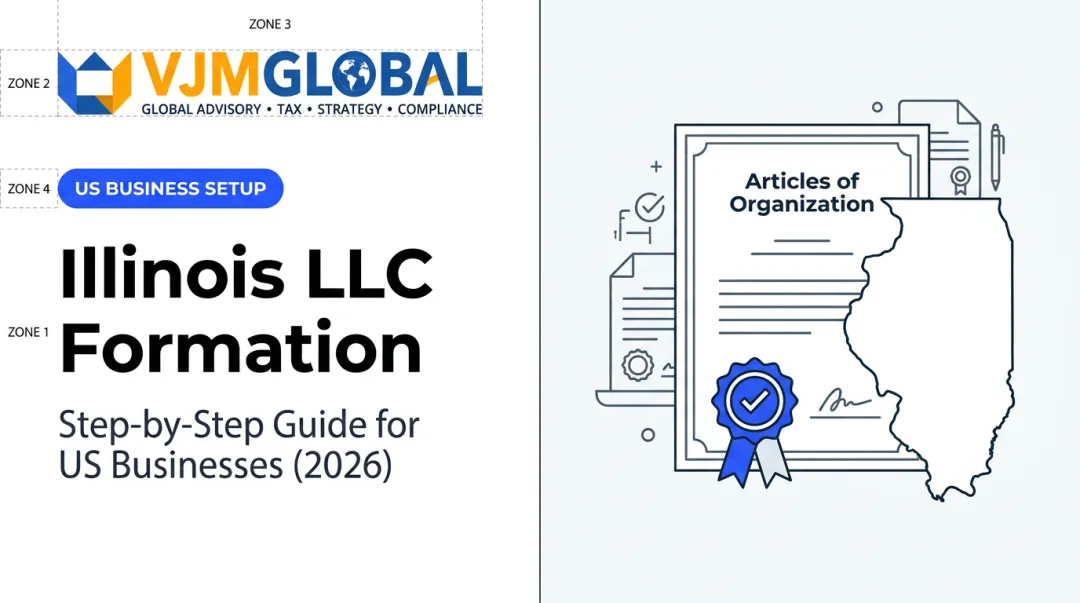
Depending on your structure, you'll file Articles of Organization, Articles of Incorporation, or the relevant foreign-entity application with the Illinois Secretary of State. Fees and processing times change periodically, so confirm the current figures directly before filing.
Once approved, you'll receive formation evidence or a certificate of authority. From there:
- Draft an operating agreement (LLC) or bylaws (corporation)
- Record ownership and capital contributions
- Maintain these records going forward, since banks and tax authorities will ask for them
This is where coordination gets tricky for founders managing everything from India. VJM Global supports international founders with formation documentation, accounting setup, and business planning coordination throughout this stage, though separate licensed professionals should handle legal opinions and any immigration-related questions.
Step 5 – Obtain an EIN, Register for Taxes, and Review Cross-Border Tax Issues
An EIN (Employer Identification Number) from the IRS is required for tax filings, banking, hiring, and vendor onboarding. Applicants without a US Social Security number typically apply by phone, fax, or mail rather than through the IRS online tool.
Registrations to check based on your activity:
- Illinois income tax and sales/use tax accounts through MyTax Illinois
- Employer withholding and unemployment insurance through the Illinois Department of Employment Security
- Federal payroll tax accounts, if hiring
Cross-border tax exposure deserves separate attention. Indian founders and parent companies may face:
- Transfer pricing documentation requirements under Indian tax rules, including Local File obligations for international transactions between associated enterprises
- Permanent establishment questions under the US-India tax treaty, which generally allows US taxation of profits attributable to a US permanent establishment
- Withholding on related-party payments and eventual profit repatriation
Tax treatment depends on entity classification, ownership structure, and elections made along the way. Nobody can promise a specific outcome like automatic pass-through treatment.
This is where a US-India tax specialist earns their fee. VJM Global's cross-border tax accounting work covers dual-jurisdiction review for founders in this position.
Step 6 – Set Up Banking, Licenses, Insurance, Hiring, and Ongoing Compliance
Opening a US business bank account from India isn't always straightforward. Banks generally ask for formation records, an EIN, identification, beneficial-owner information, and a business address.
Some require in-person verification or enhanced due diligence for foreign-owned entities, and requirements vary by bank.
Licensing and permits to check:
- State-level professional or industry licenses through Illinois licensing agencies
- County or municipal permits, including zoning approvals
- Sales-tax permits if selling taxable goods
Insurance considerations depend on your activity but often include general liability, professional liability, and workers' compensation. Illinois law requires workers' compensation coverage for nearly everyone hired or injured while working in the state, according to the Illinois Workers' Compensation Commission.
If you're hiring locally, address worker classification, payroll withholding, wage rules, and required employment notices before your first hire starts.
Ongoing compliance checklist:
- Annual reports and franchise tax filings
- Federal and state tax returns
- License renewals
- Payroll filings and bookkeeping
- Registered-agent address updates
- Deadlines for any Indian parent company's own filings
After launch, track customer acquisition, gross margin, cash flow, and tax reserves closely. These numbers tell you when the business is ready to hire, scale, or needs a course correction.

Conclusion
Starting a business in Illinois from India is a staged process: validate the market, choose your entity, register with the state, set up taxes and banking, secure licenses, and stay on top of ongoing compliance.
The fastest filing option isn't necessarily the safest one. Getting the structure right and planning for both US and Indian obligations early tends to save far more time and money than it costs upfront.
VJM Global works with founders on this kind of cross-border setup—company formation coordination, accounting, and tax compliance across the US and India.
This article provides general information only and does not constitute legal, tax, or immigration advice. Consult qualified professionals for guidance specific to your situation.
Frequently Asked Questions
How much does it cost to start a business in Illinois?
Total cost depends on entity type, Illinois filing fees, registered-agent charges, licenses, insurance, banking, and professional services. Indian founders should also budget for foreign qualification and cross-border support—confirm current fees with the Illinois Secretary of State.
Is $5,000 enough to start a business in Illinois?
It may cover a lean, service-based launch with minimal overhead. It typically won't stretch to cover inventory, physical premises, employees, or cross-border professional support, so build a budget specific to your business model.
How can I start a small business in Illinois with little or no money?
Low-overhead service models, customer pre-sales, and bootstrapping can reduce upfront costs significantly. Illinois SBDCs and SBA resources offer free guidance, though statutory filing and compliance fees still apply regardless of your budget.
How do I start a small business in Illinois?
Validate your market, choose a structure, and confirm name availability. File with the Illinois Secretary of State or complete foreign qualification, then secure your registered agent, EIN, tax registrations, licenses, and banking.
How do I register a small business in Illinois?
Registration differs for informal businesses, new Illinois entities, and Indian or other overseas companies filing as foreign entities. Check the Illinois Secretary of State site and your county or municipal authority for current forms.
Does my business need a license in Illinois?
Requirements vary by industry, business activity, and municipality. Check for professional licenses, local permits, zoning approvals, and sales-tax or employer registrations through Illinois and local agency databases.