The interest isn't limited to one type of founder. Indian-origin business owners in Dubai and Abu Dhabi, holding company structurers looking to diversify beyond UAE free zones, trading firms eyeing African markets, and fintech founders exploring new licensing options are all asking the same question: how do you actually set this up?
This guide walks through the structures, process, costs, and compliance obligations involved in starting a Mauritius business from the UAE.
TL;DR
- 15% flat corporate tax, reducible to an effective 3% on qualifying foreign-source income (80% exemption, substance required)
- 45 DTAs in force, including a treaty with the UAE
- UAE founders can incorporate remotely through CBRIS
- GBC, Authorised Company, or Domestic Company—choice hinges on where the business actually operates
- Domestic companies typically incorporate in 5-10 working days; GBCs and ACs take 2-3 weeks due to FSC review
What Is a Business in Mauritius (From a UAE Perspective)?
A Mauritius business, from a UAE founder's standpoint, is a locally incorporated entity owned by a UAE resident or company — either to trade within Mauritius or to structure international investment and holding activity.
Mauritius plays one of two roles for a UAE-based founder:
- An operating base: a Domestic Company running local trade or services
- A low-tax holding or trading vehicle: a Global Business Company (GBC) or Authorised Company (AC) used to structure investment flows, particularly into Africa
The format you choose depends entirely on where the actual economic activity happens.
What to Know Before You Start a Business in Mauritius from the UAE
UAE founders often underestimate the substance and residency requirements attached to a Mauritius entity. Treat what follows as a reality check before you commit time and money.
Resident Director and Substance Rules
Mauritius law requires most companies to have at least one director ordinarily resident in Mauritius. An Authorised Company has more flexibility here, permitting a director who isn't Mauritius-resident and even allowing a corporate director. A UAE-based director alone does not satisfy this requirement for a GBC or Domestic Company.
Timezone and Realistic Timelines
Mauritius sits at GMT+4 — the same timezone as the UAE — so founders can manage local operations without juggling large time gaps. That said, banking and full compliance readiness rarely happen overnight — expect several weeks between incorporation and having an operational bank account.
Paperwork vs. Ongoing Management
Success with a Mauritius entity depends on both:
- Getting the incorporation paperwork right the first time
- Maintaining ongoing local management: AGMs, filings, and resident director engagement don't stop after day one
If you're using Mauritius purely as a tax-efficient holding structure, your obligations are lighter but not zero. If you're building an active local business, expect closer day-to-day involvement.
Why Start a Business in Mauritius from the UAE? (When It Makes Sense)
This works well under specific conditions. It isn't a guaranteed advantage for every UAE founder.
Where the fit is usually strongest:
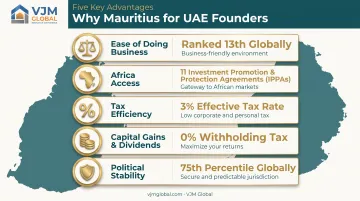
- Ease of doing business: The World Bank ranked Mauritius 13th of 190 economies in its final Doing Business report, still a useful signal of regulatory efficiency in the region.
- Africa access: IPPAs with 11 African countries in force (including South Africa, Egypt, and Senegal) sit alongside the UAE's own growing trade ties with the continent.
- Tax efficiency: The PwC Mauritius tax summary shows the 80% exemption can bring qualifying foreign-source income down to a maximum effective rate of 3% when income and substance tests are met—not automatic for every GBC.
- Capital gains and dividends: No ordinary capital gains tax and 0% domestic withholding on dividends, which helps outbound structuring for UAE investors.
- Stability: Mauritius sat in the 75th percentile globally on the World Bank's political stability index in 2023, a useful complement to a UAE base when weighing jurisdictional risk.
Early Decisions That Matter When Starting a Business in Mauritius from UAE
Early Decisions That Matter When Starting a Business in Mauritius from the UAE
Most problems come from underestimating how different the Mauritius and UAE regulatory environments really are.
Areas UAE founders frequently overlook:
- True cost of maintenance: Registration is only the start. FSC processing fees run around $600, with annual fees of roughly $2,600 for a GBC and $1,400 for an AC, before resident director, audit, and filing costs
- Wrong entity choice: Picking a Domestic Company when your activity is genuinely international adds unnecessary tax exposure
- Banking realities: Opening an account from the UAE takes longer than most founders expect, and local banking is not mandatory for every structure
- Compliance overlap: Mauritius filings do not pause UAE corporate tax and VAT obligations; both run in parallel
- Dependency on local providers: Your resident director and registered agent sit in the middle of day-to-day operations, not only on paper
How to Start a Business in Mauritius from the UAE – Step by Step
This breaks the cross-border setup into practical stages. The most common mistakes: picking the wrong structure, skipping substance requirements, and delaying bank account applications until it's too late to launch on schedule.
Step 1 – Define Your Business Activity and Target Structure
Decide whether the business operates inside Mauritius or purely serves as an international holding vehicle. This determines your entity type:
- Domestic Company — for genuine local trade or services
- GBC — for internationally-focused activity needing treaty access
- Authorised Company — for holding/trading structures without treaty reliance
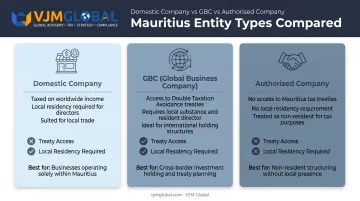
Common miss: Choosing a Domestic Company for an internationally-focused holding activity, which adds tax exposure you didn't need.
Step 2 – Reserve Your Company Name and Prepare Documentation
Check availability through the Mauritius Registrar of Companies and reserve your chosen name (valid for two months). Meanwhile, gather your documents:
- Passport copies of directors and shareholders
- Proof of residential address (recent utility bill or bank statement)
- Shareholding structure details
Common miss: Delays from incomplete KYC documentation sent from the UAE — missing notarization or outdated address proof are frequent culprits.
Step 3 – Appoint a Resident Director and Registered Agent
Mauritius mandates a resident director for most structures. UAE founders typically fulfil this through a local service provider rather than relocating staff. You'll also need a registered office address in Mauritius.
Common miss: Assuming your UAE-based director satisfies this requirement, when in fact a Mauritius resident director is a separate, mandatory role.
Step 4 – Complete Online Registration via CBRIS
Submit incorporation forms, the Memorandum and Articles of Association, and pay registration fees electronically through CBRIS. Domestic companies move faster; GBCs and ACs face an additional FSC review layer.
Common miss: Underestimating the extra 2-3 week review period for licensed structures.
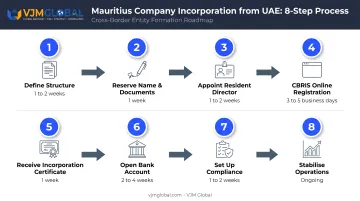
Step 5 – Receive Certificate of Incorporation and Business Registration Card
These documents legally establish your company. Next, register with the Mauritius Revenue Authority for tax purposes, and complete FSC licensing if you've chosen a GBC or AC.
Step 6 – Open a Corporate Bank Account
Mauritius companies aren't required to bank locally in every case — offshore banking is permitted and relevant for UAE-based founders managing multiple jurisdictions. Consider:
- Account opening timelines (often longer than UAE norms)
- Currency flexibility for cross-border transactions
- Whether a Mauritius bank or an international one better suits your operations
Common miss: Applying for banking too late, delaying when the business can actually start operating.
Step 7 – Set Up Cross-Border Compliance and Accounting
Annual obligations include a Financial Summary, Annual Return of Income, and audited statements for GBCs. These sit alongside your existing UAE corporate tax and VAT filings, not in place of them.
Firms offering multi-jurisdiction accounting and tax coordination, such as VJM Global, can help align Mauritius entity requirements with UAE compliance obligations you're already managing across both regulatory systems.
Step 8 – Stabilise Operations and Plan for Growth
Track your compliance calendar closely:
- AGMs must happen within 15 months of the previous one
- Late filings carry meaningful penalties under Mauritius company law
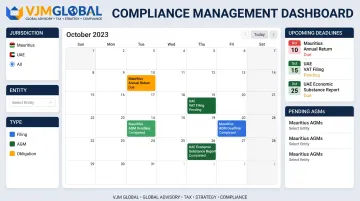
Revisit periodically whether your structure still fits as your UAE operations scale. Common miss: treating the Mauritius entity as "set and forget" rather than an ongoing obligation.
Conclusion
Starting a business in Mauritius from the UAE pays off when you get structure, residency, and documentation right from day one. Speed of incorporation matters less than clarity on entity type and compliance obligations.
Long-term success comes from treating your Mauritius entity as an active part of your broader UAE-based compliance and growth strategy , not a one-time paperwork exercise. VJM Global supports entity formation and ongoing compliance across both jurisdictions, easing the cross-border burden so you can focus on growth.
Frequently Asked Questions
How much does it cost to start a business in Mauritius?
Official FSC processing fees run around $600, with annual fees near $2,600 for a GBC or $1,400 for an AC. Budget separately for resident director fees, audit, and registered agent costs beyond the registration fee itself.
Can a foreigner start a business in Mauritius?
Yes — foreign ownership is permitted for Domestic Companies and GBCs. You will still need a Mauritius-resident director for most structures, which is typically fulfilled through a local service provider.
Which business is most profitable in Mauritius?
Financial services, ICT/BPO, tourism, and global business or holding structures remain the leading sectors, largely due to Mauritius's tax treaty network and its role as an Africa-facing gateway.
Do I need to visit Mauritius to incorporate a company from the UAE?
No. Most incorporation steps can be completed remotely through CBRIS, with a local registered agent handling submissions and liaison with the Registrar and FSC.
How long does it take to set up a Mauritius company from the UAE?
Domestic companies typically take 5-10 working days. GBCs and Authorised Companies take longer, around 2-3 weeks, due to additional FSC licensing review.
Can I manage Mauritius corporate tax and UAE compliance together?
Yes, though it requires coordination across two separate regulatory systems. A cross-border partner such as VJM Global can align filing calendars across both systems and close compliance gaps before they overlap.