That reputation is exactly why free zone founders, consulting firms, e-commerce sellers, and SaaS businesses across the UAE are increasingly registering a Private Limited Company (Pte Ltd) in Singapore. It opens doors to Southeast Asian customers, international investors, and banking relationships that a UAE entity alone often can't unlock.
ACRA's incorporation process itself is genuinely fast. But UAE founders run into hurdles most generic guides never mention: no Singpass access, a mandatory local nominee director, UAE-side apostille requirements, and DTAA substance rules that can undo the tax benefits if ignored.
This guide covers who should make this move, the exact steps, documents required from both sides, realistic costs, taxation, and the mistakes UAE founders repeat most often.
Key Takeaways
- Singapore permits 100% foreign ownership; a Corporate Service Provider files everything through ACRA's Bizfile+ portal remotely
- You'll need a locally resident nominee director, a Singapore-resident company secretary, a registered address, and just SGD 1 in paid-up capital
- Prepare notarised, apostilled passport, address, and trade licence documents on the UAE side
- The UAE-Singapore DTAA and 17% flat tax rate create real tax efficiency, but only where genuine business substance exists
- Registration usually completes in 1–3 business days; budget SGD 800–1,500 upfront and SGD 4,000–7,000 annually for ongoing compliance
Why Singapore Is a Strategic Choice for UAE Entrepreneurs
Singapore isn't automatically the right move for every UAE business. It suits founders chasing international banking credibility, investor access, or a genuine Southeast Asian footprint. For a company whose operations stay entirely within the UAE, a Singapore entity just adds a second layer of compliance with no obvious payoff.
Where it does make sense, the structure is genuinely founder-friendly:
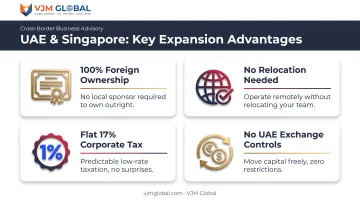
- 100% foreign ownership with no local shareholder requirement; you only need a resident nominee director, not a resident owner
- No relocation needed. Founders can run the Singapore company entirely from Dubai, Abu Dhabi, or Sharjah
- Flat 17% corporate tax, paired with the UAE-Singapore Double Taxation Avoidance Agreement so profits are not taxed twice
- No UAE exchange controls. Unlike jurisdictions with FEMA-style remittance restrictions, UAE residents can fund a Singapore company without approval hurdles
There's also a market-access angle. Singapore sits inside ASEAN and the CPTPP trade bloc, and already handles roughly two-thirds of ASEAN's digital trade activity (OECD Digital Trade Review of ASEAN).
For a UAE trading house, consultancy, or SaaS business eyeing Vietnam, Indonesia, or the Philippines, that is a shorter path than entering those markets directly from the Gulf.
What You Need Before You Start: Requirements from Both Sides
Most incorporation delays for UAE founders have nothing to do with ACRA. They come from missing or improperly legalised paperwork on the UAE side, which only surfaces once the Singapore filing is already underway.
Singapore-Side Statutory Requirements
Four things are non-negotiable before ACRA will approve your application:
- A locally resident nominee director — a Singapore citizen, permanent resident, or valid Employment Pass holder. Most UAE founders won't personally qualify, so this role gets outsourced
- A qualified company secretary, ordinarily resident in Singapore, appointed within six months of incorporation to avoid penalties
- A physical registered office address, open to the public at least three hours on business days. Virtual office addresses work if they meet this access requirement; a P.O. box does not
- Minimum paid-up capital of SGD 1, which you can increase at any point after incorporation
Documents Required from the UAE
For individual shareholders and directors, expect to gather:
- Passport copies and Emirates ID (for residents) for every shareholder and director, used for both ACRA filing and bank KYC
- UAE address proof, such as an Ejari tenancy contract, a DEWA bill, or a recent bank statement
If a UAE Mainland or Free Zone entity holds shares, add:
- A copy of the trade licence
- The Memorandum and Articles of Association (MOA/AOA)
- A board resolution authorising the overseas investment
Nearly all of these documents need notarisation and legalisation through the UAE Ministry of Foreign Affairs before Singapore banks or nominee directors will accept them.
Running legalisation and nominee sourcing in parallel, not one after the other, is what keeps the process from stalling. VJM Global, for instance, handles both sides concurrently for UAE clients rather than waiting on one before starting the other.
How to Register a Private Limited Company in Singapore from the UAE
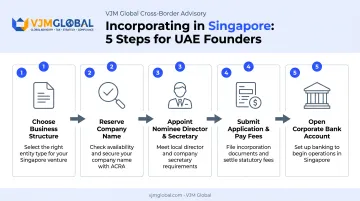
Step 1: Choose Your Business Structure
A Pte Ltd beats a Branch Office or Representative Office for nearly every UAE founder. It offers:
- Limited liability protection
- Full foreign ownership
- Eligibility for the startup tax exemption
A Branch Office, by contrast, ties Singapore liabilities directly to the UAE parent company and is excluded from that exemption. It is not built for founders establishing something new in Singapore.
Step 2: Reserve Your Company Name via ACRA Bizfile+
Without Singpass, UAE founders can't file directly. A registered Corporate Service Provider files on your behalf. Name reservation costs SGD 15 and holds the name for 120 days.
One catch: names containing restricted words like "finance," "bank," or "education" get sent to a referral authority for review. That can stretch approval from a few days to 14–60 days, so it pays to check your proposed name against ACRA's referral list before filing.
Step 3: Appoint a Nominee Director and Company Secretary
Since most UAE founders don't qualify as Singapore residents, a professional nominee director fills that seat. What matters most is a signed nominee agreement that clearly limits the nominee's authority over banking, contracts, and company decisions. A vague or missing agreement is one of the most common sources of disputes later.
The company secretary appointment is often bundled into the same CSP engagement, but the six-month statutory deadline applies regardless of who handles it.
Step 4: Submit the Incorporation Application and Pay Fees
Your CSP submits the constitution, shareholder and director details, registered address, share capital structure, and SSIC business activity codes through Bizfile+.
Fees break down as follows:
| Item | Details |
|---|---|
| ACRA name reservation + registration | SGD 315 (government fee) |
| Typical CSP service package | SGD 800–1,500 |
| Standard approval time | 1 hour to 3 business days* |
*Applications flagged for referral-authority review, or those with complex ownership structures, can take considerably longer.
Step 5: Open a Singapore Corporate Bank Account Remotely
This is the step that trips up most UAE founders. Have your incorporation documents, proof of business activity, and shareholder KYC ready before you approach a bank; preparation matters more than speed here, and the full process is covered in its own section below.
Banking and Taxation for Your Singapore Pte Ltd
This is the part most UAE founders underestimate. Incorporation can finish in a day. Getting a fully compliant, tax-efficient structure that a bank will actually approve takes real preparation.
Opening and Operating a Corporate Bank Account
Traditional banks and digital-first platforms handle UAE-originated applications very differently:
- DBS, OCBC, UOB — Foreign-owned companies are supported; only OCBC advertises a fully remote process for foreign directors, while DBS and UOB often need a relationship manager and sometimes in-person signing.
- Airwallex, Aspire, Wise Business — Built for fully remote KYC, with no branch visit and typically faster approval for straightforward structures.
Whichever route you take, have these ready before applying:
- ACRA Bizfile and UEN certificate
- Company constitution
- Director and shareholder passports
- Source-of-funds and UBO (ultimate beneficial owner) declaration
Taxation, DTAA, and Compliance Considerations
Singapore's tax framework is genuinely favourable, but only if the structure has real substance behind it.
- 17% flat corporate tax rate, with startup relief of 75% on the first SGD 100,000 and 50% on the next SGD 100,000 for three Years of Assessment
- No withholding tax on dividends paid out of the Singapore company
- UAE-Singapore DTAA — caps dividend withholding at source and generally taxes business profits in the residence country, limiting double taxation (IRAS, Singapore-UAE DTA)
Here's the catch: the OECD's Multilateral Instrument added a Principal Purpose Test to this treaty in 2019. If a tax authority concludes that treaty benefits were a principal purpose of the structure, rather than a byproduct of genuine business activity, those benefits can be denied outright.
A Singapore company with no staff, no office activity, and no real decision-making on the ground is exactly the profile that invites scrutiny.
There's a UAE-side layer too. UAE Corporate Tax applies at 9% above AED 375,000 of taxable income (UAE Federal Tax Authority, Corporate Tax Guide). Economic Substance Regulations reporting was cancelled for periods after December 2022, but earlier obligations and enforcement can still apply.
Structuring ownership so both jurisdictions are satisfied, not just Singapore, is where firms handling compliance on both sides, such as VJM Global, add the most practical value.
Common Mistakes UAE Founders Make When Incorporating in Singapore
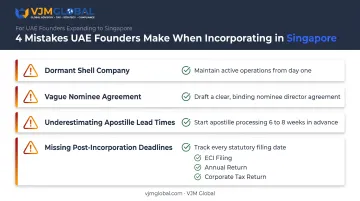
A handful of errors show up repeatedly among UAE founders setting up in Singapore:
- Treating the company as a dormant shell. No real operations, no local activity, nothing beyond a bank account. This is a red flag during KYC checks and DTAA substance reviews alike.
- Signing a vague nominee director arrangement. Without a clear agreement defining scope and limits, disputes over authority tend to surface exactly when you can least afford them.
- Underestimating UAE apostille lead times. ACRA approval can happen in a day; getting UAE documents legalised for bank submission often takes longer and stalls the process afterward.
- Missing post-incorporation deadlines, specifically:
- Estimated Chargeable Income (ECI) filing within 3 months of financial year-end
- Annual Return with ACRA within 7 months of financial year-end
- Corporate Tax Return (Form C-S or Form C) by 30 November
Miss these deadlines and penalties escalate quickly: late fees, possible director disqualification, or company strike-off.
A properly structured Singapore Pte Ltd gives UAE founders durable access to global banking and Southeast Asian markets. That durability depends entirely on documentation, substance, and compliance being handled correctly from day one, not patched together after ACRA sends its first reminder.
Frequently Asked Questions
How can foreigners set up a company in Singapore?
Foreigners, including UAE residents, can fully own a Singapore Pte Ltd, but they can't self-file. A Corporate Service Provider files the application via Bizfile+, and a locally resident nominee director must be appointed.
Can UAE residents own 100% of a Singapore Pte Ltd company?
Yes. There's no local shareholder requirement at all. The only mandatory local appointment is a resident nominee director, who holds no ownership stake in the company.
Do I need to travel to Singapore to incorporate from the UAE?
No. Incorporation and most documentation happen entirely online. Travel is only occasionally needed for traditional bank accounts that still require in-person signing.
What is the minimum paid-up capital required for a Singapore Pte Ltd?
SGD 1 is the legal minimum. You can raise it anytime after incorporation; banks and partners rarely treat the starting figure as a credibility signal.
How much does it cost to set up a Singapore company from the UAE?
Government fees total SGD 315. With a typical CSP, nominee, and secretarial package, total setup usually lands between SGD 800–1,500. Annual compliance typically runs SGD 4,000–7,000.
How long does the registration process take?
Standard applications approve within 1 hour to 3 business days. Names containing restricted words face referral-authority review, which can extend approval to 14–60 days.