But most founders researching this route hit the same wall. Can you register a Dutch company without moving your family to Amsterdam? What does the tax exposure actually look like? Do you need a visa just to sign the paperwork?
This guide answers those questions directly. We'll cover eligibility, structure choice, the registration process, realistic costs, and the visa routes that apply if you ever want to run the business from Dutch soil yourself.
Key Takeaways
- A Dutch BV can be 100% owned and controlled remotely from Malaysia, with no local partner required
- Netherlands–Malaysia tax treaty caps withholding at 15% (dividends), 10% (interest), and 8% (royalties)
- Corporate income tax is 19% on the first EUR 200,000 of profit and 25.8% above that
- Malaysians can visit visa-free for short trips; running the business on-site needs a residence permit
- Notarial incorporation usually proceeds via Power of Attorney, with no trip to the Netherlands required
Why the Netherlands Attracts Malaysian Entrepreneurs
For Malaysian e-commerce sellers, trading houses, tech startups, and holding companies, a single Dutch registration gets you EU-wide market access. You don't need separate entities in Germany, France, or Belgium to trade legally across those borders.
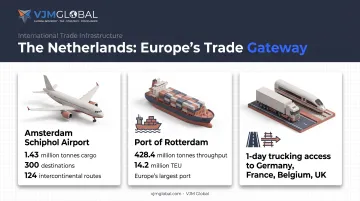
Geography plays a real role too. The Netherlands sits at the crossroads of Asia-Europe trade flows:
- Amsterdam Schiphol Airport handled 1.43 million tonnes of cargo in 2025, connecting to 300 direct destinations including 124 intercontinental routes
- Port of Rotterdam moved 428.4 million tonnes of throughput in 2025, with container volume growing 3.1% to 14.2 million TEU, making it Europe's largest port
- Road and rail links put major markets in Germany, France, Belgium, and the UK within roughly a day's trucking
Tax Treaty Protection for Malaysian Owners
The Netherlands and Malaysia have had an income tax treaty in place since 1988. Under this agreement, Dutch withholding tax on dividends paid to a Malaysian shareholder cannot exceed 15% of the gross amount. Interest is capped at 10%, royalties at 8%. That's a meaningful buffer against double taxation for anyone repatriating profits home.
On the corporate side, Dutch tax policy stays predictable. As of 2026, Dutch corporate income tax is 19% on taxable profit up to EUR 200,000, rising to 25.8% above that threshold.
Several structural factors also lower the barrier for Malaysian founders:
- English-speaking workforce across business and government
- Full foreign ownership with no local partner required
- Clear regulation that is simpler to navigate than many EU peers
Can Malaysians Start a Dutch Business Without Relocating?
Yes, mostly. But there's a catch many self-managed applications miss: the KVK (Dutch Chamber of Commerce) requires evidence of genuine economic activity in the Netherlands and a real Dutch business address. A PO box won't cut it.
One structure is off the table for most Malaysia-based founders: the eenmanszaak (sole proprietorship). It's built around ongoing physical presence and doesn't map well onto a founder running things remotely from Kuala Lumpur or Penang.
Your Realistic Entry Routes
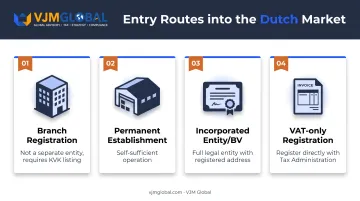
Instead, most Malaysian founders choose one of these paths:
- Branch registration: not a separate legal entity, but must still be listed with the KVK if it conducts ongoing Dutch operations
- Permanent establishment: a shop, warehouse, or office capable of operating as a self-sufficient business
- Incorporated Dutch legal entity (typically a BV) with a registered local address
- VAT-only registration: if you're not setting up a permanent establishment but still supply goods or services subject to Dutch VAT, you register directly with the Dutch Tax Administration instead of the KVK
Nationality is never the obstacle here. Dutch authorities care about documentation quality: business activity descriptions, shareholding transparency, and proof of legitimate operations.
Self-managed applications from abroad often stall on incomplete paperwork, mismatched details between the notary and the KVK filing, or vague business activity descriptions that trigger follow-up questions.
Best Business Structure: Dutch BV vs Other Options
For most Malaysian founders, the besloten vennootschap (BV) (the Dutch private limited company) is usually the strongest fit. It offers limited liability, doesn't restrict foreign shareholding, and carries the credibility EU banks, suppliers, and payment processors expect to see.
Here's how it stacks up against the alternatives:
| Structure | Liability | Notary Required? | Best For |
|---|---|---|---|
| BV | Limited liability for shareholders | Yes | Operational businesses, holding companies, EU credibility |
| VOF (partnership) | Partners personally liable for full debt | No | Small joint ventures with trusted local partners |
| Branch | No separate liability shield; parent company remains exposed | No | Testing the market before full incorporation |
BV incorporation requires a Dutch civil-law notary to execute the deed. Minimum paid-in capital is just EUR 0.01, a formality more than a financial hurdle.
For Malaysia-based founders, the practical upside is remote setup: Dutch notaries support digital incorporation through the Digitaal Passeren platform, using a qualified electronic signature under power of attorney. Deed signing and KVK registration can usually happen without a flight to Amsterdam.
Step-by-Step Process to Register Your Business from Malaysia
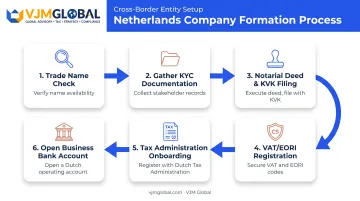
Registering a Dutch BV from Malaysia follows this sequence:
Check and reserve your trade name — Run it through the KVK Name Checker, which searches both the Business Register and the trademark register to flag conflicts before you commit.
Gather your KYC documentation — This typically includes your passport, proof of Malaysian residential address, a business activity description, shareholding structure, and a Power of Attorney if someone is signing on your behalf remotely.
Execute the notarial deed and file with KVK — The civil-law notary prepares the incorporation deed and articles of association, then registers the BV and its ultimate beneficial owners (UBOs) with the KVK. You receive an official 8-digit KVK number, recognised by Dutch banks, tax authorities, and business partners.
Complete VAT (BTW) registration — For import-export operations, this is also when you'd apply for an EORI number, which enables customs clearance across the EU.
Onboard with the Dutch Tax Administration — Corporate income tax registration and ongoing filing obligations follow. Coordination between the notary, KVK, and Belastingdienst is where documents often stall; VJM Global manages this handoff end-to-end so Malaysian founders meet deadlines and avoid rejected filings.
Open a Dutch business bank account — Banks apply strict KYC checks on source of funds and business activity for non-resident applicants. Prepare bank-ready documents in advance: clean shareholding records, a coherent business plan, and proof of funds. That preparation prevents the most common rejections.
Costs, Taxes & Visa Options for Malaysian Founders
Budgeting for a Dutch BV involves both one-time and recurring costs. Here's a realistic breakdown:
| Cost Item | Typical Range | Frequency |
|---|---|---|
| KVK registration fee | EUR 85.15 | One-time |
| Notary fee | EUR 500 – EUR 1,500 | One-time |
| Registered business address | Varies by provider | Annual |
| Accounting/compliance retainer | Based on transaction volume | Monthly |
At current exchange rates (roughly RM 5 to the euro), even the higher end of notary fees translates to under RM 8,000, which is modest relative to the EU market access you gain.
Tax Obligations to Plan For
Once your BV is running, expect:
- Corporate income tax at 19% (up to EUR 200,000 profit) or 25.8% above that
- VAT at the Dutch standard rate of 21% on most goods and services
- Payroll tax if you hire staff, covering wage tax, national insurance, and health insurance contributions
Malaysia's status as a non-EU country doesn't change any of this. These obligations apply the same way they would for any foreign-owned Dutch entity.
Visa Reality Check
Malaysian passport holders can enter the Schengen area visa-free for up to 90 days in any 180-day period, per EU visa exemption rules. That covers signing documents, opening bank accounts, and short business trips.
Living in the Netherlands to run your company day-to-day is a different matter. That requires a residence permit: the self-employed/entrepreneur permit or the startup visa. You apply for either through a Dutch embassy or an approved facilitator.
How VJM Global Simplifies Netherlands Market Entry for Malaysian Businesses
Coordinating a notary, the KVK, the Belastingdienst, and a Dutch bank from Kuala Lumpur is a lot to manage on your own, especially across time zones and with documents that must meet Dutch legal standards.
VJM Global operates as a cross-border entity formation and compliance partner already active in the Netherlands and 100+ other countries. For Malaysian founders, that means:
- BV incorporation, KVK registration, and VAT/EORI setup handled remotely
- Tax onboarding coordinated directly with the Belastingdienst
- Notarial paperwork, banking documentation, and ongoing bookkeeping under one contact
You work with one coordinator instead of chasing the notary, tax office, and bank yourself.
For businesses that want to test the Dutch or wider EU market before full incorporation, VJM Global's Employer of Record service is a lower-commitment path. You can hire in the Netherlands without a local entity first and validate demand before building a permanent Dutch presence.

Frequently Asked Questions
How do I start my own business in the Netherlands?
Choose a business structure, register with the KVK via a notary (for a BV), complete VAT/EORI registration, and open a business bank account. Most of this can be done remotely from Malaysia with the right documentation in hand.
Can a Malaysian own 100% of a Dutch company?
Yes. Dutch law places no restriction on shareholder nationality or residency for structures like the BV, and there's no requirement to bring on a local Dutch partner.
Do I need to visit the Netherlands to register my company?
Not usually. Notarial incorporation can typically be completed remotely via Power of Attorney using digital signing platforms. Bank account KYC is the step most likely to need extra documents—not an in-person trip.
How long does it take to register a Dutch company from Malaysia?
With complete documents, incorporation often takes about 1–3 weeks through name check, notarial deed, KVK filing, and tax onboarding. Incomplete paperwork—not the process itself—is what usually adds time.
What visa do I need if I want to move to the Netherlands to run my business?
Two main routes exist. The self-employed/entrepreneur permit needs RVO approval of your business plan. The startup visa requires an approved facilitator for one year before you move to the self-employed permit.
How much does it cost to set up and maintain a Dutch BV?
Budget EUR 85.15 for KVK registration plus EUR 500–1,500 for notary fees upfront. Ongoing costs include a registered address and a monthly accounting/compliance retainer based on your transaction volume.