The Netherlands has emerged as one of the most practical answers to that question. Its English-speaking business environment, transparent legal system, and position at Europe's logistical centre make it a natural first port of call for UK businesses seeking an EU base.
This guide covers everything you need — from choosing a legal structure and completing KVK registration to understanding Dutch tax obligations and cross-border compliance. It's written specifically for UK entrepreneurs, not a generic foreigners' guide.
Key Takeaways
- UK citizens can own and incorporate a Dutch company without living there — but a physical Dutch business address is mandatory
- The Dutch private limited company (BV) is the most common structure for UK entrepreneurs entering the Netherlands
- KVK registration costs €85.15 (one-time fee, updated January 2026)
- BV notary fees typically run €500–€1,500 depending on the complexity of the incorporation
- Post-Brexit, UK nationals are treated as non-EU citizens — relocation requires a residence permit
- Dutch corporate income tax is 19% on profits up to €200,000 and 25.8% above that threshold
Why UK Businesses Are Choosing the Netherlands
Post-Brexit, UK companies lost their automatic right to operate across EU member states. The Netherlands has absorbed much of that displaced business activity — and the numbers back it up.
According to EY's Netherlands Attractiveness Survey 2026, the Netherlands ranked 10th in Europe for FDI projects in 2025, attracting 159 projects — up from 147 in 2024. UK-origin projects rose from 29 to 33 over the same period — a signal that British companies are actively treating the Netherlands as their EU base of operations.
The Infrastructure Advantage
The infrastructure driving that FDI growth is tangible:
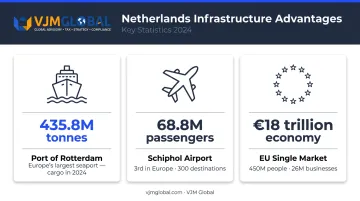
- Port of Rotterdam handled 435.8 million tonnes of cargo in 2024 — the largest seaport in Europe
- Schiphol Airport ranked 3rd in Europe for air transport movements in 2025, with 68.8 million passengers and connections to 300 destinations
- EU single market access covers 450 million people and 26 million businesses across a €18 trillion economy
For UK businesses in logistics, distribution, or professional services, this means day-one access to European supply chains without building them from the ground up.
Sectors with Strong Dutch Ecosystems
The Netherlands isn't just a gateway — it's an active hub in several sectors:
- Agrifood — 2nd largest agrifood exporter globally
- Logistics & supply chain — employs over 942,000 specialists, more than 10% of the workforce
- Life sciences & health — established as a connected European hub
- Creative industries — 7th worldwide for exports of creative services
- Renewable energy — targeting near-100% sustainable energy by 2050
- High-tech systems — NFIA-designated priority sector with government-backed innovation support
UK companies entering these sectors arrive into mature ecosystems — established supplier networks, deep talent pools, and sector-specific clusters that accelerate market entry rather than requiring years of local relationship-building.
What UK Entrepreneurs Need to Know Before Starting
Residency vs. Registration
You do not need to live in the Netherlands to register a Dutch company. However, a physical Dutch business address is mandatory — a P.O. box cannot be used as your registered address.
Registration and residency are separate from substance, though. Dutch tax authorities examine whether a company has genuine economic activity and management presence in the Netherlands — this matters most for holding companies and cross-border structures. A purely nominal address can attract scrutiny from the Belastingdienst regarding Dutch tax residency.
Visa and Permit Reality for UK Nationals
Post-Brexit, UK citizens are treated as non-EU nationals (third-country nationals) by Dutch immigration authorities. If you plan to physically relocate and work in the Netherlands:
- You must obtain a residence and work permit through the IND (Dutch Immigration and Naturalisation Service)
- Innovative startup founders can apply for a Dutch startup residence permit (valid up to one year) under an approved facilitator
- After the startup permit expires, you can apply to continue as a self-employed resident
Realistic Costs and Timelines
| Item | Cost |
|---|---|
| KVK registration fee | €85.15 (one-time, updated Jan 2026) |
| BV notary fees | €500–€1,500 (varies by notary) |
| Virtual office address | Variable (monthly cost) |
| Professional advisory fees | Varies by scope |
The KVK registration itself can move quickly, but the full process — notarial incorporation, opening a Dutch bank account (which involves thorough due diligence), and establishing accounting systems — typically runs several weeks to a few months.
Choosing the Right Legal Structure for Your Dutch Company
This is one of the most consequential early decisions you'll make. Your structure determines liability exposure, tax treatment, and ongoing administrative obligations. The Dutch government's business.gov.nl interactive tool compares the five most common structures. Use it before committing to one.
Private Limited Company (BV — Besloten Vennootschap)
The BV is the default choice for UK entrepreneurs and international businesses entering the Netherlands.
Key characteristics:
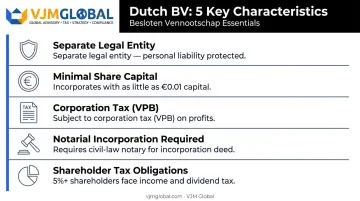
- The BV is a separate legal entity; it, not you personally, is liable for business debts
- Can be incorporated with as little as €0.01 in starting capital
- Pays corporation tax (VPB) on its profits
- Requires a civil-law notary to draft articles of association and execute the incorporation deed
- Shareholders with 5%+ of shares face income tax and potentially Dutch dividend tax on distributions
Sole Proprietorship (Eenmanszaak)
The Eenmanszaak suits individual freelancers and self-employed UK nationals who want a straightforward setup. No notary is required; register directly at the KVK.
The key trade-off: the owner is personally liable for all business debts. This makes it appropriate for lower-risk, service-based solo operations rather than businesses with growth or investment ambitions.
General Partnership (VoF — Vennootschap Onder Firma)
The VoF is designed for two or more people going into business together. Key points to understand before choosing this structure:
- Each partner pays income tax on their share of profits
- All partners are personally liable for business debts, including those created by another partner
- Popular among freelancers collaborating on shared projects
- Unsuitable if separating personal and business liability is a priority
Dutch Branch Office (Bijkantoor)
UK companies with an existing legal entity can register a Dutch branch rather than incorporating a new company. A branch is not a separate legal entity; it's an extension of the UK parent, which remains fully liable for the branch's obligations.
Consider these factors before choosing this route:
- Faster to set up than incorporating a new BV
- The UK parent carries direct liability for all branch activities
- Post-Brexit, cross-border tax treatment requires careful professional review
- No protection of the parent company's assets if the branch incurs debts
How to Start a Business in the Netherlands from the UK — Step by Step
The most common mistakes are skipping market research, underestimating substance requirements, and delaying bank account setup. Work through these steps in sequence — each one builds on the last.
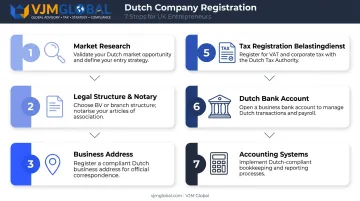
Step 1 — Research the Dutch Market and Define Your Business Case
Before registering anything, validate that there's a viable opportunity. Check whether your sector has nationality restrictions or licensing requirements (financial services, healthcare, and legal professions all have specific rules) using business.gov.nl.
Watch out for: Assuming UK market success automatically translates to Dutch demand without checking local competition, regulation, or cultural differences in business conduct.
Step 2 — Choose Your Legal Structure and Engage a Notary
Use the legal structure comparison above. For a BV, engage a Dutch civil-law notary (notaris) — they draft the articles of association, execute the incorporation deed, and handle initial KVK and tax registration on your behalf. For BV registration, you don't need to visit the KVK yourself.
Common miss: Choosing a sole proprietorship or branch for simplicity without considering long-term liability or EU substance requirements.
Step 3 — Secure a Registered Business Address
Options include:
- Leasing commercial office space
- Using a virtual office address provider (accepted for registration in many cases)
- Establishing a genuine physical presence
For holding companies and cross-border structures, a purely nominal address may not satisfy Dutch tax authority scrutiny. If economic substance matters to your structure, it needs to be real.
Step 4 — Register with the KVK
Book a KVK appointment (or register by post in exceptional cases). Bring valid ID and documentation for your Dutch business address. Non-resident founders registering an eenmanszaak need a paper extract from a foreign population register — no more than 2 months old — in Dutch, English, French, or German. A sworn translation is required for any other language.
Upon registration, you receive a KVK number and appear in the Dutch Business Register (Handelsregister). If your start date falls within 8 days of registration, the number is issued immediately — otherwise, expect it by post one week before your start date.
Easy to overlook: Arriving without the complete document checklist. Check kvk.nl before booking.
Step 5 — Register with the Dutch Tax Administration (Belastingdienst)
For sole proprietorships and partnerships, the KVK automatically passes your details to the Belastingdienst — you'll receive a letter within two weeks of your start date, along with your VAT identification number. For BVs, the notary handles tax registration, and the Belastingdienst confirms VAT requirements based on your activities.
Dutch VAT (BTW) has three rates:
- 21% — standard rate, applies to most goods and services
- 9% — reduced rate for food, medicines, books, and certain other goods
- 0% — cross-border supplies including international goods within the EU
Common miss: Not planning for EU VAT obligations on digital services. A Dutch entity simplifies EU VAT compliance considerably for UK businesses selling to EU consumers.
Step 6 — Open a Dutch Business Bank Account
Budget 4–8 weeks for this step — it consistently catches founders off guard. Banks require:
- KVK extract and articles of association (for BVs)
- ID verification for directors and UBOs (Ultimate Beneficial Owners)
- Information about business activities and expected transaction flows
Due diligence is thorough. Some traditional Dutch banks have restrictions on certain business types. International fintech alternatives can provide faster setup while your formal Dutch bank account application is processed.
Founders often miss: Starting the bank account process too late. Begin this in parallel with other setup steps — not after you're ready to trade.
Step 7 — Establish Accounting Systems and Ongoing Operations
Dutch companies must retain business records for at least 7 years (10 years for immovable property and certain digital services). BVs must file annual financial statements with the KVK within 8 days after adoption.
Set up bookkeeping systems that handle:
- Dutch VAT (BTW) quarterly returns
- Corporate income tax (VPB) returns
- Payroll tax if hiring Dutch employees
- UBO register compliance
Common miss: Leaving accounting systems until after commercial operations start. Catch-up compliance is expensive and penalties apply for late filings.
Tax, VAT, and Ongoing Compliance Obligations
Dutch Corporate Income Tax
The Belastingdienst confirms the following rates apply for both 2025 and 2026:
| Taxable Profit | Rate |
|---|---|
| Up to €200,000 | 19% |
| Above €200,000 | 25.8% |
VAT returns are filed quarterly. Dutch dividend withholding tax is 15% under domestic law, though recipients may offset or reclaim withheld amounts depending on their circumstances.
Cross-Border Considerations: UK and Dutch Obligations
Running both a UK entity and a Dutch BV creates several intersecting obligations:
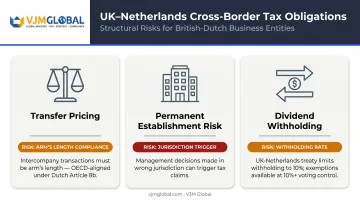
- Transfer pricing — Intercompany transactions between your UK and Dutch entities must be priced at arm's length. The Netherlands applies Article 8b of the Dutch Corporate Income Tax Act 1969, consistent with OECD guidelines.
- Permanent establishment risk — If your UK company's management and key decisions are made in the Netherlands (or vice versa), the other jurisdiction may have a tax claim on profits.
- Dividend withholding tax — The UK-Netherlands double tax convention (in force since December 2010) generally limits source-state dividend withholding to 10%, with exemptions available for companies controlling at least 10% of voting power.
Each of these risks is manageable — but only if the structure is set up correctly from the start. For businesses running parallel UK and Dutch entities, getting specialist cross-border advice at incorporation means your transfer pricing documentation, holding structure, and PE position are aligned before HMRC or the Belastingdienst asks questions. Unwinding a poorly structured arrangement later — renegotiating intercompany loans, adjusting holding tiers, addressing retrospective PE exposure — costs far more than the advisory fees upfront.
Frequently Asked Questions
Can someone from the UK start a business in the Netherlands?
Yes. UK citizens can incorporate and own a Dutch company without relocating. Post-Brexit, UK nationals are treated as non-EU nationals — relocating requires a permit, but remote ownership is fully permitted provided you have a registered Dutch business address.
How much does it cost to start a business in the Netherlands?
The KVK one-time registration fee is €85.15 (updated January 2026). BV notary fees typically run €500–€1,500 depending on the notary and complexity. Add virtual office costs, professional advisory fees, and bank account setup time to your budget.
Is the Netherlands a good place to start a business?
The Netherlands ranked 10th in Europe for FDI projects in 2025 with 159 total projects, according to EY. Its open economy, largely English-speaking workforce, world-class logistics infrastructure, and direct EU single market access make it consistently one of Europe's top choices for international businesses.
What are the most profitable businesses in the Netherlands?
Sectors with strong commercial opportunity include logistics and distribution (Rotterdam and Schiphol), agrifood technology, life sciences, high-tech systems, renewable energy, and digital industries. The Netherlands' EU access and infrastructure give internationally-facing businesses a structural edge in most of these areas.
Do I need to live in the Netherlands to register a Dutch company?
Physical residency is not required. A Dutch business address is mandatory, but day-to-day management from the UK is fully viable. Be aware that Dutch tax authorities scrutinise economic substance closely — particularly for holding structures — so purely nominal presence can create compliance risk.
What taxes does a Dutch BV pay?
A Dutch BV pays corporate income tax (VPB) at 19% on profits up to €200,000 and 25.8% above that. VAT (BTW) at the 21% standard rate applies to most goods and services. Dividend distributions are subject to 15% Dutch dividend withholding tax (subject to treaty relief). Directors holding 5%+ of shares also pay Dutch income tax on their remuneration.