Still, many Australian founders get stuck on the same questions: Which entity structure fits? Can I be a director if I live in Sydney or Perth? What happens with tax once I'm operating in two countries?
This guide walks through eligibility, structure options, the registration process, costs, and what banking and residency actually look like once your company is live.
Key Takeaways
- Australians can incorporate a NZ company online, often without a resident director.
- No minimum capital is required to incorporate a Limited Company in New Zealand.
- GST registration becomes compulsory once turnover exceeds NZD 60,000 annually.
- Incorporation doesn't grant residency or work rights; immigration approval is separate.
- Ongoing compliance and cross-border tax duties require dedicated professional support.
Can Australians Legally Start a Business in New Zealand?
Yes. Australians can register a company in New Zealand through the Companies Office, the government body that governs company registration and maintains the Companies Register. There's no citizenship or residency requirement to be a shareholder, and the process is entirely digital.
This ease exists largely because of two agreements: the Trans-Tasman Travel Arrangement and the Closer Economic Relations (CER) agreement, in force since 1983. Together, they've removed most trade and mobility friction between Australia and New Zealand, making cross-border business almost routine for citizens of either country.
The Director Residency Rule
Here's the part that trips people up. Every NZ company needs at least one director who either:
- Lives in New Zealand, or
- Lives in Australia and is currently a director of a company already incorporated in Australia
That second condition is specific. Simply living in Australia isn't enough on its own. You need to already hold a directorship in an Australian-incorporated company, and you'll need to supply that company's ACN during registration.
Registration vs. the Right to Live and Work There
Registering a company is a paperwork exercise. It doesn't grant you residency, a work visa, or any immigration status in New Zealand. Those are governed separately by Immigration New Zealand, not the Companies Office.
Two entry routes exist:
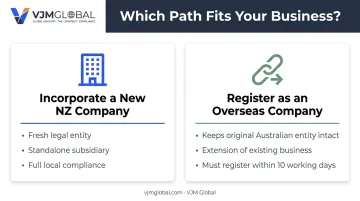
- Incorporate a brand-new NZ company: a fresh legal entity registered on the NZ Companies Register.
- Register your existing Australian company as an "overseas company" — this keeps your original entity intact while giving it legal standing to trade in NZ.
The right choice depends on whether you want a standalone NZ subsidiary or simply an extension of your Australian business.
Why New Zealand Appeals to Australian Entrepreneurs
Beyond geographic proximity, New Zealand offers structural advantages that make it an attractive first stop for outbound expansion.
It ranks highly on economic freedom. The Fraser Institute's Economic Freedom of the World 2025 report places New Zealand 3rd globally, trailing only Hong Kong and Singapore. That's a strong signal of regulatory predictability and low barriers to commercial activity.
Tax and trade access are competitive:
- Most companies pay a flat 28% corporate tax rate
- Membership in the CPTPP connects NZ businesses to 12 economies, including Japan, Canada, the UK, and Mexico, with reduced tariffs and simplified rules of origin
- Electronic origin declarations and SME-friendly procurement provisions cut red tape for smaller exporters
Support infrastructure is genuinely useful. The Regional Business Partner Network connects new businesses with local advisers and a Management Capability Development Fund that subsidises eligible training. Combined with a mature banking sector and an active startup ecosystem, this network makes it straightforward to register a company here and grow it afterward.
Business Structures and Step-by-Step Registration Process
Choosing the Right Business Structure
Most Australian founders default to one structure, but the right choice depends on how you plan to operate and who else is involved.
Limited Company (Ltd) is the standard choice for good reason:
- No minimum capital requirement
- Shareholders are generally liable only for unpaid amounts on their shares
- Shares carry no fixed nominal value, giving flexibility in how you allocate ownership
Co-operative Company suits businesses (often agricultural) where members transact with the company itself. At least 60% of voting rights must sit with transacting shareholders, and a constitution is mandatory.
Unlimited Company is rare, but relevant where shareholders want (or need) to accept full personal liability for company debts, often for specific tax or lending arrangements.
Overseas Company registration applies if you'd rather keep your existing Australian entity's identity than create a new NZ company. You register it on the Overseas Register within 10 working days of starting NZ activity.
Once you've settled on a structure, the registration process itself follows a clear sequence.
Step-by-Step Registration Process
- Set up a RealMe login, then create your Companies Office online services account. This account is free; individual transactions carry small fees.
- Check your business name via ONECheck — a preliminary search across trademarks, domains, and social handles. Once you've confirmed availability, formally reserve the name through the Companies Register.
- Complete the incorporation application within 20 working days of your name reservation, supplying director and shareholder details, registered addresses, and constitution information if applicable. If you're relying on the Australian-director exception, enter your company's ACN here.
- Submit director and shareholder consent forms. Everyone named must sign and return consent within 20 working days, or the application risks cancellation.
- Receive your Certificate of Incorporation, issued by email once the Companies Office approves everything.
- Finish post-incorporation registrations:
- Your NZBN (New Zealand Business Number) is allocated automatically
- Apply for an IRD number for tax purposes
- Register for GST if turnover will exceed NZD 60,000
- Check for any industry-specific licences relevant to your sector

Costs, Taxes and Ongoing Compliance to Budget For
Setting up is inexpensive compared to most overseas markets, largely because Australians don't need a mandatory local registered agent.
| Item | Cost (NZD, incl. GST) |
|---|---|
| Name reservation | $11.50 |
| Incorporation | $136.55 |
| Annual return | $57.20 |
Ongoing tax obligations to plan for:
- Corporate tax: 28% for most companies
- GST: 15%, with registration compulsory once taxable turnover reaches NZD 60,000 in any 12-month period, past or projected
- Cross-border tax treatment: A non-resident company with a NZ permanent establishment is taxed on NZ-sourced income, though the Australia-NZ double-tax agreement affects exactly how this applies to your structure.
Compliance obligations don't stop at incorporation:
- File an annual return each year during your assigned filing month
- Prepare and file financial statements if your company meets size thresholds (assets over NZD 22 million or revenue over NZD 11 million for overseas-linked entities)
- Arrange an audit where required by company size or structure
- Avoid missed filings, which can lead to penalties or, in the worst case, your company being struck off the register
Given the overlap between Australian and NZ tax rules, most founders bring in a local accountant early rather than trying to manage both jurisdictions solo.
Banking, Visas and Residency Considerations
Opening a NZ business bank account is usually the most tedious step in this whole process, mostly because banks apply strict identity checks.
What banks typically ask for:
- Certificate of Incorporation and company extract
- Proof of identity for all directors and any shareholder holding 25%+ ownership
- Proof of address, sometimes verified in-branch or via an approved certifier
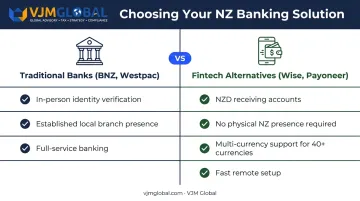
Major banks like BNZ and Westpac may require in-person verification, which can be a genuine hurdle if you're managing everything remotely from Australia.
Fintech alternatives fill this gap well. Wise Business and Payoneer both offer NZD receiving accounts without requiring a physical NZ presence. Wise, for instance, lets you hold and convert 40+ currencies for a one-time setup fee, useful if you're trading beyond NZ and Australia too.
Residency Isn't Automatic
Incorporating a company doesn't grant you the right to live or work in New Zealand. That said, Australian citizens and permanent residents already have it relatively easy. Citizens can generally live, work, or study in NZ without applying for a visa beforehand, while permanent residents typically need an NZeTA before travel plus a valid Australian Resident Visa or Resident Return Visa.
Both groups normally receive a New Zealand Resident Visa on arrival, subject to standard character and passport checks. It's a far smoother path than most countries offer, but it's still worth confirming your specific circumstances rather than assuming.
How VJM Global Supports Australian Businesses Expanding Overseas
Expanding into a new market always raises the same practical question: who handles the compliance work on both sides of the border?
VJM Global has spent 30+ years in tax, audit, and advisory services, and has worked with 250+ Australian businesses on entity formation, accounting, and cross-border tax matters. That experience matters when you're juggling ASIC obligations at home while trying to get a new structure right overseas.
Practical value for Australian founders eyeing New Zealand:
- Structuring your Australian-side compliance (ASIC filings, ABN/ACN management, GST/BAS reporting) so it stays clean while you're focused on a new market
- Advising on cross-border tax implications, including how the Australia-NZ double-tax agreement might affect your structure
- Applying entity formation and compliance experience gained across 16+ markets to help you think through structuring decisions before you commit
- Coordinating bookkeeping, payroll, and statutory filing support so nothing falls through the cracks as you operate across two jurisdictions
Cross-border missteps are rarely dramatic; they're usually small, boring compliance gaps that snowball into penalties. Talk to VJM Global's team before you start, not after something's already gone sideways.
Frequently Asked Questions
How much money do you need to start a business in NZ?
Mandatory setup fees are minimal, around NZD 148 total for name reservation and incorporation. The real cost variable is operational: office space, staff, and ongoing compliance support can range widely depending on your business type.
Can an Australian open a business in New Zealand?
Yes. The Trans-Tasman relationship makes this straightforward, and the director residency rule means Australian company directors often qualify without needing a NZ-resident director at all.
What is the 92-day rule in New Zealand?
This is a tax provision covering short stays, unrelated to immigration or company law. It offers an exemption for non-residents earning income from services performed in NZ for 92 days or fewer. Confirm applicability with a tax advisor, as conditions are specific.
Do I need to move to New Zealand to run my business?
No, incorporation doesn't require relocation. Some banking tasks or active management functions may benefit from local presence or professional support, but plenty of Australian-owned NZ companies run entirely from across the Tasman.
What is the New Zealand Business Number (NZBN)?
It's a unique identifier automatically issued to every registered business in NZ. You'll use it when dealing with government agencies and trading partners, similar in function to an ABN in Australia.
Can I be the sole director of my NZ company from Australia?
Only if you're already a director of a company incorporated in Australia. If that's not the case, you'll need at least one NZ-resident director on your board.