Add to that a shared language, a common law system, and business norms that translate almost directly between the two markets, and the UK looks less like a foreign market and more like a natural extension of home turf.
This guide is for three types of readers: Australian startups testing UK demand before committing fully, established SMEs building an international footprint, and founders planning a personal move. We'll cover structure decisions, Companies House and HMRC registration, banking, employment obligations, cross-border tax, and visa implications, so you have the full picture before you register anything.
Key Takeaways
- Australians can own and run a UK company remotely, without ever holding UK residency
- A UK private limited company (subsidiary) is the default structure for most Australian founders
- Companies House registration takes 24-48 hours, but operational readiness takes 2-6 weeks
- Settle IP placement, transfer pricing, and treaty positions before you register, not after
- Relocating physically triggers UK visa rules and possible Australian CGT on deemed asset disposal
Why Australian Businesses Are Expanding to the UK Right Now
The AU-UK FTA delivers concrete commercial benefits for Australian business owners, removing practical friction in three specific ways:
- Tariffs: more than 99% of Australian goods exports enter the UK duty-free, though some agricultural tariffs phase out over five to ten years rather than disappearing immediately
- Services: non-discrimination rules block UK favouritism toward its own providers, and a most-favoured-nation clause extends future UK trade concessions to Australian firms automatically
- Professional qualifications: a new framework helps regulatory bodies streamline recognition of Australian qualifications, though it doesn't guarantee automatic approval in every profession
Investment data confirms this momentum: Australian foreign direct investment in the UK reached AUD210 billion (GBP104 billion) in 2024, up 11.5% from the previous year, according to the Australian Government's Department of Foreign Affairs and Trade. UK investment into Australia sits at AUD156 billion, growing 6.5% over the same period.

Founders expanding into the UK today are following a well-worn corridor that thousands of Australian businesses have already mapped.
What You Need to Know Before You Start
Before registering anything, get clear on realistic timeframes and where your money actually goes.
Realistic Setup Timeline
| Stage | Approximate Timeframe |
|---|---|
| Companies House registration | 24-48 hours (online) |
| Corporation Tax registration | Immediate filing; UTR can take 2-8 weeks for overseas-registered offices |
| VAT registration | Required once turnover exceeds £90,000 in a rolling 12 months |
| UK business banking | 1-3 weeks for digital platforms; longer for traditional banks |
| Full operational readiness | 2-6 weeks, depending on banking and tax activation |
What You'll Actually Pay For
Budget for these core categories:
- Companies House filing fee: a flat online fee for incorporation
- Registered UK address or mail-forwarding service: a legal requirement, since a PO Box alone won't satisfy Companies House
- Professional advisory fees: entity formation, tax structuring, and compliance setup
- Ongoing annual compliance: confirmation statements, accounts filing, and Corporation Tax returns
A common follow-up question: do you need to live in the UK to run the company?
You don't legally need to be physically present in the UK to own or run a company there. That said, a UK presence helps meaningfully with hiring, building client trust, and qualifying for certain funding programmes.
Not every choice here is as flexible. Three decisions are genuinely hard to reverse once you've registered:
- Where your IP sits: in the Australian parent or the UK subsidiary
- Branch vs. subsidiary structure: this affects liability, tax treatment, and access to UK incentive schemes
- How intercompany arrangements get documented: loose documentation now creates real tax exposure later
This is often where specialists like VJM Global step in, since fixing these choices after registration costs far more than getting them right upfront.
How to Set Up Your Business in the UK from Australia — Step by Step
Step 1: Choose Your Business Structure
Most Australian founders choose between a UK subsidiary (private limited company) or a UK branch (technically an "overseas company establishment").
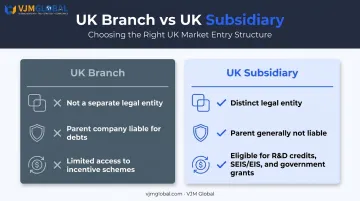
- Branch: not a separate legal entity; your Australian company remains directly liable for its debts and obligations
- Subsidiary: a distinct UK legal entity; the Australian parent generally isn't liable for the subsidiary's debts
Most SMEs default to the subsidiary route, and for good reason. Access to R&D tax credits, SEIS/EIS investment schemes, and government grants typically requires local UK incorporation. EIS, for example, explicitly disqualifies companies controlled by another company, which rules out most branch structures and even some subsidiary arrangements depending on how control is defined.
Step 2: Register with Companies House
To register a private limited company, you'll need:
- A company name (checked for availability)
- At least one director — UK residency is not required
- A registered UK office address in the same jurisdiction as incorporation
- Articles of association
Online registration typically completes within 24 hours. From November 2025, new directors must also complete an identity verification step as part of incorporation.
Once registered, ongoing obligations kick in immediately: an annual confirmation statement, yearly accounts (even for dormant companies), and notifying Companies House of any changes to directors or the registered office. Getting these filings wrong from day one creates compounding compliance headaches.
VJM Global's entity formation and compliance support helps Australian founders unfamiliar with UK statutory requirements. We get registration and ongoing filings right from the outset, rather than leaving gaps for HMRC or Companies House to flag later.
Step 3: Register with HMRC for Tax
Three registrations matter here:
- Corporation Tax — notify HMRC within three months of starting your accounting period
- VAT — register once your rolling 12-month taxable turnover exceeds £90,000, or if you expect to cross that threshold within the next 30 days
- PAYE — register before your first payday if you're hiring staff, but no more than two months ahead of it
Overseas-based applicants face a practical snag. HMRC aims to process Corporation Tax registration within 15 working days, but the activation code delivered to your registered office can take considerably longer, sometimes several weeks, when that office isn't UK-resident. Registering early avoids this becoming a bottleneck for your first VAT or payroll filing.
Step 4: Open a UK Business Bank Account
Most Australian founders don't start with a traditional UK bank. Instead, they open a digital multi-currency account first, then pursue a traditional bank later if needed.
- Wise Business and Airwallex offer UK account details and multi-currency holding for eligible non-residents, though both operate as e-money institutions rather than banks
- Revolut Business eligibility depends on both your company's registration and your personal residence
- Traditional banks like HSBC often restrict certain products to UK tax residents, which rules many newly incorporated Australian-owned entities out at first
This staged approach gets you operational faster while you build the local banking relationship that traditional lenders often expect before onboarding.
Step 5: UK Employment Obligations (If Hiring Locally)
Hiring your first UK employee triggers obligations immediately, not gradually:
- PAYE and National Insurance — deducted through payroll software and reported via Real Time Information submissions
- Workplace pension auto-enrolment — applies to staff aged 22 to State Pension age earning at least £10,000 a year
- Right to work checks — verify each employee's legal right to work in the UK before their start date
UK employment law diverges from Australian law in ways that catch founders off guard, particularly around notice periods, statutory leave entitlements, and termination procedures. Getting local advice before your first hire protects against costly legal and compliance missteps down the line.
For founders who want to hire in the UK without incorporating first, an Employer of Record arrangement is worth considering. VJM Global's EOR service acts as the legal employer on your behalf, covering compliant contracts, PAYE and National Insurance processing, and statutory benefits administration. This lets you hire before your entity is even fully operational.
Cross-Border Tax, IP, and Ongoing Compliance
The AU-UK Double Tax Agreement
The Australia-UK tax treaty exists to stop the same income being taxed twice. In practice, it governs how dividends, interest, royalties, and service fees flow between your Australian parent and UK subsidiary.
Key caps under the treaty:
- Dividends: generally capped at 5% at source where the parent holds at least 10% voting power directly, or 15% otherwise
- Interest: typically capped at 10%, with exemptions for certain government and institutional payments
- Royalties: capped at 5% at source
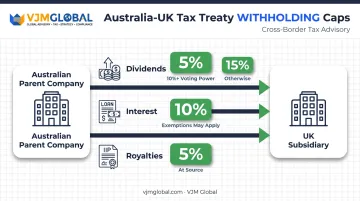
These rates only apply correctly if your intercompany structure is documented properly from the start.
Transfer Pricing Between Parent and Subsidiary
Any transaction between your Australian parent and UK subsidiary (shared services, IP licensing, intercompany loans) must be priced as if the two companies were unrelated. This is the arm's-length principle, and UK rules apply it consistently with OECD guidance.
You'll need to maintain documentation from day one, including:
- Records supporting how your pricing was determined
- A local file covering material intercompany transactions
- A master file if your group falls within country-by-country reporting scope (generally consolidated revenue above EUR 750 million, though smaller groups still need adequate records)
Waiting until year two to build this documentation is a common and costly mistake.
IP Ownership: Decide Before You Register
Where you place your intellectual property shapes your royalty flows, withholding tax exposure, and long-term flexibility. You can hold it in the Australian parent with a licensing arrangement to the UK subsidiary, or register it directly in the UK entity. Moving IP after the fact usually triggers a taxable event in at least one jurisdiction.
This decision benefits from a proper functional analysis: which entity performs the functions, holds the assets, and bears the risks associated with that IP? VJM Global's multi-jurisdiction advisory team works through this analysis, benchmarks appropriate royalty rates, and drafts the intercompany agreements needed to support the structure, before registration happens rather than after.
Visa and Personal Tax Considerations for Relocating Founders
Visa Options for Founders Planning to Relocate
If you're planning to move to the UK personally, three routes are most relevant:
- Innovator Founder visa: for an endorsed, innovative and scalable business idea
- Global Talent visa: for recognised leaders (or potential leaders) in digital technology, academia, or arts and culture
- Skilled Worker visa: requires an approved sponsor and typically a salary of at least £41,700 a year or the going rate for the role
Eligibility criteria on all three shift periodically, so treat this as a starting point for discussion with an immigration specialist, not a final answer. VJM Global's expertise covers business structuring and tax planning for your UK entity, not visa applications, so pair this guidance with advice from a qualified immigration specialist.

Australian Capital Gains Tax on Departure
Here's something that surprises a lot of founders: ceasing Australian tax residency can trigger a deemed disposal of your assets, including shares in your own business, even if you never actually sell them.
This is CGT event I1, and it applies at market value on the date you cease residency, according to the Australian Taxation Office. You can elect to disregard the resulting gain, but that election has ongoing consequences for how those assets are treated later.
Given the potential size of this liability, get professional tax advice before you leave Australia, not after you've already relocated.
Frequently Asked Questions
Can you run a UK business from Australia?
Yes. It's fully legal, and most steps, including registration, banking, and tax setup, can be completed remotely. No UK residency is required to own or direct a UK company.
What's the easiest business to start in the UK?
Sole trader status and low-overhead service businesses like consulting or e-commerce involve the fewest registration steps. That said, Australian founders trading internationally usually still benefit more from a limited company structure.
Do I need a UK director to register a company from Australia?
No, a UK-resident director isn't legally required. Having one can simplify business banking and add local credibility with clients and suppliers.
What is the difference between a UK branch and a UK subsidiary for Australian businesses?
A branch isn't a separate legal entity, so your Australian parent stays liable for its debts. A subsidiary is legally distinct, which is why most Australian businesses choose it.
How long does it take to register a company in the UK from Australia?
Companies House registration itself typically completes within 24-48 hours online. Full operational readiness, including tax registration and banking, usually takes 2-6 weeks.
Do I need a visa to run a UK business from Australia without relocating?
No. You can own and direct a UK company remotely without any visa. A visa only becomes necessary if you plan to live or work in the UK for more than 6 months.