But the excitement usually meets a wall of confusion once founders start researching the mechanics. Which visa applies? Does FIRB approval apply to a small business? Why does every guide mention a "resident director requirement"? And how does tax work once profits start moving between ringgit and Australian dollars?
This guide covers eligibility, the registration steps, realistic costs, tax and banking obligations, common roadblocks, and where expert support fits into the picture.
Key Takeaways
- Malaysians need a visa pathway or resident director to register an Australian company
- Pty Ltd suits most foreign founders, though sole trader and trust structures also exist
- No minimum share capital applies to most structures; visa-linked thresholds are the exception
- The Malaysia-Australia DTA helps prevent double taxation on repatriated profits
- VJM Global can manage director residency, banking documentation, and ongoing compliance remotely
Can a Foreigner From Malaysia Start a Business in Australia?
Yes. The core company registration process is identical to what an Australian citizen would follow. What differs is everything around it: visa eligibility, the requirement for a locally resident director, and in select sectors, sign-off from the Foreign Investment Review Board (FIRB).
Malaysia also carries a distinct advantage here. As an AANZFTA member and a party to the Malaysia-Australia Free Trade Agreement, Malaysian-formed entities benefit from clearer regulatory treatment and better services market access than founders from non-FTA countries.
Visa Options for Malaysian Entrepreneurs
Most founders assume there's a dedicated "start-up visa" for opening an Australian business. There isn't, not anymore.
The current visa landscape breaks down as follows:
| Visa | Status | Cost | Key Details |
|---|---|---|---|
| National Innovation Visa (Subclass 858) | Permanent, invitation-only | AUD6,235 | Requires an internationally recognised record of exceptional achievement; applicants submit an Expression of Interest before applying |
| Business Innovation and Investment Program (BIIP) | Closed since 31 July 2024 | N/A | No replacement exists; the NIV that followed is achievement-based, not investment-based |
| Business Visitor Visa (Subclass 600) | Up to 3 months | AUD250 | Covers market scoping and trade fairs only; doesn't permit working for or selling to an Australian business |
For most Malaysian founders without an exceptional achievement record, the realistic route to ownership is incorporating remotely with a resident director, rather than relying on a personal visa.
Do Malaysians Need FIRB Approval?
Most small business registrations by individual Malaysian founders don't trigger FIRB review at all. The thresholds only bite once investment size or sector sensitivity crosses specific lines.
As of 2026, private Malaysian investors face these monetary thresholds:
- Non-sensitive business (20%+ stake): approval needed above AUD1.498 billion
- Sensitive business (20%+ stake): approval needed above AUD347 million
- Agribusiness (10%+ stake): approval needed above AUD75 million cumulative
- Agricultural land: approval needed above AUD15 million cumulative
- Mining tenements, national security businesses, telecom carriers: approval needed from AUD0
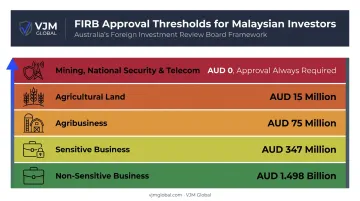
In practice, a Malaysian founder opening a café, consultancy, or e-commerce business sits well under these thresholds. FIRB becomes relevant mainly in defence, telecommunications, media (10%+ stake, regardless of value), or agricultural land acquisitions.
Step-by-Step Process to Register Your Business in Australia
Registration itself doesn't change because you're Malaysian. Forming an ABN, registering a company, and filing with ASIC follow the same mechanics as they would for an Australian citizen.
What changes is planning around director residency and verifying documents remotely. A certified passport copy processed from Kuala Lumpur takes longer to clear than one handed over in person.
Choose Your Business Structure
Most foreign-owned businesses land on Pty Ltd for its limited liability and separate legal identity. But it comes with a catch that surprises many Malaysian founders.
Every Australian proprietary company needs at least one director who ordinarily lives in Australia. ASIC confirms this requirement applies regardless of ownership nationality. If you don't already have a trusted contact who qualifies, you'll need a local co-director or nominee arrangement before incorporating.
| Structure | Liability | Resident Director Needed? | Best For |
|---|---|---|---|
| Sole Trader | Unlimited | No (but must meet Australian tax residency) | Simple remote consulting |
| Partnership | Unlimited, shared | No | Two or more owners, low complexity |
| Pty Ltd | Limited | Yes | Most foreign-owned businesses |
| Trust | Varies by trustee | Depends on trustee type | Asset protection, family structures |
Register Your Business (ABN, Name, ASIC)
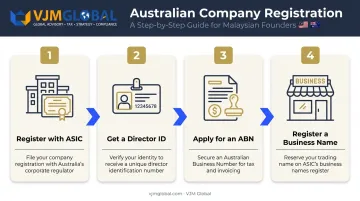
- Register with ASIC - choose a company name, registered office, and share structure, then obtain written consents from directors and members. This produces your Australian Company Number (ACN) and registration certificate.
- Get a Director ID - each proposed director applies personally before appointment. Overseas applicants unable to apply online use form NAT 75433 with certified identity documents.
- Apply for an ABN - non-residents qualify when carrying on an enterprise connected to Australia. Use certified ID plus a statement of Australian business activities if you don't yet have a Tax File Number.
- Register a business name - only needed if trading under a name different from your registered company name.
Register for Tax (TFN and GST)
A Tax File Number is issued automatically alongside your ABN application, so there's no separate step for most founders. GST registration only becomes compulsory once your GST turnover reaches AUD 75,000 in a 12-month period, and you have 21 days to register once you cross it.
Register early if you expect to hit that mark within your first year. Backdating GST registration creates avoidable paperwork.
Obtain Necessary Licences and Permits
Licensing in Australia is fragmented across federal, state, and local levels. The Australian Business Licence and Information Service (ABLIS) lets you search by business type and location to generate a tailored list, rather than guessing which regulator applies to your industry.
Common examples include food handling permits, import/export licences, and state-based trade certifications, depending on your industry.
How Much Money Do You Need to Start a Business in Australia?
Most business structures, including Pty Ltd, carry no mandatory minimum share capital. The real budgeting risk lies in the accumulation of setup fees and the investment thresholds tied to visa pathways such as the Business Innovation and Investment Program (subclass 188), not the share capital requirement itself.
Real registration costs to budget for:
- ASIC company registration (with share capital): AUD636
- Business name registration: AUD47 for one year, or AUD108 for three years
- Company name reservation: AUD65
- Proprietary company annual review fee: AUD342 (recurring annually)
Beyond registration, plan for:
- Professional and legal advisory fees for resident director arrangements and cross-border structuring
- Ongoing accounting and bookkeeping costs
- MYR-AUD currency conversion and transfer fees when moving capital or repatriating profits
- Remote notarisation or document certification for identity verification
- Possible travel costs if your bank insists on in-person verification for account opening
A Malaysian founder budgeting only for the AUD636 ASIC fee will be caught short within the first quarter.
Tax, Banking and Compliance Obligations for Malaysian-Owned Businesses
Registration is the easy part. What follows determines whether your Australian entity stays in good standing: taxes, banking access, and a compliance calendar that doesn't pause because you're managing it from Kuala Lumpur or Penang.
Understanding Australian Business Taxes
Company tax sits at 25% for base rate entities (aggregated turnover under AUD 50 million, with no more than 80% passive income) and 30% for larger companies. GST runs at 10%, and once you hire staff, PAYG withholding obligations kick in.
The Malaysia-Australia Double Taxation Agreement determines which country taxes what. Under the treaty, business profits are generally taxable only in your home country, unless you operate through a permanent establishment in Australia, meaning a fixed place, branch, office, or long-running project or service arrangement.
The ATO's synthesised treaty text caps source-country withholding at 15% on dividends, interest, and royalties. In practice, this stops a Malaysian founder from being taxed on the same profit twice.
Opening an Australian Business Bank Account
Banks typically ask for:
- Passport identification for all directors and beneficial owners
- An active ABN or ACN
- Business registration documents
- Proof of business address
Non-resident founders often hit extra friction here. Several major banks route foreign-director applications to a branch or phone-based process instead of the standard online sign-up, since default digital onboarding assumes you already live in Australia. Confirm requirements directly with your chosen bank before you need the account operational.
Ongoing Compliance Requirements
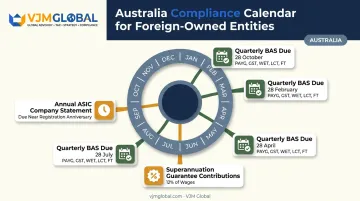
- Annual ASIC company statement - due near your registration anniversary, with the review fee payable within two months
- Quarterly BAS filings - standard due dates fall on 28 October, 28 February, 28 April, and 28 July
- Superannuation Guarantee - currently 12% of wages once you hire staff
Missing these deadlines doesn't just draw penalties. It can flag your company for closer regulatory scrutiny down the line. Firms such as VJM Global track these Australian filing dates for Malaysian-owned entities, so deadlines don't get lost across time zones.
Common Challenges Malaysian Entrepreneurs Face and How VJM Global Can Help
Malaysian founders repeatedly run into the same three snags:
- Satisfying the resident director rule without relocating - trustworthy Australian residents willing to take on this role rarely sit in a Malaysian founder's contact list
- Managing GST and BAS filings from abroad - quarterly deadlines don't adjust for time zones or public holidays back home
- Coordinating FIRB (Foreign Investment Review Board) or visa timelines with company registration - if your pathway involves a visa or sector-sensitive investment, sequencing matters
This is where working with a firm that has genuine Australian market experience makes a practical difference. VJM Global has served 250+ Australian businesses, delivering services using Australia's own regulators and statutory instruments rather than adapting a template built for another country.
Practical support areas include:
- Helping structure local director or registered office arrangements so your Pty Ltd meets ASIC's residency requirement
- Assisting with the documentation banks request for foreign-director account opening
- Overseeing ongoing bookkeeping, BAS lodgements, and ASIC annual compliance so the entity stays in good standing while you run it from Malaysia
If you're weighing up an Australian expansion, it's worth speaking with VJM Global's cross-border entity formation and compliance team before lodging anything with ASIC. Getting the structure right at the start avoids costly restructuring later.
Frequently Asked Questions
Can a foreigner start a business in Australia?
Yes, a foreigner including a Malaysian national can start a business in Australia, provided they arrange for a resident director or hold a relevant visa. Beyond these requirements, the process largely mirrors what an Australian citizen would go through.
How much money do I need to start a business in Australia?
There's no fixed minimum capital for most business structures. Budget instead for registration fees (around AUD 636 for ASIC), professional advisory costs, and any visa-linked investment thresholds if your pathway requires one.
Do I need to visit Australia in person to register my company as a Malaysian?
Much of the process, including ABN and ASIC registration, can be completed remotely with a local agent's help. Certain banking steps, however, may still require in-person identity verification depending on the bank.
Can I be the sole director of my Australian company while living in Malaysia?
No. Proprietary companies require at least one director who ordinarily lives in Australia, so you'll typically need a local co-director or nominee arrangement alongside yourself.
Is there a double taxation agreement between Malaysia and Australia?
Yes. The Malaysia-Australia DTA generally taxes business profits only in your home country unless you have a permanent establishment in Australia. This agreement prevents the same income from being taxed twice.
How long does it take to register a business in Australia from Malaysia?
Company registration through ASIC can be completed within a couple of business days once documents are ready, and ABN applications are often instant online. Visa processing or FIRB approval, if required, will extend the overall timeline considerably.