Introduction
Dutch entrepreneurs eyeing growth outside the EU need an English-speaking market with straightforward company registration and a real path into Asia-Pacific. New Zealand fits that brief—and you can often complete the setup without leaving Amsterdam or Rotterdam.
New Zealand allows 100% foreign ownership, has no minimum share capital requirement, and lets you register a company online in a matter of days once identity checks clear.
That route isn’t only for large corporates. Dutch startups, SMEs, freelancers, and individual investors are asking the same question: can we register and operate from the Netherlands without relocating?
This guide walks through exactly what’s involved, step by step, for a Dutch resident or company looking to legally register and operate in New Zealand.
TL;DR
- Dutch nationals can own 100% of a NZ company, but a NZ or Australian resident director is mandatory
- Register online through the Companies Office, usually within days of identity verification
- Budget for incorporation fees, 15% GST, and 28% corporate tax
- A visa is only needed if you plan to live in NZ and actively run the business yourself
- Remote setup is viable; plan compliance and tax support so ongoing NZ obligations stay on track
What Is Involved in Starting a Business in New Zealand from the Netherlands?
This means legally registering and operating a New Zealand-based entity while you remain based in the Netherlands. You don't need to relocate immediately, or at all, depending on your goals.
This guide covers:
- Online incorporation through the Companies Office
- Resident director appointment
- Tax and GST registration
- Business banking setup
It does not cover visa or immigration planning. That's a separate track entirely if you eventually want to live and work in NZ.
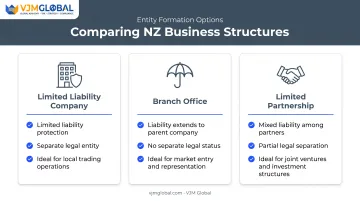
Three structures are commonly used:
- Limited Liability Company (LTD) - a standalone NZ legal entity, the most common choice
- Branch office - your Dutch company registers to operate in NZ without creating a separate legal entity
- Limited partnership - useful for specific investment or joint-venture structures
What to Know Before You Start
Many Dutch founders assume NZ registration will mirror the Dutch KvK process. It doesn't, and two things trip people up most: the resident director rule and banking friction.
Before you begin, get clear on:
- Time and paperwork: Remote registration is possible, but expect more document preparation than an in-person setup
- Resident director: If you remain in the Netherlands, at least one director must live in New Zealand or Australia
- Timeline to full operation: Incorporation itself is fast, but banking and GST registration can add weeks
- Bank account verification: Company registration can run fully remotely; opening a bank account often needs extra identity checks
- Registration vs. visa: Forming a company does not grant permission to live or work in New Zealand
Why Start a Business in New Zealand? (When It Makes Sense)
New Zealand isn't the right fit for everyone, but under the right conditions, it's a strong one. Here's what the data supports:
- Ease of doing business: Ranked 1st out of 190 economies in the World Bank's Doing Business 2020 report (score 86.8), including the "Starting a Business" category
- No minimum capital, full foreign ownership: One share to one shareholder—Dutch or otherwise—with no capital floor
- Tax structure: Flat 28% corporate tax, plus a Netherlands–New Zealand double tax agreement (1980) that limits tax twice on the same income
- Asia-Pacific access: Trade deals such as CPTPP give a practical bridge into Asia-Pacific markets
- Legal stability: Common law system with transparency standards comparable to EU norms
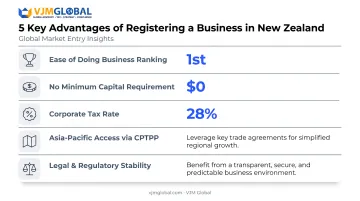
The World Bank discontinued the Doing Business report in 2021, so treat that ranking as a strong historical signal, not a live score.
This path fits best when you:
- Target Asia-Pacific customers from a low-friction NZ entity
- Need a holding or trading company without relocating yet
- Want to test the market before a fuller commitment
It fits less well if you need daily hands-on management and cannot secure a qualifying resident director.
Early Decisions That Matter
Most friction Dutch founders hit comes from underestimating a handful of specific requirements before they start.
Budget and plan for these early:
- Nominee director costs: If you're not relocating, budget for an ongoing nominee or local director arrangement, not just a one-time fee
- Bank account timeline: Remote account opening often takes longer than expected due to identity verification steps
- Company vs. branch decision: A new NZ company is a clean local entity; an overseas branch keeps one legal umbrella but ties NZ obligations to the Dutch parent
- GST trigger point: Registration becomes compulsory once turnover hits or is expected to hit NZD 60,000 in a 12-month period
- Dual compliance: You'll run Dutch obligations (VAT, corporate tax, KvK filings) and NZ obligations (annual returns, IRD filings) in parallel
How to Start a Business in New Zealand from the Netherlands – Step by Step
This breaks the process into practical stages. Dutch founders most often trip up on three points:
- Assuming EU registration norms apply in New Zealand
- Leaving director and banking arrangements until the last minute
- Forgetting visa questions if relocation may come later
Step 1 – Choose Your Business Structure and Reserve a Name
Decide between an LTD, branch office, or limited partnership based on your liability preferences and tax goals. Then:
- Check name availability through the Companies Office online register
- Reserve your chosen name (approval usually confirmed within a couple of hours during business hours, giving you 20 working days to incorporate)
- Verify the name doesn't clash with existing NZ trademarks
Step 2 – Satisfy the Resident Director Requirement
This is the step most Dutch founders get wrong. NZ law requires at least one director who either lives in New Zealand, or lives in Australia and currently directs an Australian-incorporated company. A Dutch-resident director, no matter how qualified, doesn't meet this test on their own.
If relocating isn't part of your plan, you'll need a nominee or local director service. Sort this before you file—director consent is required at incorporation, not after.

VJM Global supports cross-border company formation and governance planning across 16+ markets, including the Netherlands, and helps Dutch clients lock in resident-director arrangements before they block registration.
Step 3 – Register with the Companies Office
Once your director arrangement is sorted:
- Complete the online incorporation application, including director and shareholder consent forms
- Provide a registered NZ office address (a virtual office is acceptable)
- Pay the incorporation fee and wait for your Certificate of Incorporation
Step 4 – Register for Tax, GST and NZBN
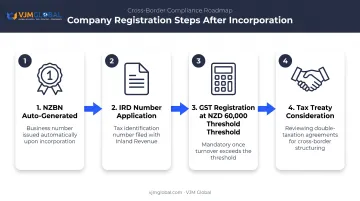
Incorporation automatically generates a New Zealand Business Number (NZBN). You'll also need:
- An IRD number for tax purposes
- GST registration once turnover is expected to exceed NZD 60,000
- An understanding of how the Netherlands-New Zealand tax treaty applies to your specific income flows, particularly if profits move back to a Dutch parent company
Step 5 – Open a Business Bank Account
This is often the slowest part of the process for non-residents. Prepare:
- Certified incorporation documents
- Passports for all directors and shareholders
- Proof of address documentation
Build in extra time for anti-money-laundering checks. Some banks may require additional verification for non-resident applicants. Consider international payment tools alongside a traditional account so Netherlands–NZ transfers keep moving while the account is still opening.
Step 6 – Plan Compliance, Reporting and Ongoing Operations
Once you're operational, set a clear schedule for:
- Annual returns (due each year to keep your company on the register)
- Financial statement filing (requirements vary by company size)
- Tax return deadlines on both sides
Decide early whether you'll manage this in-house or use a firm that understands both Dutch and NZ rules. VJM Global already runs multi-entity accounting and payroll across markets including the Netherlands, Australia, and Germany—useful when dual-side filing deadlines have to stay aligned.
Frequently Asked Questions
How much does it cost to start a business in New Zealand?
Registry fees are low: roughly $11.50 NZD for name reservation, $136.55 NZD for incorporation, and $57.20 NZD for the annual return. Professional fees for director or compliance services are separate and vary by provider.
Is there a $5,000 Small Business Grant available in New Zealand?
Not as a universal grant. The Management Capability Development Fund can subsidise up to 50% of management training costs, capped at $5,000 NZD a year excluding GST. Eligibility depends on your registration and residency status.
What is the 92-day rule in New Zealand?
It's actually a 90-day rule, referring to employment trial periods under NZ law. It applies once you start hiring staff, not to company registration itself.
What businesses are in demand in New Zealand?
Renewable energy, advanced transportation, cleantech, and aquaculture are current government investment priorities. Agritech, tourism, and IT services also remain active sectors for foreign entrants.
Can a Dutch citizen own 100% of a New Zealand company without relocating?
Yes. Ownership isn't restricted by nationality or residency. You'll still need to satisfy the resident director requirement through a local or nominee appointment.
Do I need a visa to start a business in New Zealand from the Netherlands?
No, not to register the company. A visa only becomes necessary if you plan to live in NZ and actively work in or manage the business yourself.