This isn't just a large-corporate story. Malaysian SMEs, export traders, tech and services founders, and investors looking to diversify across Asia-Pacific are all part of this shift. New Zealand's tiny domestic market punches above its weight when it comes to trade agreements and market access.
This guide walks through the structures, requirements, costs, and compliance steps Malaysians need to know before registering a business in New Zealand.
Key Takeaways
- New Zealand permits 100% foreign ownership, but every company needs a resident director based in NZ or Australia.
- Online company registration is fast; banking, tax registration, and visas take considerably longer.
- Budget for name reservation, incorporation, annual returns, and resident director services.
- Secure your NZ or Australian resident director and map cross-border tax obligations before you file.
What Is Involved in Starting a Business in New Zealand from Malaysia?
Starting a business in New Zealand from Malaysia means registering and operating a legal entity in New Zealand while managing operations from Malaysia. You'll use New Zealand's Companies Office and Inland Revenue (IRD) systems, either remotely or through local representation.
This process involves three parallel tracks:
- Choosing an entity type that fits your growth plans
- Meeting resident director and registered office requirements, which most Malaysian founders can't satisfy alone
- Managing tax and banking obligations across two jurisdictions with different currencies, deadlines, and reporting standards
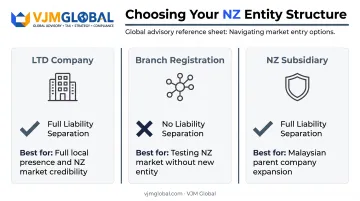
Malaysian founders typically choose one of three formats:
- NZ-incorporated LTD company: a standalone New Zealand entity
- Branch registration: the existing Malaysian company on New Zealand's Overseas Register
- NZ subsidiary: wholly owned by the Malaysian parent company
Each carries different liability and tax consequences, which we'll unpack below.
What to Know Before You Start (Malaysia-to-NZ Specific)
Malaysian founders often underestimate how much cross-border friction affects setup timelines. Registration itself is usually quick; the delays sit in everything around it.
Here's what catches most people off guard:
- Resident director requirement: You need a director who lives in New Zealand (or in Australia while also directing an Australian company)—living in Malaysia alone does not qualify unless you relocate.
- Physical registered office: A New Zealand physical address is mandatory for both the registered office and address for service. A PO Box, DX service, or Malaysia-only address won't work.
- Banking verification: New Zealand banks typically require in-person verification or certified documentation for non-resident applicants, which creates delays when you're based in Malaysia.
- Visa status matters: Whether you can actively manage day-to-day NZ operations depends entirely on your visa or residency status.
- Time zone and currency gaps: NZD and MYR move independently, and New Zealand sits several hours ahead of Malaysia, which affects everything from bank call scheduling to remittance timing.
None of these issues are deal-breakers. They just need planning before you start, not after.
Why Malaysian Businesses Choose New Zealand
These are favourable conditions, not a guarantee of success. New Zealand still requires the same commercial validation any market does.
Still, the fundamentals are attractive:
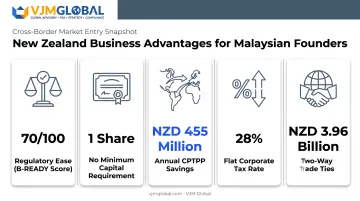
Regulatory ease. New Zealand ranks strongly on operational efficiency in the World Bank's B-READY 2025 assessment, scoring 70/100 — placing it in the top 20% of the 101 economies covered.
No minimum capital. You don't need a specific capital amount to incorporate. One share is sufficient, which lowers the barrier for smaller Malaysian investors testing the market.
CPTPP access. Both New Zealand and Malaysia are CPTPP members. According to New Zealand's Ministry of Foreign Affairs and Trade, the agreement is projected to save exporters an estimated NZD 455 million annually in tariffs once fully implemented. It also expands access to government procurement.
Straightforward tax structure. Companies pay a flat 28% corporate tax rate on most income. Capital gains on shares held as capital assets are generally non-taxable, though trading stock and assets bought for resale don't get the same treatment.
Existing trade ties. For the year ended December 2024, Malaysia was New Zealand's 10th-largest trading partner overall and third-largest within ASEAN, with two-way trade reaching NZD 3.96 billion.
These fundamentals explain the growing Malaysian interest. They don't remove the operational work required to actually get set up.
Early Decisions That Matter for Malaysian Founders
Most setup problems come from underestimating how two legal systems interact, not from lack of effort. Settle these four points before you file anything:
- Subsidiary vs. branch: a branch is not a separate legal entity, so your Malaysian parent stays fully liable for NZ activity. A subsidiary creates genuine liability separation.
- Resident director cost: if you won't relocate, budget for ongoing resident director services. Quality and price vary widely between providers.
- MYR–NZD exposure: conversion costs and exchange-rate risk hit every cross-border payment and add up fast with regular transfers.
- Visa vs. ownership: owning the company does not grant the right to work in it. Confirm which visa (if any) lets you operate hands-on from inside New Zealand.
How to Register a Business in New Zealand from Malaysia – Step by Step
The most common mistakes are skipping the resident director requirement entirely, or assuming a Malaysian mailing address will satisfy the physical office rule.
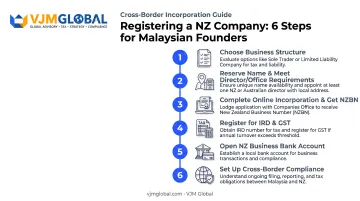
Step 1 – Choose Your Business Structure
| Structure | Liability | Best For |
|---|---|---|
| LTD Company | Limited to shareholders | Long-term NZ presence, scaling plans |
| Branch Office | Parent company fully liable | Testing the market, minimal NZ footprint |
| NZ Subsidiary | Limited, separate entity | Malaysian parent wanting liability separation |
Base your decision on how much liability protection you need and how you plan to scale. A branch office looks simpler on paper, but the liability trade-off is significant if things go wrong.
Step 2 – Reserve Your Company Name and Meet Director/Office Requirements
Use the Companies Office's online name-check tool and reserve your approved name. This costs NZD 10 plus GST, and most requests submitted during business hours process within 2 hours. Once approved, the name stays reserved for 20 working days.
At the same time, arrange:
- A resident director (NZ-based, or Australia-based with an Australian directorship)
- A physical NZ registered office address — not a virtual mailbox
Common miss: Assuming a virtual mailbox service satisfies the "physical address" requirement. It doesn't.
Step 3 – Complete Online Incorporation and Get Your NZBN
Submit director and shareholder consents, share allocation details, and incorporation documents through the Companies Office portal. Incorporation costs NZD 118.74 plus GST. Once approved, you'll receive your Certificate of Incorporation and NZ Business Number (NZBN) automatically.
Common miss: Incomplete consent forms from overseas shareholders. These delay the whole process and are one of the easiest things to get right if you prepare documents in advance.
Step 4 – Register for IRD Number and GST
Apply for an IRD number immediately after incorporation, using Inland Revenue's non-individual application process. Note that companies more than 25% owned or controlled by offshore persons are treated as "offshore" for IRD purposes, which affects documentation requirements.
Register for GST (currently 15%) if your turnover is expected to exceed NZD 60,000 in any 12-month period. Corporate tax sits at a flat 28% for most companies, applied to worldwide income for NZ tax residents and NZ-sourced income for non-residents.
Common miss: Missing the GST registration deadline once trading actually starts, not when you first planned to trade.
Step 5 – Open a New Zealand Business Bank Account
Prepare certified copies of your incorporation certificate, passports, and IRD/NZBN documentation well in advance. New Zealand banks apply strict anti-money-laundering checks. BNZ, for example, requires identity and address verification for anyone holding 25% or more aggregate ownership, plus foreign tax numbers for foreign tax residents.
Verification methods vary by bank and may include branch visits, certification by an approved referee, or online photo verification where available.

Common miss: Underestimating how long AML verification takes for Malaysia-based applicants. Build in buffer time rather than assuming a quick turnaround.
Step 6 – Set Up Cross-Border Compliance and Ongoing Filings
Once you're trading, the ongoing obligations kick in: annual returns (NZD 49.74 plus GST), financial record-keeping, and tax filings in both Malaysia and New Zealand.
This dual-jurisdiction workload is where many founders get stretched thin: two sets of deadlines, two currencies, and two regulators is not a side task.
VJM Global supports entity formation and ongoing compliance using each market's own regulators and filings, so a Malaysian founder can keep NZ incorporation and home-market obligations under one coordinated process instead of juggling separate providers.
Conclusion
Starting a business in New Zealand from Malaysia is straightforward on paper. The online registration system is fast, foreign ownership is unrestricted, and there is no minimum capital requirement.
The real work sits in the details:
- Securing a resident director
- Meeting the physical office requirement
- Navigating bank verification
- Keeping tax obligations current in both countries
Founders who plan for these before filing incorporation documents avoid costly delays later.
Registration is only the start. Ongoing Malaysian and New Zealand filings, tax residency questions, and banking upkeep decide whether the structure stays clean as you grow. If you want help with entity formation, tax setup, or cross-border compliance, VJM Global can support the process from first filing through ongoing obligations.
Frequently Asked Questions
Can a Malaysian citizen fully own a company in New Zealand?
Yes. New Zealand permits 100% foreign ownership of a company, including wholly owned subsidiaries. You'll still need to meet the resident director requirement separately from ownership.
Do I need to move to New Zealand to start a business there?
No, relocation isn't mandatory. You can appoint a resident or nominee director and set up a physical registered office without living in New Zealand yourself.
How long does it take to register a company in New Zealand?
Name reservation typically processes within 2 hours during business hours. Overall incorporation timing depends on how quickly you submit complete documentation, particularly consent forms.
What is the corporate tax rate for a NZ company owned by a Malaysian?
Most companies pay a flat 28% corporate tax rate. NZ tax residents are taxed on worldwide income, while non-residents are generally taxed only on NZ-sourced income.
Can I open a New Zealand bank account without visiting in person?
Some banks offer certified or remote verification options, but most require in-person checks or additional documentation for non-resident applicants, which can extend account-opening timelines.
Is there a minimum investment required to start a business in New Zealand from Malaysia?
No minimum share capital is required to register a company — one share is enough. This is separate from any investment thresholds tied to specific visa categories.