This isn't just a large-corporate play. UK freelancers, ecommerce sellers building US-facing brands, and small-to-medium businesses testing the American market are all forming Ohio LLCs from their kitchen tables in Manchester or Bristol.
This guide walks through entity choice, registration, banking, and the tax obligations you'll face on both sides of the Atlantic — in the order that actually prevents rework.
Key Takeaways
- UK residency isn't required for an Ohio LLC, but an Ohio-based registered agent is mandatory
- An LLC is the most practical structure for most non-resident founders
- HMRC and US/Ohio tax authorities both apply : plan for dual reporting from day one
- Formation is quick; banking and full compliance take weeks
- Stick to this order: structure → register → EIN → bank → tax → launch
What Does Starting a Business in Ohio from the UK Actually Involve?
It means registering and legally operating a US business entity under Ohio law while you remain based in the UK.
That's different from simply selling to US customers from your existing UK company. If you're invoicing American clients from a UK Ltd, you don't need an Ohio entity at all. You only need one if you're incorporating an actual Ohio LLC or corporation: filing with the Ohio Secretary of State and paying US federal and Ohio state tax.
Two common paths exist:
- Ohio LLC run remotely by a non-resident owner, often for ecommerce, consulting, or SaaS businesses targeting US buyers
- US subsidiary or branch opened by an existing UK company as a genuine market-entry vehicle
Most solo founders and small teams fall into the first category.
What to Know Before You Start a Business in Ohio from the UK
Here's the honest bit: most UK founders underestimate the admin of running two regulatory systems simultaneously. The business idea is rarely the hard part.
Residency and Agents
Ohio doesn't require you, as an LLC owner, to live in the state or even the country. What it does require is a statutory (registered) agent with a genuine Ohio street address (not a PO box) who can receive legal notices on your behalf.
Two Filing Systems, Not One
You'll be dealing with:
- Ohio Secretary of State, IRS, and Ohio Department of Taxation filings
- UK Self Assessment or corporation tax reporting on foreign income and ownership
Neither cancels out the other. Expect to report the same business activity twice, in two different formats.
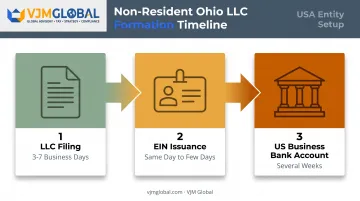
Realistic Timelines
- LLC filing: often processed within 3-7 business days online through Ohio Business Central
- EIN: often same day to a few days online once your entity legally exists
- US business bank account: this is where non-residents get stuck. Budget several weeks, not days
Compliance Is Where Most Founders Slip
Missing a Commercial Activity Tax (CAT) registration deadline will cause more damage than any product gap. The businesses that struggle here usually treated compliance as an afterthought, not a core workstream.
Selling into the US from a UK company requires no Ohio entity at all. Operating as an Ohio business requires full registration and ongoing compliance. Know which one you're actually doing.
Why Start a Business in Ohio from the UK? (When It Makes Sense)
Ohio incorporation isn't a default choice — it makes sense under specific conditions.
Ohio works well when you:
- Have the US, or specifically Ohio, as a primary target market
- Want the credibility of a US EIN and business bank account for American customers or partners
- Are comfortable managing both UK and US compliance obligations simultaneously
Ohio has a strong small business base to back this up. According to the SBA's 2025 Ohio State Profile, the state has 1.1 million small businesses, making up 99.6% of all Ohio businesses and employing 2.2 million people (nearly 44% of the state's workforce).
What draws non-residents specifically:
- No state corporate income tax (replaced by the Commercial Activity Tax, which only applies above $6M in gross receipts)
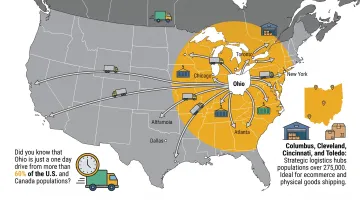
- Central US logistics location if you ship physical goods
- Low registration costs, with a base LLC filing fee of $99
Early Decisions That Matter When Starting a Business in Ohio from the UK
The costliest early mistakes usually come from underestimating how UK and US rules interact.
Entity choice made carelessly
Choosing between forming an Ohio LLC and continuing to sell from your UK entity isn't a coin flip. Get it wrong and you risk unnecessary tax exposure: triggering US filing obligations you didn't need, or missing US tax residency questions you should have addressed upfront.
The real cost of remote-only operation
Formation is cheap. Staying compliant isn't free:
- Registered agent fees (annual, ongoing)
- US accountant or compliance costs for CAT (Commercial Activity Tax) filings and any applicable returns
- UK reporting requirements on foreign business ownership
US banking assumptions that don't hold
Many UK founders assume a UK business account or a PayPal balance will cover US operations. It won't. US customers and payment processors generally expect a real US bank account with a routing number attached.
No local presence means no local safety net
Without someone physically checking US mail, missed Ohio Secretary of State notices or tax deadlines pile up fast. There's no one nudging you when a letter arrives.
That gap is why founders bring in a cross-border partner. VJM Global has supported 250+ UK businesses with entity formation and ongoing compliance, and the pattern is consistent: gaps surface months after a notice should have been handled.
How to Start a Business in Ohio from the UK – Step by Step
Remote Ohio formation breaks down into five practical stages. The most common mistakes are registering the wrong entity type, delaying EIN or tax registration, and assuming a UK bank account will work for US operations.
Step 1 – Validate Demand and Choose Your Ohio Business Structure
Don't assume UK market research transfers to US buyer behaviour. Research US-specific competitors and demand signals separately.
Entity comparison for non-resident founders:
| Structure | Liability Protection | Tax Flexibility | Best For |
|---|---|---|---|
| LLC | Yes | High (pass-through by default) | Most non-resident UK founders |
| Corporation | Yes | Less flexible, double taxation risk | Raising US venture capital |
| Sole Proprietorship | None | N/A | Not recommended for non-residents |
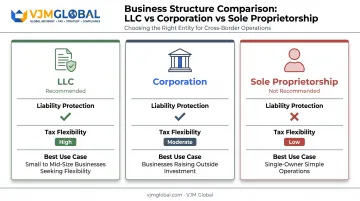
For most UK founders, an LLC is the better fit: liability protection plus tax flexibility.
Step 2 – Register Your Ohio Business Entity Remotely
File Articles of Organization (LLC) or Articles of Incorporation (corporation) with the Ohio Secretary of State online through Ohio Business Central. The base fee is $99, with standard processing taking 3-7 business days.
You must also appoint a registered agent with a genuine Ohio street address. Non-resident founders cannot skip this. Using an informal US contact's home address instead of a proper registered agent service risks missed legal notices you will never see.
Step 3 – Obtain Your EIN and Register for US and Ohio Taxes
Apply for a federal EIN from the IRS. As a UK applicant without a US SSN or ITIN, you can't use the standard online application. Call the IRS international line, or submit by fax or mail, and build in 4-5 weeks for mail processing.
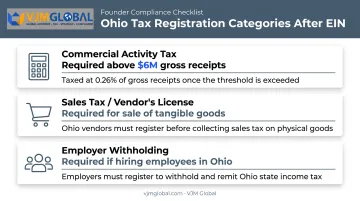
Then register with the Ohio Department of Taxation for:
- Commercial Activity Tax (CAT): required once gross receipts exceed $6M, taxed at 0.26%
- Sales tax / vendor's license, if selling tangible goods
- Employer withholding, if hiring in Ohio
Common miss: forgetting that this US business income may also need reporting to HMRC. UK residents typically report foreign income through Self Assessment, potentially claiming Foreign Tax Credit Relief where the same income has already been taxed in the US.
Step 4 – Open a US Business Bank Account and Set Up Payments
Traditional US banks often expect in-person verification, which is impractical from the UK. Many non-resident founders use fintech providers such as Mercury or Relay instead. These accept non-US-owned entities when the business is properly formed in the US and can show genuine US operations.
Common miss: relying solely on a UK bank account or PayPal balance instead of proper US banking infrastructure.
Step 5 – Launch, Market, and Stay Compliant
Build your offering around US expectations — pricing in dollars, realistic delivery timelines, and payment methods Americans actually use.
There's no general Ohio annual report requirement for a standard LLC, which is one less thing to track. But CAT filings (quarterly, if applicable) and any license renewals still need monitoring.
Common miss: generating early revenue but missing a first CAT filing deadline simply because no one local was there to catch the reminder.
Conclusion
Starting a business in Ohio from the UK is achievable without relocating, provided entity choice, registration, and dual-country tax obligations are handled correctly from the outset.
Formation itself is fast and inexpensive. The real challenge is sustained compliance across HMRC, the IRS, and Ohio state agencies, year after year, not just in month one.
Working with a firm experienced in both UK and US compliance, such as VJM Global, helps catch the errors that tend to surface only after year one, once it's harder and more expensive to fix them.
Frequently Asked Questions
How much does it cost to start a business in Ohio?
The base LLC filing fee is $99. Add optional costs like registered agent service, vendor's licenses, and professional or accounting fees if you're using a firm to manage UK-side compliance.
What are the steps to form an LLC in Ohio?
Check name availability, file Articles of Organization with the Ohio Secretary of State, appoint a registered agent with an Ohio address, then obtain an EIN from the IRS once the entity exists.
How long does it take to set up an LLC in Ohio?
Online filings typically process within 3-7 business days. EIN issuance and, especially, opening a US bank account as a non-resident can take considerably longer.
Do I need a business license if I have an LLC in Ohio?
An LLC alone doesn't cover industry-specific licensing. Depending on what you sell and where, you may still need a vendor's license or other permit.
Do you have to pay for your LLC every year in Ohio?
Ohio doesn't require a general annual report for standard LLCs. However, ongoing costs like registered agent fees and any applicable CAT filings still apply.
How do I check if a business name is available in Ohio?
Use the Ohio Secretary of State's business name search tool before filing to confirm your chosen name isn't already registered.