For Canadians, the appeal is specific: no personal income tax, a currency pegged to the US dollar, and the ability to own 100% of a Qatari company without a local sponsor. That last point matters — it's the single biggest change from how Gulf expansion used to work.
This interest is coming from Canadian SMEs, independent consultants, tech founders, and established Canadian firms exploring a Qatar branch or subsidiary. This guide walks through eligibility, entity structures, costs, and the registration process step by step.
Key Takeaways
- Law No. 1 of 2019 allows up to 100% foreign ownership for most activities (exceptions include banking and insurance)
- MOCI’s Single Window covers trade name reservation, commercial registration, and licensing in one portal
- Pick Mainland LLC for Qatar market access; use QFC or a Free Zone for regional or export-focused models
- Most filings can start from Canada, but bank account opening and visa stamping usually need you in Qatar
What Does Starting a Business in Qatar as a Canadian Actually Involve?
It means registering a legally recognized commercial entity in Qatar that a Canadian citizen or Canadian-incorporated company can own and operate. You file either through the Ministry of Commerce and Industry (MOCI) or a Qatar free zone authority.
This is a different exercise from applying for a Qatar visa or setting up an informal branch. It covers company formation, activity licensing, and ongoing regulatory compliance.
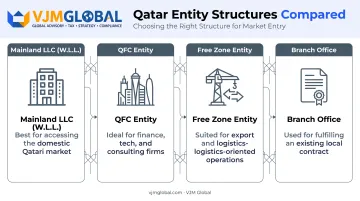
Canadians commonly use one of four formats:
- Mainland LLC (W.L.L.) — for businesses needing access to the domestic Qatari market
- QFC entity — suited to finance, tech, and consulting firms operating onshore in Doha
- Free Zone entity — for export-oriented logistics or manufacturing operations
- Branch Office — when an existing Canadian company is fulfilling a specific Qatar-based contract instead of forming a new legal entity
What Canadian Entrepreneurs Should Know Before Starting a Business in Qatar
Canadian founders often underestimate how much documentation, certification, and in-person work is involved, even though much of the process is now digital.
Documentation and Certification
MOCI requires that documents issued outside Qatar be duly certified before submission. For a Canadian applicant, this typically means:
- Passport copies
- Corporate registration papers from Canada (federal CBCA or provincial incorporation records)
- Board resolutions authorizing the Qatar entity
Confirm the exact certification chain (apostille versus consular legalization) with MOCI or a formation partner before you assemble documents. Requirements can shift by activity type.
Physical Presence Requirements
Most filing steps happen through the Single Window portal remotely. But bank account opening and visa stamping typically require someone physically present in Qatar. Founders who plan to run everything from Toronto or Calgary without a single trip usually hit delays here.
Regulated vs. Fully Open Activities
Not every activity qualifies for the full 100% ownership rule. Banking, insurance, natural resource exploitation, and commercial agencies sit outside the general policy and may need extra ministerial approval or a different structure. Check your specific activity code before assuming a straightforward path.
Standalone Entity vs. Branch
A branch office is treated as an extension of your existing Canadian company, not a new local entity. That structure works well if you are fulfilling a fixed Qatar contract. A standalone Qatar company makes more sense if you plan ongoing local operations.
Why Canadian Businesses Are Choosing Qatar (When It Makes Sense)
Qatar isn't a fit for every Canadian business. But under the right conditions, the numbers make a strong case.
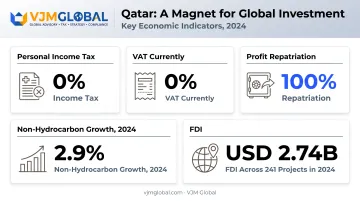
- No personal income tax on salaries and wages, improving founder take-home pay relative to Canadian rates
- No VAT currently in effect, though a future 5% VAT has been discussed without a confirmed date
- 100% profit repatriation to Canada, with no capital controls restricting CAD/QAR transfers
- Non-hydrocarbon sector growth of 2.9% in the first three quarters of 2024, according to IMF Article IV data, signalling genuine economic diversification
- Qatar attracted USD 2.74 billion in FDI across 241 projects in 2024, per Invest Qatar's reporting
- Vision 2030 funding priorities favour technology, logistics, and professional services, sectors where Canadian consultants and tech founders already have strong credentials
That demand is measurable and concentrated in specific sectors. It is not a blanket opportunity across every industry.
Early Decisions That Matter for Canadian Founders
Most delays for Canadian applicants trace back to two things: picking the wrong entity type, or underestimating how long document certification from Canada actually takes.
Cost and Capital Comparison
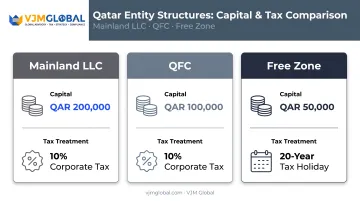
| Structure | Capital requirement | Tax treatment |
|---|---|---|
| Mainland LLC | No official min/max under MOCI; market practice ~QAR 200,000 | 10% corporate tax on profits |
| QFC entity | No minimum capital for non-regulated activities | 10% corporate tax; mandatory QFC registered office |
| Free Zone entity | Activity- and eligibility-dependent | Renewable 20-year corporate tax holiday |
Note the QFC and Free Zone tax treatments differ significantly. QFC carries a standard 10% rate; the tax holiday belongs only to Qatar's free zone regime. Don't confuse the two when comparing options.
Other Decisions That Trip Up Canadian Founders
- Qatari partner requirement: restricted sectors like banking and insurance may need additional structuring beyond a simple LLC
- CAD/QAR remittance planning: map out currency conversion costs before wiring capital, since the Qatari riyal is pegged to USD, not CAD
- Office requirements: Mainland LLCs generally need a physical Qatari office; QFC allows more flexible arrangements
- Local support: a PRO or formation partner handling in-person steps in Doha while you stay in Canada saves multiple flights
How to Start a Business in Qatar as a Canadian – Step by Step
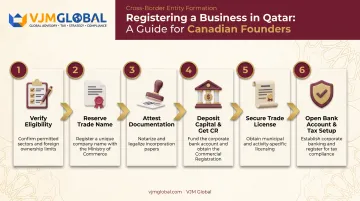
The MOCI Single Window portal consolidates most registration tasks into one digital workflow. Use the sequence below to move from eligibility checks through banking and tax registration.
Common mistakes to avoid:
- Submitting Canadian documents without proper certification
- Choosing Mainland LLC when a QFC entity actually suits a service business better
- Underestimating how long bank KYC checks take for foreign-owned entities
Verify ownership eligibility and choose your activity Check the MOCI activity code list to confirm your business qualifies for full Canadian ownership. Identify whether your activity is "fully open" or "regulated," since regulated activities need ministerial pre-approval before you go further.
Reserve your trade name and lock the legal structure Reserve your trade name through the Single Window portal. The reservation lasts 180 days and can be extended once. At the same time, choose Mainland LLC, QFC entity, Free Zone, or Branch Office based on whether you need domestic market access or will serve regional clients.
Prepare and attest Canadian documentation Notarize and certify Canadian passport copies, corporate registration documents, and board resolutions to MOCI's current attestation chain. Translate your Articles of Association into Arabic or a bilingual format before filing.
Deposit capital and obtain Commercial Registration Deposit share capital into a Qatari bank and obtain a deposit certificate. For Mainland LLCs, many founders use around QAR 200,000 as customary practice, though that figure is not a fixed legal minimum. Submit the CR application with attested documents to receive your Commercial Registration certificate.
Secure the trade license and any sector permits Apply for your activity-specific trade license and establishment card. If the sector needs extra approval (financial services through QFC, healthcare through the Ministry of Public Health), build that review time into your timeline.
Open a corporate bank account and finish compliance setup Open a corporate account with a Qatari bank such as QNB, Commercial Bank, or Doha Bank. Foreign-owned entities often face longer KYC review than domestic applicants. Register with the General Tax Authority through the Dhareeba portal and set your annual compliance calendar from day one.
Conclusion
Starting a business in Qatar as a Canadian is achievable. The 100% ownership rights and tax-friendly regime remove barriers that used to make Gulf expansion a non-starter for smaller Canadian firms. What determines success now is picking the right entity structure early and getting your Canadian documentation properly certified before you submit anything.
A phased approach — confirm eligibility, reserve your name, attest documents, then register — cuts down the delays that trip up most first-time applicants.
VJM Global works with companies expanding into markets across the Gulf, including Qatar, alongside its established Canadian entity formation and compliance practice. For Canadian founders navigating MOCI, QFC, or Free Zone pathways, that cross-border experience on both sides of the transaction helps avoid the documentation gaps that cause the most delays.
Frequently Asked Questions
How much does it cost to start a business in Qatar?
MOCI’s Single Window core start-business service is about QAR 1,700 (registration, legal form, and commercial permit). Totals rise with structure choice and any sector approvals.
How to start a business in Qatar as a foreigner?
Use the MOCI Single Window portal to reserve a trade name, file commercial registration with certified documents, get your trade license, then open a corporate bank account. Most filing steps can start remotely.
How to open a company in Qatar free zone?
Through QFZA: apply and clear eligibility, agree property terms, register the entity, sign the lease, then license. Set up as an LLC or branch—common for logistics, manufacturing, and export businesses.
Can a foreigner own a company in Qatar?
Yes. Law No. 1 of 2019 allows up to 100% foreign ownership in most sectors. Banking, insurance, natural resources, and commercial agencies remain restricted.
What business is best to start in Qatar?
Technology, consulting, logistics, and professional services best match Vision 2030 priorities. Professional services alone were about USD 6 billion, or 3.1% of GDP, in 2022.
What is an LLC company in Qatar?
Qatar’s common LLC form is the W.L.L., widely used by foreign investors including Canadians. MOCI sets no fixed minimum capital; many founders still capitalize around QAR 200,000.