
It's not just multinationals making the move. Tech founders, e-commerce sellers, independent consultants, and established Canadian SMEs are all exploring UAE company formation, drawn by 100% foreign ownership, a low corporate tax rate, and direct access to markets across the Middle East, Africa, and South Asia that are far harder to reach from Toronto or Vancouver.
This guide walks through exactly how a Canadian founder can register and operate a UAE business, without relocating full-time, while avoiding the mistakes that slow most people down.
TL;DR
- Foreigners, including Canadians, can own 100% of a UAE business in free zones and most mainland sectors
- Free zone, mainland, and offshore structures each suit different goals; choose based on target market and banking needs
- Registration is often remote, but opening a UAE corporate bank account usually requires travel or residency
- Setup costs typically run AED 15,000–30,000+, depending on licence type, visas, and office space
- Full setup, from structure selection to being fully operational, generally takes 4–8 weeks
What Is a UAE Business Setup?
A UAE business setup is the process of legally establishing a licensed entity (mainland, free zone, or offshore) that lets a foreigner trade, invoice, and operate under UAE law. It's more than registering a name. You need an actual trade licence from a Department of Economic Development (DED) or a specific free zone authority.
Three structure types dominate UAE setups:
- Free zone LLC/FZE – built for international trade, common choice for Canadian founders selling outside the UAE
- Mainland LLC – required for accessing the local UAE market directly
- Offshore company – used mainly for holding structures and asset protection, not active trading
The UAE Ministry of Economy and Tourism notes that free zone entities can take the form of a free zone LLC, free zone company, or free zone establishment, though not every zone offers every structure. Choosing correctly at this stage avoids a costly restructure later.
What to Know Before You Start a UAE Business as a Canadian
Can Canadians start a UAE business? Yes, without question. The real question is what effort, cost, and banking reality actually look like once you commit.
Time, Travel, and Who Does the Work
Most registration steps can be handled remotely. IFZA, for example, explicitly advertises no physical presence required during incorporation. Bank account opening and Emirates ID processing are different stories. They typically still require an in-person visit.
Many Canadian founders lean on a local formation agent or PRO (Public Relations Officer) service to manage documentation and government liaison, since juggling UAE bureaucracy from a Canadian time zone gets old fast.
Realistic Timeline
Being "incorporated" and being "fully operational" aren't the same thing. A registered company without a bank account can't invoice properly. Budget extra weeks specifically for banking, not just licensing.
Physical Presence Dependency
- Needs UAE presence: retail, food and beverage (F&B), or any model with a storefront or on-site staff
- Can run remotely: consulting, e-commerce, trading, and most professional services
- Hybrid: sales or delivery partners on the ground, with ownership and admin kept offshore or in a free zone
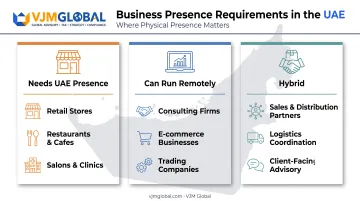
If your model doesn't need boots on the ground in Dubai, a free zone setup usually beats mainland. Even then, treat banking as a separate workstream: non-resident business accounts remain the single most common friction point for Canadian founders comparing the UAE with other jurisdictions.
Why Start a Business in the UAE From Canada? (When It Makes Sense)
UAE setup works under the right conditions. It is not a guaranteed win for every Canadian founder.
Tax structure comparison:
| Factor | UAE | Canada |
|---|---|---|
| Corporate tax (low band) | 0% up to AED 375,000 | 9% federal SBD + provincial |
| Corporate tax (standard) | 9% above AED 375,000 | 15% federal general rate + provincial |
| Personal income tax | 0% | Progressive federal + provincial |
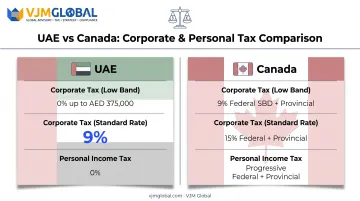
The UAE's corporate tax framework applies to financial years starting on or after 1 June 2023. Compare that to Canada's federal corporate rates, which run 9% federally for CCPCs claiming the small-business deduction, with provincial rates added on top.
Setup usually makes sense when you need a Gulf base for regional clients, expect cross-border revenue you want to repatriate cleanly, or the tax differential on profits booked in the UAE is material versus Canada.
Other reasons Canadian founders expand through the UAE:
- Faster entry into GCC, African, and South Asian markets than building those relationships from Canada alone
- UAE as Canada's top Middle East export market in 2025, with bilateral merchandise trade at CAD $3.5 billion
- Full profit repatriation and no currency controls when revenue regularly crosses borders
- Free zone holding structures for a long-term Middle East presence without over-committing upfront
None of this guarantees success on its own. It just removes several structural barriers that would otherwise slow down a Canadian founder trying to expand internationally.
Early Decisions That Matter Before Registering
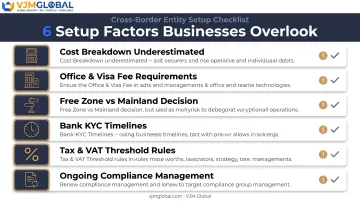
Most Canadian founders underestimate complexity around banking, ongoing costs, and compliance, not the registration paperwork itself. Areas people consistently overlook:
- Full cost beats headline cost: DMCC lists AED 1,035 application, AED 9,020 registration, AED 2,020 Articles of Association, and AED 20,285 annual licence
- Office space, visas, and activity fees stack on top of those registration line items
- Free zone vs. mainland hinges on whether clients sit inside the UAE or are purely international; the wrong choice can force a full re-registration
- Non-resident Canadians often face longer bank KYC timelines and may need to appear in person
- Revenue above AED 375,000 triggers corporate tax registration and mandatory VAT registration
- If you're not in the UAE year-round, someone must handle renewals, filings, and compliance on your behalf This is where a firm like VJM Global typically enters the picture: coordinating UAE registration with a Canadian founder's home-country obligations in one plan.
How to Start a UAE Business From Canada – Step by Step
These stages walk you through UAE setup while you manage the work from Canada. Avoid these mistakes from day one:
- Picking a free zone without confirming your activity is licensable there
- Underestimating bank KYC requirements
- Assuming registration means you're ready to invoice
Step 1 – Choose Your Business Structure and Jurisdiction
Match the structure to where your customers actually are:
- Mainland LLC – for UAE-based clients, licensed through the local DED
- Free zone – for international trade, with zones tailored by industry (DMCC for trading, DIFC for finance, Dubai Silicon Oasis for tech)
- Offshore – for holding structures only, not active trading
Common miss: Choosing a free zone purely on price, then discovering it doesn't support your specific business activity.
Step 2 – Reserve a Trade Name and Get Initial Approval
UAE naming rules are strict. Names can't reference anything offensive, political, or religious, and must reflect the actual business activity. Submit your initial approval application to the relevant DED or free zone authority.
Common miss: Submitting a name that gets rejected, pushing the entire timeline back by days.
Step 3 – Apply for Your Trade Licence
Select the right licence type (commercial, professional, or industrial) to match your actual activity. You'll need:
- Passport copies
- Business plan
- Memorandum of Association
- Proof of address (required by some zones)
Common miss: Underestimating how much documentation a Canadian passport holder needs when there's no local presence backing the application.
Step 4 – Register the Company and Secure an Office or Flexi-Desk
Complete registration with the DED or free zone authority, then finalise your office setup. Some free zones, like DMCC, allow entirely digital registration through their portal. They still require an office address, even if that is only a flexi-desk.
Common miss: Committing to physical office space before confirming how many visas you actually need.
Step 5 – Open a UAE Corporate Bank Account
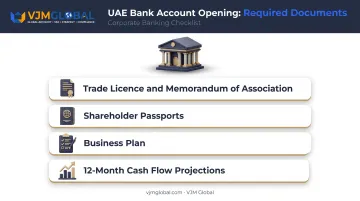
This is where most Canadian founders hit a wall. Required documents typically include:
- Trade licence and Memorandum of Association
- Shareholder passports
- A detailed business plan
- 12-month cash flow projections
Emirates NBD's public requirements confirm the entity must hold a valid UAE trade licence, with passports for partners and signatories, plus Emirates IDs when those individuals are UAE residents.
Common miss: Assuming remote account opening is guaranteed. Most UAE banks still require in-person verification for non-residents.
Step 6 – Apply for Residency Visas (If Relocating or Visiting Frequently)
If you plan to spend meaningful time in the UAE, look at investor or Golden Visa pathways. The UAE government's Golden Visa programme offers up to 10 years for qualifying public investors, though minimum capital thresholds apply. You'll also need an Emirates ID and a medical fitness test.
Common miss: Forgetting to budget visa and Emirates ID costs into your first-year setup budget.
Step 7 – Set Up Corporate Tax, VAT and Compliance Processes
Register for corporate tax once revenue is expected to exceed AED 375,000, and for VAT if your activity requires it. Build bookkeeping and annual filing habits from day one, since some free zones require audited accounts to keep their 0% tax benefit intact.
This is where working with a cross-border firm like VJM Global helps, coordinating UAE compliance alongside whatever you're already filing back in Canada, rather than managing two disconnected systems.
Common miss: Treating UAE compliance as a one-time task instead of an annual renewal and filing cycle.
Conclusion
Starting a UAE business from Canada is achievable, and 100% foreign ownership makes it more accessible than many founders expect. Banking access and total ongoing costs still deserve as much planning as the registration itself.
Getting the structure right upfront—free zone or mainland, chosen for where your customers actually are—saves you from an expensive restructure later. Working with a cross-border advisory firm like VJM Global can shorten the timeline and reduce compliance risk for Canadian founders managing setup from a distance.
Frequently Asked Questions
Can a foreigner open a business in the UAE?
Yes. 100% foreign ownership is permitted in free zones and most mainland sectors, with no requirement for a UAE national partner in the vast majority of business activities.
How much money do I need to start a business in the UAE?
Costs vary significantly by free zone and activity, but expect a realistic range of AED 15,000–30,000+, covering the trade licence, office or flexi-desk, and visa fees.
Can I open a business in Dubai if I don't live there?
Mostly, yes. Registration can largely be completed remotely, but banking and certain visa steps typically require at least one in-person visit.
Can I start a business from home in the UAE?
Yes. Many free zones allow virtual or flexi-desk setups, particularly well-suited to consulting and e-commerce businesses run remotely.
What is the cheapest business to start in the UAE?
Asset-light services such as consulting, e-commerce, and trading in cost-effective free zones tend to have the lowest overall setup costs.
What business is best to start in the UAE?
It depends on your industry expertise, but trading, tech, consulting, and logistics all have strong free zone support and clear relevance to Canada-UAE trade patterns.