
For Canadian entrepreneurs, the UK offers something few other markets can: a shared language, a common-law system that mirrors Canada's own legal heritage, and a company registration process that's entirely digital, no UK residency needed.
This guide walks through exactly what a Canadian founder needs to know: eligibility, visas, banking, tax, and the mechanics of registering a UK company from home.
Key Takeaways
- Canadians can own and direct a UK limited company with zero residency requirement
- Company registration is legally separate from the right to live or work in the UK
- You must have a UK registered address, at least one director, and Companies House plus HMRC registration
- A UK business bank account isn’t required to incorporate—but you need one to trade smoothly
- Cross-border firms like VJM Global can manage formation, tax, and banking logistics end to end
Can a Canadian Start a Business in the UK?
Yes. Any Canadian citizen, whether living in Toronto or London, can register and fully own a UK company. There's no nationality restriction and no residency test attached to company ownership.
Here's the distinction that trips people up: forming a company is not the same as being allowed to work in the UK day-to-day. You can own 100% of a UK Ltd from your kitchen table in Vancouver. Working in that business day-to-day from inside the UK is a separate question, and it depends on your immigration status.
Canadian founders generally choose from three structures:
- Sole trader — simplest setup, but no liability separation from your personal assets
- Partnership — shared ownership and shared liability between two or more people
- Limited company (Ltd) — separate legal entity, limited liability, and generally more credible with UK banks, suppliers, and customers
Most non-resident founders go with a limited company. It protects personal assets and looks more credible to UK banks, suppliers, and clients than an unfamiliar overseas entity.
Why Canadians Are Choosing to Start a Business in the UK
A UK company only makes sense under the right conditions. Here's what actually tips the scale for Canadian founders.
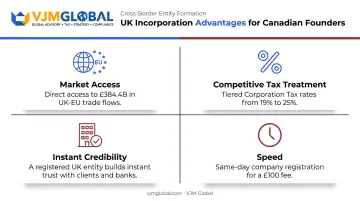
Market access. The UK remains a launchpad into Europe and beyond. UK exports to the EU hit £384.4 billion in 2025, accounting for 41.3% of all UK exports. A UK-registered entity gives Canadian e-commerce, consulting, and SaaS founders a foothold that's harder to build from Toronto or Calgary alone.
Competitive tax treatment. UK Corporation Tax runs on a tiered system:
| Profit Level | Rate |
|---|---|
| Below £50,000 | 19% |
| £50,000 – £250,000 | 19–25% (marginal relief) |
| Above £250,000 | 25% |
R&D-intensive SMEs can also claim enhanced relief, including a payable credit worth up to 14.5% of surrenderable loss under the current merged R&D scheme.
Instant credibility. A UK company number and registered address carry weight with UK and European B2B clients who'd otherwise be wary of invoicing an unfamiliar Canadian entity.
Speed. Online applications through Companies House are typically processed within a day, for a £100 fee. No notary trips, no in-person appointments.
What to Know Before You Start
Many Canadians blur "registering a company" with "gaining UK work rights." These are two separate legal tracks, and confusing them causes real problems later.
Owning vs Working: Do You Need a Visa?
No visa is required simply to register or remotely own a UK company from Canada. You can incorporate, hold shares, and act as sole director without ever setting foot in the UK.
Things change if you want to relocate and actively run the business on UK soil. Relevant routes include:
- Innovator Founder visa — endorsed business idea from an approved body, plus at least £1,270 in maintenance funds held for 28 days
- Global Business Mobility (UK Expansion Worker) — for an overseas business opening a UK branch; you must already be a senior manager or specialist earning at least £52,500
- Skilled Worker sponsorship — an employer (including your own UK company once it holds a sponsor licence) must issue a Certificate of Sponsorship
None of these are optional extras. If your growth plan includes physically working from the UK, sort the visa question before you sort the logo.
Tax and Banking Realities
UK company profits are subject to UK Corporation Tax regardless of where the director lives. That part's non-negotiable. What gets complicated is how that income is treated back in Canada.
The Canada-UK tax treaty generally taxes business profits only where the enterprise is resident, unless you have a permanent establishment on the other side.
Director remuneration is treated as employment income under the treaty. Double-tax credits are available, but they are not automatic—have a cross-border accountant review the position before you file.
Banking has its own friction. Some providers welcome non-resident directors; others don't.
Tide, for instance, allows applicants outside the UK if they direct a Companies House-registered company. Revolut's eligible-residence list for UK company applicants doesn't currently include Canada.
Fintech alternatives such as Wise are often more flexible for overseas founders, though they typically operate as e-money providers rather than full banks.
How to Start a UK Business as a Canadian – Step by Step
Getting a UK company live takes six practical stages. Avoid two common missteps upfront: skipping the three-month Corporation Tax registration window, and assuming your registered address doubles as a work permit. It doesn't.
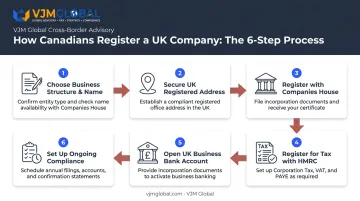
Step 1 – Choose Your Business Structure and Name
Weigh liability exposure against setup complexity:
- Sole trader — easiest, but no asset protection
- Limited company — separate legal entity, better credibility with UK banks and clients
- Partnership — shared control, shared risk
Once you've settled on a structure, run a name check through Companies House to confirm it's not already taken and doesn't clash with existing trademarks.
Step 2 – Secure a UK Registered Address
Every UK company needs a physical UK address on file. PO boxes are no longer accepted. The address must sit within the same UK jurisdiction where you're registering.
For Canadian founders with no plans to relocate, a virtual office or registered address service is the practical fix, giving you a compliant UK mailing point without renting real office space.
Step 3 – Register with Companies House
You'll need to submit:
- Director information (a Canadian can serve as sole director, no UK co-director required)
- Shareholder details and share structure
- A SIC code describing your business activity
- Memorandum and Articles of Association
Online applications are usually processed within one business day.
Step 4 – Register for Tax with HMRC
Once trading begins, you have three months to register for Corporation Tax with HMRC. Miss that window and penalties follow.
If taxable turnover is projected to exceed £90,000, VAT registration applies too. Overseas businesses supplying into the UK may need to register regardless of turnover.
Step 5 – Open a UK Business Bank Account
Non-resident applicants typically need:
- Proof of identity (passport)
- Proof of address
- Certificate of incorporation
- A business plan or activity summary
Traditional banks tend to scrutinise non-resident applications more heavily. Fintech providers often move faster, though eligibility varies by platform, so check current terms before committing.
Step 6 – Set Up Ongoing Compliance and Accounting
Annual obligations don't stop after incorporation. You'll need to file:
- A confirmation statement every 12 months (due within 14 days of the review period ending)
- Statutory accounts (first accounts due 21 months after incorporation)
- Corporation Tax returns via form CT600
VJM Global’s Canada and UK teams handle formation through ongoing cross-border tax compliance. That support helps Canadian founders hit filing deadlines and avoid accidental double taxation.
Conclusion
Registering a UK company as a Canadian is straightforward. The harder part is everything around it: visa planning if you intend to work there directly, understanding how the Canada-UK tax treaty applies to your situation, and finding a bank that will open an account for a non-resident director.
Founders who map out these three areas before incorporating, or work with a cross-border firm such as VJM Global on UK entity formation and Canada-UK tax, sidestep the delays that catch most first-timers off guard.
Frequently Asked Questions
Can a non-citizen start a business in the UK?
Yes. There's no residency or citizenship requirement to register a UK company. You just need a valid UK registered address and the standard incorporation details.
Do I need a visa to register a company in the UK as a Canadian?
No visa is needed to register or own the company from Canada. You'll only need one if you plan to relocate and actively work in the business inside the UK.
Can I open a UK business bank account from Canada?
It's possible, though it often involves extra verification since you're a non-resident director. Fintech alternatives like Wise or Tide tend to be more accommodating than traditional high street banks.
Will I be taxed in both Canada and the UK?
The Canada-UK tax treaty prevents most double taxation, but the rules around permanent establishment and director remuneration can be complex. Professional cross-border tax advice is strongly recommended before you file.
What's the fastest way to register a UK company as a non-resident?
Online registration through Companies House—directly or via a formation agent—is usually done within a day. Have your documents and UK registered address ready in advance.
Can I be the sole director and shareholder of my UK company as a Canadian?
Yes. There's no requirement for a UK-resident co-director or co-shareholder. You can hold both roles entirely on your own.