Introduction
Dutch entrepreneurs are looking past Europe's saturated markets, and Qatar keeps coming up in the conversation. The reasons aren't hard to see: no personal income tax, a 10% corporate rate, and a post-World Cup infrastructure legacy that's still paying dividends for logistics and consulting firms.
Qatar's ownership reforms have made this shift possible. Under Law No. 1 of 2019, foreign investors can now hold 100% of companies in multiple sectors, though banking, insurance, and a handful of other activities remain restricted.
That single change removed a major barrier for Dutch SMEs, trading companies, and consultancies that previously needed a local partner just to get started.
This guide walks Dutch founders through the practical steps: structuring, registering, and running a Qatar entity while staying compliant back home.
TL;DR
- Qatar allows up to 100% foreign ownership in many sectors; eligibility depends on activity.
- Choose Mainland (MoCI), Free Zone (QFZA), or Qatar Financial Centre (QFC) for setup.
- Register digitally via Qatar's Single Window; banking and licensing can add weeks.
- The Netherlands-Qatar tax treaty governs dividend and profit tax on repatriation.
- Plan translations and cross-border filings early to avoid documentation delays.
What Does It Mean to Start a Business in Qatar from the Netherlands?
In simple terms, it means legally registering a commercial entity in Qatar while your ownership, management, or parent company remains in the Netherlands. This doesn't necessarily mean relocating.
Some founders manage everything remotely. Others move to Doha to run day-to-day operations. Both are common, and the right approach depends on your business activity.
Typical structures Dutch founders use:
- A Qatar branch of an existing Dutch B.V.
- A new standalone Qatar LLC or Qatar Financial Centre (QFC) entity
- A representative office for market research and networking before committing further
What Dutch Entrepreneurs Should Know Before Starting a Business in Qatar
Many Dutch founders underestimate two things: the licensing process and the Arabic documentation requirements. Use this section to set realistic expectations before you commit time or capital.
Time, Travel, and Presence Requirements
Some approvals move quickly online through Qatar’s Single Window portal. Others, particularly notarizations and bank account setup, may require you to be physically present in Qatar. Budget for at least one trip during setup.
Key questions to answer early:
- Does your activity qualify for 100% foreign ownership, or does it need a local sponsor?
- Can the business run remotely (consulting, QFC-based services), or does it need boots on the ground (trading, retail)?
- Are you building a lean holding structure, or a fully staffed Qatar operation?
Realistic Timelines
Build your plan around staged timelines, not a single go-live date:
- Registration: Single Window filing typically takes 2–4 weeks once documents are complete
- Licensing and banking: Approvals and account onboarding usually run longer, with no universal published timeline
- Buffer: Plan for delays rather than the fastest-case scenario
Why Start a Business in Qatar as a Dutch Entrepreneur? (When It Makes Sense)
Qatar expansion isn't automatically the right move for every Dutch business. It makes sense under specific conditions.
It tends to fit when you need GCC market access, a low-tax trading or services base, or a regulated platform for financial or professional work.
The economic case:
- Zero personal income tax and a flat 10% corporate tax on net profits
- Bridge position between European trade routes and the GCC, Asia, and Africa
- IMF data shows 1.4% growth in the first three quarters of 2024, with medium-term growth projected near 4.75%
- Generally no withholding tax on dividend repatriation to the Netherlands
- Sector incentives for IT, logistics, consulting, and financial services under the Qatar Financial Centre (QFC) and Free Zones
That growth projection matters because it signals Qatar isn't relying solely on hydrocarbons. Manufacturing, logistics, tourism, and digital services are part of the diversification push, which broadens the opportunity beyond energy-linked trading.
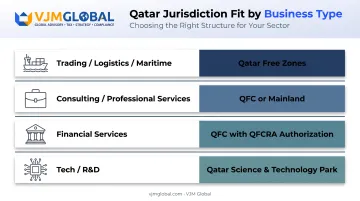
Where the fit is strongest:
| Business type | Best-fit jurisdiction |
|---|---|
| Trading, logistics, maritime | Qatar Free Zones (QFZ) |
| Consulting, professional services | QFC or Mainland |
| Financial services | QFC (with QFCRA authorization) |
| Tech, R&D | Qatar Science & Technology Park (QSTP) |
Early Decisions That Matter for Dutch Founders Entering Qatar
Most delays trace back to two things: picking the wrong jurisdiction, or underestimating what bilingual documentation demands. Here's what founders often overlook.
Setup Costs Add Up Beyond the Headline Fee
Qatar's Ministry of Commerce reduced the standard commercial registration and license fee to QAR 500 in 2024. Home-based business licenses run around QAR 300. But those figures don't include office lease, professional fees, or activity-specific approvals, which vary widely depending on your sector and location.
Matching Structure to Activity
- Trading businesses generally fit Mainland or a Qatar Free Zone (QFZ)
- Services and consulting often suit the Qatar Financial Centre (QFC) or Mainland
- Financial services require QFC plus regulatory approval
Documentation Friction
Two documentation traps slow Dutch filings more than most founders expect:
- Articles of Association usually need bilingual (Arabic/English) drafting from the start
- MoCI naming rules restrict certain words and require checks against existing trademarks
Fix both at the drafting stage—rework later costs time and professional fees.
The Treaty Layer
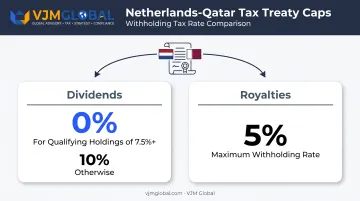
The Netherlands-Qatar double tax treaty, signed in 2008, caps source-state dividend tax at 0% for qualifying direct holdings of at least 7.5%, and 10% otherwise. Royalties are capped at 5%. Those caps shape ownership between your Dutch parent and Qatar entity, so model the treaty position before you lock the structure.
How to Start a Business in Qatar from the Netherlands – Step by Step
Three mistakes come up repeatedly: assuming full ownership applies to every activity, skipping the Single Window eligibility check, and underestimating how long banking takes.
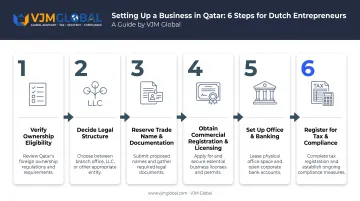
Step 1 – Verify Ownership Eligibility and Choose a Jurisdiction
Check your activity's eligibility for 100% foreign ownership through Qatar's Single Window platform before assuming it applies. Compare Mainland (MoCI), Free Zone (QFZA/QSTP), and QFC based on what your business actually does.
Common miss: Assuming full ownership without checking sector-specific restrictions, then discovering mid-process that a local partner is required.
Step 2 – Decide the Legal Structure Linking the Dutch Entity to Qatar
Choose between:
- Forming a new Qatar LLC
- Setting up a branch of your Dutch B.V.
- Registering a QFC entity
Each option carries different implications for Dutch tax reporting and parent-company liability. A branch, for instance, ties liability more directly to the Dutch parent than a standalone LLC does.
Common miss: Picking a structure that complicates profit repatriation later.
Step 3 – Reserve Trade Name and Prepare Documentation
Reserve your trade name through MoCI or the relevant free zone authority. Names are valid for 180 days, with one extension available.
Next:
- Draft and notarize the Articles of Association, with certified Arabic translation where required
- Prepare Dutch corporate documents (Certificate of Incorporation, KvK extract, Board Resolution) for use abroad
Common miss: Submitting Dutch documents without the legalization or attestation Qatar requires, which sends the application back for correction.
Step 4 – Obtain Commercial Registration and Licensing
Apply for your Commercial Registration (CR) and Trade License. If your activity touches health, engineering, or another regulated area, secure the additional ministerial approval first.
Common miss: Overlooking an activity-specific license requirement, which stalls CR issuance until it's resolved.
Step 5 – Set Up Office Space and Corporate Banking
Secure office space, physical or virtual depending on your jurisdiction's rules. Then open a corporate bank account with a Qatari bank.
QNB's documented checklist for corporate accounts typically includes:
- Commercial Registration (CR) and commercial license
- Articles of Association
- Tax card and partner identification
- Board mandate and FATCA self-certification
Common miss: Assuming bank onboarding moves as fast as registration. There is no fixed published timeline for foreign-owned entities.
Step 6 – Register for Tax and Ongoing Compliance
Register with Qatar's General Tax Authority through the Dhareeba portal. The tax card must be issued within 60 days of the relevant approval or CR event, and returns are due within four months of year-end.
Cross-check your obligations against the Netherlands-Qatar treaty to avoid double taxation on repatriated profits.
Common miss: Filing Qatar returns without aligning the deadlines to your Dutch corporate tax reporting cycle, which creates a scramble at year-end.
Managing the Dutch-Qatar Connection After Setup
Setup is only the start. Keeping your Dutch KvK records and tax filings aligned with the new Qatar entity's reporting matters just as much.
What ongoing management typically involves:
- Renewing trade licences on schedule
- Coordinating audits where applicable
- Planning visa and staffing needs as the Qatar side grows
- Keeping VAT (21% standard rate in the Netherlands), corporate tax, and KvK annual accounts current alongside Qatar's Dhareeba filings
Running two separate finance functions across jurisdictions gets expensive fast. VJM Global provides entity formation and multi-jurisdiction tax compliance support for both the Netherlands and Qatar, so you can avoid building duplicate internal finance teams while you test the market.
Pricing and scope depend on your entity structure and activity, so a tailored quote makes more sense than a flat number.
Conclusion
Starting a business in Qatar from the Netherlands hinges on matching jurisdiction and legal structure to your real activity. Accurate documentation and a clear read on how the Dutch–Qatar tax relationship applies to your setup matter more than registration speed.
Stay compliant in both countries, and revisit the structure as the Qatar side scales. VJM Global helps with Qatar entity formation, cross-border tax structuring, and ongoing compliance so Dutch businesses enter with the right setup from day one.
Frequently Asked Questions
How to start a business in Qatar as a foreigner?
Check foreign-ownership eligibility on the Single Window portal and reserve a trade name. Choose Mainland, Free Zone, or QFC, then secure your Commercial Registration and licence.
How much does it cost to start a business in Qatar?
Expect a range from roughly QAR 15,000 to QAR 50,000+, covering registration, licensing, office rent, and professional fees. The exact figure depends heavily on your activity and chosen jurisdiction.
How much does it cost to get a home business license in Qatar?
Home-based licences cost less than commercial office setups, around QAR 300 for the licence fee itself, though MoCI approval and activity eligibility checks still apply.
Can foreigners start a business in Qatar?
Yes. Many sectors allow up to 100% foreign ownership under Qatar's 2019 reform, though some regulated activities still require a local partner.
Is Qatar a good country to start a business in?
Qatar offers real tax advantages, a strategic location, and steady economic growth. Whether it's a good fit for you depends on your specific activity and readiness for local compliance work.
Which industry is booming in Qatar?
IT, logistics, consulting, and financial services (via QFC) are current growth areas, alongside infrastructure-linked sectors benefiting from continued LNG expansion.