That interest hasn't disappeared, but the landscape has changed dramatically. Since 2022, sanctions, banking restrictions and compliance rules have reshaped what's actually possible for UK nationals and UK companies.
This guide is aimed at UK SMEs with existing supply chains, consultants, e-commerce sellers and larger firms evaluating market entry. We'll walk through the legal structures, registration steps and — critically — the compliance realities that determine whether this is viable for you right now.
Before anything else: current UK sanctions guidance prohibits UK nationals and UK-incorporated companies from making specified new investments connected with Russia, including forming new subsidiaries, joint ventures or representative offices. This applies worldwide, not just to activity conducted from the UK. Read the GOV.UK Russia sanctions guidance in full before taking any practical steps described below.
TL;DR
- Russian law permits 100% foreign ownership; an LLC (OOO) is the standard structure
- Valid residency or a business visa is required for UK nationals to operate a business in Russia legally
- Registration typically takes 2 weeks to 1.5 months once documents are ready
- UK sanctions and banking limits are the main barrier, far more than the registration paperwork
- Specialist cross-border compliance advice is essential before you commit capital or open accounts
What Does Starting a Business in Russia From the UK Involve?
In practical terms, it means registering and legally operating a Russian entity, branch or representative office as a UK national or UK company, subject to both Russian company law and current UK sanctions regimes. It does not cover visa sponsorship or relocation services — those sit outside company formation entirely.
Common structures include:
- LLC (OOO) — the default choice for most SMEs, governed by Federal Law No. 14-FZ
- Sole proprietorship (IP) — available to individuals, but only with Russian residency
- Branch or representative office — an extension of an existing UK company, recognised under Civil Code Article 55
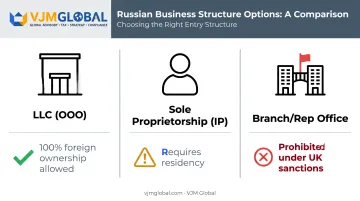
Sanctions constraint: Under UK sanctions guidance, opening a representative office or branch, or forming a subsidiary, is among the specifically prohibited new investments for UK entities.
What to Know Before You Start a Business in Russia as a UK Founder
Most UK founders underestimate the immigration and banking friction involved. Both are usually far more disruptive than the registration paperwork itself.
Immigration Status Comes First
You need the right status before you can register anything:
- A sole proprietorship (IP) requires a temporary or permanent residence permit — a UK passport alone isn't enough
- An OOO founded by a foreign national or foreign company needs documented proof of legal status, though residency requirements are less rigid than for an IP
- A business visa may cover short-term registration activity, but ongoing operation typically needs a stronger status
Banking Is the Real Obstacle
Since December 2023, UK Regulation 17A bars UK banks from processing payments routed through designated Russian banks. Correspondent banking access for the wider sector remains severely constrained (OFSI, 2023).
SWIFT readmission for sanctioned banks is not on the table either. As of March 2025, German officials confirmed no such plans exist.
In practice: even a properly registered Russian entity may struggle to move money in and out through UK banking channels.
Other Practical Realities
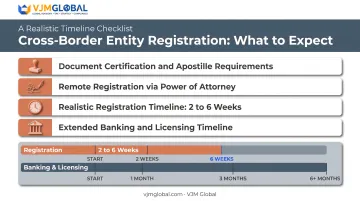
- UK-issued identity and corporate documents generally need certification before Russian authorities will accept them — confirm exact requirements with your Russian notary, as this varies by document
- Remote registration via power of attorney is possible through electronic filing, notary routes, or postal submission. Notarial or electronic-signature formalities still apply
- Realistic timeline: 2-6 weeks for registration alone; banking and licensing take considerably longer
Why UK Entrepreneurs Still Consider Russia (When It Makes Sense)
This is not a blanket recommendation. It sets out when market entry has historically looked attractive, even with today's constraints.
- Market size: Russia's resident population stood at roughly 146.1 million as of January 2025 (Rosstat)
- Reduced competition: foreign firms have incurred more than $107 billion in writedowns and losses from Russia exits since 2022, opening gaps in several sectors (Reuters, 2024)
- Full foreign ownership: Russian law permits 100% foreign ownership of an OOO, with no local partner requirement
- Historical ease-of-entry: Russia ranked 28th in the World Bank's 2020 Doing Business report, before the ranking was discontinued in 2021 — useful context, not a current score
Labour costs are often cited alongside these factors, but UK–Russia wage figures differ so much by methodology (mean versus median, monthly versus annual) that a direct ratio is not reliable. Treat any such comparison with caution.
Early Decisions That Matter for UK Founders Entering Russia
Most friction stems from underestimating sanctions exposure and banking limitations, not the registration forms themselves. Areas founders commonly overlook:
- True banking cost: maintaining any UK-Russia payment channel under current restrictions often costs more in fees, delays and workaround complexity than most founders budget for
- Sector-specific licensing: UK export controls cover military and dual-use items, critical-industry goods, advanced materials, energy technology and more. Restrictions can apply even to indirect supply via a third country
- Legal address arrangements: a registered address must be genuine and usable; Russia's Federal Tax Service (FTS) flags "absence at declared address" as grounds for an unreliability entry in the company register
- Local representation: day-to-day compliance depends heavily on a local legal or accounting representative if the founder can't be physically present
- Currency friction: factor remittance and conversion friction into any break-even timeline — it changes the maths considerably
How to Start a Business in Russia From the UK – Step by Step
Registration breaks into six sequential stages. Common mistakes include skipping legal address verification, underestimating document translation timelines, and failing to screen the intended business activity against sanctions lists before choosing it.
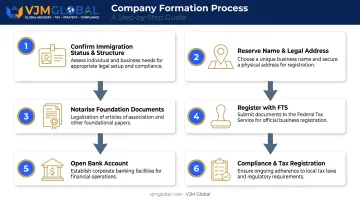
Step 1 – Confirm Immigration Status and Choose a Legal Structure
Decide between an LLC (OOO), sole proprietorship (requires residency), or branch/representative office. Confirm whether a residence permit, business visa, or power of attorney route fits your situation.
Common miss: assuming a UK passport alone allows registration without addressing residency or visa requirements first.
Step 2 – Reserve Company Name and Secure a Legal Address
Check name availability through the Federal Tax Service (FTS) database, then arrange a legal address — either rented office space or a virtual office provider.
Common miss: using a residential address that fails registration verification checks.
Step 3 – Prepare and Notarise Foundation Documents
- Draft the charter and founding agreement, specifying shareholder contributions and legal responsibilities
- Certify and translate UK-issued identity and corporate documents as required
- Deposit minimum charter capital — 10,000 RUB — into a Russian bank account, payable no later than four months after registration
Common miss: submitting improperly certified UK documents, which causes registration delays or refusals.
Step 4 – Register With the Federal Tax Service (FTS)
Submit your application, foundation documents and proof of the registration fee. Statutory processing is no more than three working days once documents reach the FTS. You'll receive an Incorporation Certificate, Tax Certificate, INN and OGRN.
Common miss: incomplete documentation, leading to refusal under Federal Law No. 129-FZ.
Step 5 – Open a Corporate Bank Account and Set Up Operations
Open a Russian corporate account using your incorporation and tax documents, then establish basic accounting workflows compliant with Russian tax authority requirements.
Common miss: assuming existing UK banking relationships translate smoothly. They generally don't — correspondent banking restrictions and SWIFT access constraints mean UK-linked entities face real practical friction here.
Step 6 – Address Compliance, Licensing and Tax Registration
Apply for sector-specific licences via the Gosuslugi portal or a Multifunctional Centre, and register for VAT and corporate tax. Russia's main corporate profit tax rate rose to 25% from 1 January 2025, with quarterly or monthly advance payments due by the 28th of the following month.
If you keep a UK entity alongside the Russian one, plan for two filing calendars from day one. Keep Companies House and HMRC obligations in view, and use local Russian counsel for FTS filings, licensing and statutory accounts so cross-border tax positions stay aligned.
Common miss: overlooking the ongoing quarterly and monthly reporting obligations that follow initial registration.
Conclusion
Registering a Russian business as a UK founder is procedurally straightforward on paper. Banking access, sanctions exposure and ongoing compliance are what actually determine whether the venture works.
Lock in the foundations early:
- Immigration status sorted before you rely on local directors or site visits
- A valid legal address and complete registration file
- A realistic plan for bank onboarding under current restrictions
After launch, review banking arrangements and sanctions exposure on a fixed schedule — Russia is not a set-and-forget market.
Frequently Asked Questions
Can a UK citizen own 100% of a business in Russia?
Russian law permits full foreign ownership of an LLC (OOO), subject to sector-specific restrictions under Federal Law No. 57-FZ for strategically important industries. Current UK sanctions guidance must also be checked before proceeding.
What documents do I need to register a business in Russia?
You'll need the company charter, founder identification documents, proof of legal address, and certified translations of UK-issued documents. Exact certification requirements vary by document type and should be confirmed with your Russian notary.
How long does it take to register a company in Russia?
Registration typically takes 2 weeks to 1.5 months, depending on structure and whether you're filing remotely or in person. The FTS itself processes complete applications within three working days of receipt.
Do I need to travel to Russia to start a business there?
Remote registration via power of attorney is possible through electronic filing, notary routes or postal submission. Notarial or electronic-signature formalities still apply regardless of the filing method.
What is the minimum share capital needed to open a company in Russia?
The minimum charter capital for an LLC is 10,000 RUB, payable by each founder no later than four months after registration is completed.
How are UK businesses affected by sanctions when operating in Russia?
UK sanctions restrict new investments, subsidiaries, joint ventures and representative offices connected with Russia. Correspondent banking limits since December 2023 also severely constrain payment processing. Specialist compliance advice is essential before proceeding.