But "legally allowed" and "practically feasible" are two very different questions right now. EU sanctions on Russian banking, energy, and professional services have reshaped what's actually workable for Dutch-owned businesses.
This article covers legal eligibility, the entity types available, the registration process, tax obligations, and the real-world obstacles Dutch companies need to evaluate before committing capital. Given how fast sanctions lists change, treat the legal framework as stable and the sanctions landscape as something to verify the week you plan to act.
Key Takeaways
- Dutch founders can own 100% of a Russian LLC (OOO) with no residency requirement
- Skip sole proprietorship (IP): it needs Russian residency, so it is off-limits for most Dutch owners
- Treat the Netherlands–Russia tax treaty as gone — terminated on 1 January 2022, not suspended
- Plan around EU sanctions and correspondent banking limits; those block deals more than Russian company law
- Budget for cross-border tax, apostille, and sworn translation support in both countries
Can Dutch Businesses Legally Start a Company in Russia?
Yes. Under Federal Law No. 160-FZ, foreign investors—including Dutch nationals and companies—receive the same "national legal regime" as Russian citizens for business formation. A Dutch company can own 100% of a Russian entity's shares without a local partner.
Who can register what still matters:
- LLC (OOO) or Joint Stock Company founders can remain based in the Netherlands. No Russian residency needed.
- Individual entrepreneurs (IP) must hold a Russian residence permit, which makes this route impractical for most Dutch business owners.
National treatment doesn't override Russia's public-interest and security exceptions. A separate law on strategic-sector investments (57-FZ) was expanded in 2026, adding another screening layer for certain acquisitions.
The Tax Treaty Problem
Structuring decisions historically leaned on the Netherlands-Russia double taxation agreement. That treaty is gone: Russia formally denounced it, and it stopped applying from 1 January 2022.
Dividend, interest, and royalty flows between the two countries no longer get treaty-reduced withholding rates. That changes the maths on any Dutch holding structure.
Which Business Structures Are Available to Dutch Investors in Russia?
Dutch investors can choose among several Russian structures. The right fit depends on capital, liability protection, ownership split, and whether you need full operations or only a local presence.
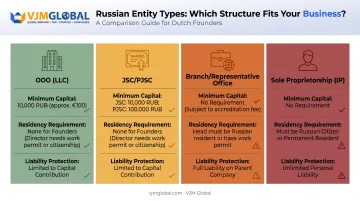
Limited Liability Company (OOO)
This is the standard choice for foreign investors entering Russia.
- Minimum charter capital: RUB 10,000
- Shareholders’ liability limited to their capital contribution
- No residency requirement for founders
- A Dutch parent company can be the sole shareholder
- Directors can manage the entity remotely from the Netherlands
For most SMEs and mid-sized companies, the OOO is the entry point that balances simplicity with legal protection.
Joint Stock Company (JSC/PJSC)
JSCs suit larger investments where ownership will be split among multiple shareholders.
- Non-public JSC minimum capital: RUB 10,000
- PJSC minimum capital: RUB 100,000
- More registration formalities than an OOO
- Rarely the right fit for a first-time SME entry
Branch or Representative Office
A branch or representative office gives a Dutch company a non-independent legal presence in Russia. It suits liaison or representative work rather than full commercial operations.
- Requires accreditation through Russia’s tax authority before operating
- Accreditation fee for a non-EAEU parent: around RUB 120,000 per unit
- Not a separate legal entity from the Dutch parent
Sole Proprietorship (IP)
Technically available, but requires a Russian Temporary or Permanent Residence Permit. For a Dutch business owner staying based in the Netherlands, this route is essentially off the table.
Registration Process and Documents Required
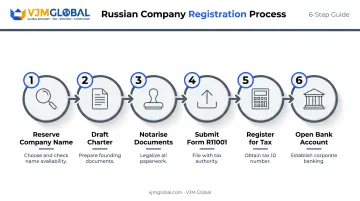
Russia's registration authority (FNS) processes standard LLC filings quickly on paper. The core steps:
- Reserve a company name and confirm it's not already in use
- Draft the charter (standard template or bespoke)
- Notarise required documents
- Submit for state registration via Form R11001
- Register for tax purposes
- Open a bank account
Dutch corporate founders need to prepare:
- Apostilled extract from the Dutch trade register (KVK)
- Translated and notarised Articles of Association
- Power of attorney for a local representative
FNS states registration itself takes just 3 working days. That figure is misleading: it covers paperwork processing only, not the full path to an operating company.
Banking compliance checks—driven by sanctions screening and KYC—are the real bottleneck. Get written confirmation of bank and payment feasibility before you incorporate, not after.
Taxation and Ongoing Compliance for Dutch-Owned Companies
Current standard rates for a Russian entity:
| Tax | Rate | Notes |
|---|---|---|
| Corporate profit tax | 25% (8% federal, 17% regional) | Standard regime |
| VAT | 22% | Standard rate |
| Dividend withholding (to foreign parent) | 15% | No treaty relief available |
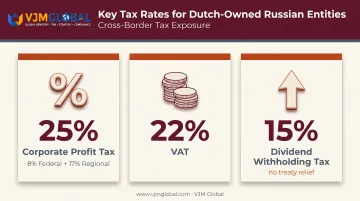
Because the Netherlands-Russia treaty no longer applies, dividends paid to a Dutch parent face the full 15% domestic withholding rate. Structuring decisions need Dutch-side tax advice on whether unilateral relief can offset that cost.
Simplified taxation system (USN): Qualifying small companies can use a simplified regime. Key 2026 limits include:
- Income ceiling of roughly RUB 490.5 million
- Headcount cap of 130 employees
- Participation by other organisations generally limited to 25%
A Russian OOO wholly owned by a Dutch parent typically fails the ownership test, even when income and staff numbers qualify.
Ongoing statutory reporting, payroll compliance, and tax filings in Russia are rarely practical for a foreign owner to run alone. VJM Global supports multinational clients with cross-border accounting, tax compliance, and entity management across shifting regulatory regimes.
Key Challenges Dutch Businesses Should Evaluate Before Entering Russia
Sanctions and banking are the primary obstacle. International restrictions on correspondent banking, along with the EU's rolling sanctions packages, now limit Dutch-Russia business far more than Russian company law does.
Recent EU measures have added restrictions on financial institutions, crypto platforms, and specific trade sectors. Verify the latest package before any transaction—not only before incorporation.
Beyond sanctions, practical friction points include:
- Bureaucratic processes that move slower than the 3-day registration figure suggests
- Cultural and market differences that catch first-time entrants off guard
- Limited free government advisory support for foreign investors
- Sector-specific restrictions that shift with each new sanctions package
Retail, transport, real estate, IT, and services have historically been cited as profitable areas for foreign entrants.
Several of these now carry sanctions exposure for EU-owned businesses—particularly IT and professional services, where certain advisory work to Russian entities is restricted outright. Sector viability needs a fresh check, not a five-year-old assumption.
Foreigners, including Dutch nationals, can generally purchase and own real estate in Russia. Exceptions apply to specific border territories and seaport boundary zones, and agricultural land can only be leased—not owned outright—by foreign-controlled entities.
Frequently Asked Questions
Can a foreigner start a business in Russia?
Yes. Under national treatment law, foreigners can register an LLC without needing residency. Sole proprietorship is the exception, since it requires a Russian residence permit.
Which businesses are profitable in Russia?
Retail, IT, logistics, and real estate have historically performed well for foreign entrants. Verify current sector-specific sanctions restrictions before committing capital, as several of these sectors now carry exposure.
Are foreigners allowed to own property in Russia?
Generally, yes. Exceptions exist for certain border territories and seaport zones, and agricultural land can only be leased by foreign-controlled entities rather than owned.
Do Dutch companies need a local partner to register a business in Russia?
No. An LLC can be 100% owned by a Dutch company or individual, with no mandatory local partner.
How long does it take to register a company in Russia?
Formal registration itself takes about 3 working days. Banking compliance and account activation, driven by sanctions screening, often stretch the real timeline by weeks or months.
Is it currently advisable for Dutch companies to invest in Russia given sanctions?
Company-law permission does not mean the investment is workable in practice. Sanctions and banking restrictions mean you need full due diligence—not only a registration check—before moving any capital.