If you're based in England, Scotland or Wales, the appeal makes sense. You're working within the same legal framework, but gaining a foothold near both UK and EU-adjacent markets, with genuine cross-border trade opportunities into the Republic of Ireland.
This interest isn't just theoretical. Relocating professionals, remote founders, and GB business owners looking to expand are all asking the same question: how does this actually work? This guide walks through structure, registration, tax and support step by step, specifically for someone starting in NI from elsewhere in the UK.
TL;DR
- Northern Ireland uses the same UK company law as England, Scotland and Wales, with registration and filings through Companies House
- Most founders pick a limited company over sole trader or partnership for liability protection
- Online registration can be completed in as little as 24 hours
- Local bodies (NI Business Info, Go Succeed, Invest NI) cut early-stage risk and cost significantly
- Ongoing Corporation Tax, VAT and compliance obligations match the rest of the UK
What Does Starting a Business in Northern Ireland Involve?
It means registering and operating a legally recognised business entity in Northern Ireland while you remain a UK resident based elsewhere.
Northern Ireland operates under the same Companies Act 2006 regime as the rest of the UK. There is no separate company-law system: filings go through Companies House, and an NI company must show a Northern Ireland registered office and jurisdiction on the public register.
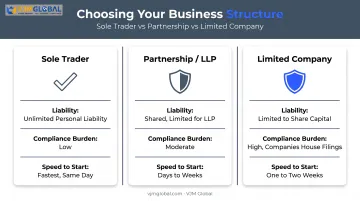
Common structures include:
- Sole trader — fastest to start; you carry full personal liability
- Limited company — separate legal entity with stronger liability protection and more compliance
- Partnership/LLP — shared ownership; an LLP needs at least two members
What to Know Before You Start a Business in Northern Ireland
GB-based founders often assume the process differs more than it actually does. Others underestimate the gap between where they physically live and where their business must be legally registered.
Before you file, get clear on the practical mechanics so your timelines and setup choices stay realistic.
Registered Office and Identity Checks
Your registered office must be a physical Northern Ireland address if you're incorporating there, even if you live in Manchester or Edinburgh. A mail-forwarding-only address is not enough. The location needs to actually receive post and confirm delivery.
Since 18 November 2025, Companies House has required identity verification for all directors and persons with significant control (PSCs). New directors submit a personal code with their appointment filing; existing directors do so with the next confirmation statement.
PSCs get a 14-day window to comply. Miss this, and your company can't file its confirmation statement at all.
Realistic Timelines
- Incorporation: usually within 24 hours online
- Bank account opening: typically longer, often 1-3 weeks
- Tax registration: allow extra time if you need VAT or PAYE
Other Considerations
Check whether your sector needs a specific licence before trading in NI. Also decide whether you need a new NI entity, or whether trading into NI from an existing GB company is enough for your plans.
Why Start a Business in Northern Ireland? (When It Makes Sense)
NI incorporation isn't automatically better than registering in England or Scotland. It makes sense when you want NI-specific funding, free council-level advisory support, lower costs than London, or a base closer to the Republic of Ireland.
Where NI has an edge:
- Dedicated funding access — the NI Small Business Loan Fund and Start Up Loans through Enterprise NI offer routes not uniformly available elsewhere in the UK
- Free advisory support — Go Succeed operates across all 11 local councils, offering Start, Grow and Scale programmes alongside Invest NI's client support
- Proximity to the Republic of Ireland — a practical advantage for anyone eyeing EU-adjacent trade
- Lower operating costs — Invest NI states general costs run 33% lower than London, based on its own promotional benchmarking
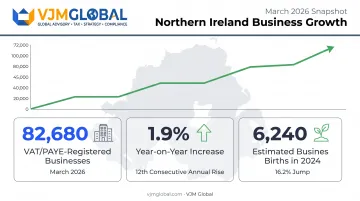
The scale of the local business community backs this up. According to NISRA's business register data, Northern Ireland had 82,680 VAT- and/or PAYE-registered businesses in March 2026, up 1.9% year on year — the twelfth consecutive annual increase.
Business births hit an estimated 6,240 in 2024, a 16.2% jump. The market has grown steadily for over a decade.
Early Decisions That Matter When Registering in Northern Ireland
Most friction for GB residents comes from one wrong assumption: that NI rules mirror England's exactly, address included. They mostly do, but the details matter.
GB founders often overlook these early choices:
- Decide whether to incorporate a fresh NI entity or extend your existing GB company's trade into the region
- Source a genuine NI registered office that meets the delivery-and-confirmation test, not just a mail drop
- Complete identity verification for every director and PSC under Companies House rules, wherever they live
- Budget for business rates on physical premises (Net Annual Value × regional and district rate poundages)
- Use local knowledge for grants, sector licensing, and council support rather than UK-wide guidance alone
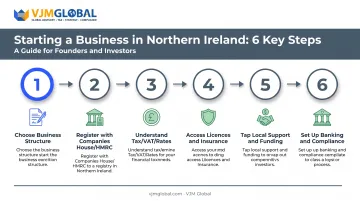
How to Start a Business in Northern Ireland — Step by Step
Here's the practical execution path, broken into stages. Common mistakes along the way include registering with a residential address unnecessarily, delaying tax registration, and skipping local support entirely before launch.
Step 1 – Choose Your Business Structure
| Structure | Liability | Compliance Burden | Funding Access |
|---|---|---|---|
| Sole trader | Personal, unlimited | Low | Limited |
| Partnership | Shared, personal | Moderate | Moderate |
| LLP | Limited | Moderate-High | Moderate |
| Limited company | Limited | High | Best |
Common miss: Defaulting to a limited company without weighing the added filing and reporting obligations that come with it.
Step 2 – Register with Companies House or HMRC
- Sole traders register for Self Assessment with HMRC: free, but required once trading income exceeds £1,000 in a tax year
- Limited companies incorporate via Companies House, currently costing £100 for digital filing, usually processed within 24 hours
Remember: your registered office must be a genuine NI address, not a GB one, if incorporating in Northern Ireland. Directors and PSCs also need to complete identity verification during this stage.
Common miss: Assuming a GB residential or office address is acceptable for an NI-registered company's registered office. It isn't.
Step 3 – Understand Tax, VAT and Business Rates Obligations
- Corporation Tax: 19% on profits below £50,000, 25% above £250,000, with Marginal Relief in between
- VAT: registration required once taxable turnover exceeds £90,000 in a rolling 12-month period
- PAYE: register before your first payday if hiring staff
- Business rates: apply if you're operating from NI premises, collected through Land and Property Services using the NAV-based formula
Common miss: Waiting until turnover exceeds the VAT threshold before registering, rather than planning ahead.
Step 4 – Access Local Licences, Permissions and Insurance
Check whether your sector needs a specific licence. GOV.UK's licence finder and nibusinessinfo's equivalent tool cover most cases, alongside council-specific licensing for things like street trading or entertainment permits.
If you're hiring, employers' liability insurance is generally required, with cover of at least £5 million. Operating without it can attract fines of up to £2,500 per day.
Common miss: Launching before confirming a required licence is actually in place.
Step 5 – Tap Into Local Business Support and Funding
- nibusinessinfo: Invest NI's free official channel, including a step-by-step My New Business service
- Go Succeed: council-led support across all 11 councils, covering Start, Grow and Scale stages
- Invest NI: start-up guidance, export support, and Access to Finance schemes
- Enterprise NI: delivers Start Up Loans (up to £25,000 per owner, capped at £100,000 per business, at 7.5% annual interest) and helps administer the NI Small Business Loan Fund

Common miss: Self-funding everything before checking whether free mentoring or grant funding is available first.
Step 6 – Set Up Banking and Compliance Systems
Open a dedicated business bank account from day one, and set up bookkeeping before your first invoice goes out. Mixing personal and business finances is one of the fastest ways to create a mess later, both for tax filing and for anyone reviewing your accounts.
For founders trading across the border with the Republic of Ireland or wider EU, the compliance picture gets more layered. You're potentially juggling UK Corporation Tax and VAT alongside Irish tax registration, VAT rules, and reporting obligations if you also operate an Irish entity. Multi-jurisdiction compliance support keeps both sets of filings aligned.
VJM Global works with companies expanding across jurisdictions. It handles entity setup, bookkeeping, payroll, VAT and Corporation Tax for UK-registered businesses, plus company registration and tax support in Ireland when cross-border trade is involved. One firm tracking UK and Irish obligations in parallel cuts out most of the manual cross-checking.
Common miss: Treating your business account as an extension of your personal one, especially in the early months.
Conclusion
Starting a business in Northern Ireland follows the same UK legal framework you already know, with a handful of NI-specific details around registration, addresses and support worth getting right from day one. Leaning on local bodies like Go Succeed and Invest NI, and sorting your registered office, tax registration and licensing early, cuts avoidable delays later.
After launch, keep Companies House filings, HMRC registrations and any sector licences current, and revisit your structure as you hire or expand. If you want formation and ongoing UK compliance handled together, VJM Global supports entity setup, tax and governance for businesses entering or operating in the UK market.
Frequently Asked Questions
How do I start a business in Northern Ireland?
Choose your structure, then register with HMRC (sole trader) or Companies House (limited company). From there, access free local support through nibusinessinfo and Go Succeed to guide your setup.
How much does it cost to start a business in Northern Ireland?
Sole trader registration is free. Limited company incorporation costs £100 through Companies House, plus any registered office or professional advice fees.
Can I start a business in Northern Ireland if I live elsewhere in the UK?
Yes. Directors and shareholders can live anywhere in the UK, but if you're incorporating in NI, your registered office must be a genuine physical NI address.
Do I need to register my business in Northern Ireland if I already have a GB company?
Not necessarily. You can trade into NI from your existing GB-registered company, or set up a separate NI entity if local funding, presence or grants matter more to your plans.
What support is available for new businesses in Northern Ireland?
nibusinessinfo, Go Succeed and Invest NI are the main sources of free advice, mentoring and funding signposting. Go Succeed operates through all 11 local councils.
Do I need to pay business rates in Northern Ireland?
Yes, if you're using physical premises. Rates are calculated using the property's Net Annual Value and collected by Land and Property Services on behalf of your local council.