The interest isn't limited to large corporates. UK SMEs, independent consultants, and established companies exploring African footholds are all asking the same question: what does it actually take to set up shop?
This guide walks through the structures, requirements, real costs, and honest timelines UK founders need to budget for.
TL;DR
- 100% foreign ownership is allowed in most sectors; working in your own company still needs a business visa.
- A Private Company (Pty) Ltd is the standard structure for UK-owned businesses entering the market.
- CIPC registration is fast; tax registration, banking, and compliance take considerably longer.
- An Employer of Record (EOR) lets you hire South African talent without incorporating at all.
- Decide early on entity vs EOR, tax registrations, and banking—those choices drive most first-time delays.
What Does Starting a Business in South Africa from the UK Involve?
It means registering and legally operating a South African business entity as a UK-based founder or company.
Incorporation is only step one. The fuller process also covers tax and compliance setup and, if you plan to work inside the business personally, securing the right to do so.
UK founders generally choose from three routes:
- Fully-owned local entity — typically a Pty Ltd, giving you a standalone South African company
- Branch/external company — extending an existing UK company's operations into South Africa
- EOR-based hiring — accessing South African talent without setting up any entity at all
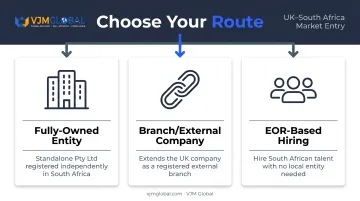
Which route fits depends entirely on whether you need a legal presence or simply need people on the ground.
What to Know Before You Start a Business in South Africa
Before you incorporate, set realistic expectations on effort, cost, and time. The points below are what most often catch UK founders out.
Registration Is Fast, But It's Just the First Step
Incorporating with the Companies and Intellectual Property Commission (CIPC) can happen quickly. However, this is only the beginning of a longer regulatory chain that includes tax registration, banking, and ongoing compliance.
Ownership Doesn't Equal the Right to Work There
Here's a distinction many UK founders miss: owning a South African company does not automatically let you manage or work in it from inside the country. That right comes from immigration status, not shareholding. More on this below.
Banking and Tax Registration Take Weeks
For non-resident-owned companies, SARS tax registration and business bank account opening typically take weeks, not days. Budget accordingly rather than assuming same-week turnaround.
Physical Presence Isn't Always Required
Many UK businesses run South African operations through local staff or an EOR arrangement, without a founder on the ground.
The Tax Numbers You Need
- Corporate income tax: 27%, per SARS's current company tax rate schedule
- VAT: 15% standard rate on registered vendors, confirmed on SARS's VAT guidance page
Foreign-owned companies pay the same figures; share ownership does not change either rate.
Why UK Businesses Are Choosing South Africa (When It Makes Sense)
South Africa isn't an automatically easy market. It's a strong option under the right conditions.
What makes it work for UK founders:
- A skilled, English-speaking workforce in a time zone close enough for real-time collaboration
- A gateway into the broader African market, not only a standalone endpoint
- Lower operating and staffing costs relative to the UK
- Legal, banking, and professional-services infrastructure used to foreign investors
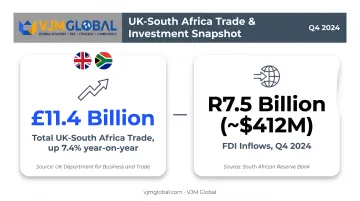
Trade flows back this up. Total UK-South Africa trade hit £11.4 billion in the year to Q4 2024, up 7.4% year-on-year, according to the UK Department for Business and Trade.
Separately, South Africa recorded FDI inflows of R7.5 billion (roughly $412 million) in Q4 2024, per Reuters. Foreign capital is entering the market, not only circling it.
That fit is strongest for UK firms that need English-language operations, a regional African hub, or lower-cost delivery centres. It is weaker for pure domestic SA plays with no regional or cost rationale.
Business Structures and Registration Requirements
Your structure choice shapes liability exposure, tax treatment, and how easily you can actually operate day-to-day.
Private Company (Pty) Ltd
This is the default choice for UK founders. Key features:
- No minimum capital requirement
- Limited liability protection
- Up to 50 shareholders
- No residency requirement for directors or shareholders
Registration runs through CIPC and includes name reservation, filing the Memorandum of Incorporation, and issuance of your registration number.
External Company (Branch Office)
If you already run a UK company and want to extend operations rather than build a new entity, a branch office is the better fit. Registration with CIPC must happen within 20 business days of starting activity in South Africa. Miss this window and you're operating out of compliance from day one.
Employer of Record (EOR) as an Alternative
If what you actually need is South African talent, not a legal entity, an EOR lets you hire compliantly without registering anything or applying for a business visa. The EOR becomes the legal employer, handling:
- Local employment contracts
- Payroll, PAYE, and UIF contributions
- Statutory filings (EMP201, EMP501, IRP5)
- Benefits and offboarding
VJM Global supports UK businesses across these paths, from Pty Ltd or branch registration through CIPC through to compliant EOR-based hiring when no local entity is wanted.
The Business Visa Reality: What UK Founders Must Know
Most UK founders underestimate the gap between registering a company and legally running it from inside South Africa. This is where plans stall.
Here's what applies if you intend to work in the business personally:
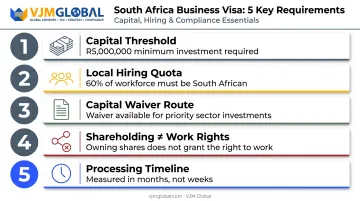
- Capital threshold: Official Immigration Act regulations set the required investment at R5,000,000. Funds must be personal, unencumbered, and certified, not borrowed or held jointly with unclear ownership.
- Local hiring quota: The Department of Home Affairs (DHA) requires that 60% of the permanent workforce be South African citizens or permanent residents.
- Capital waiver route: Section 15(3) of the Immigration Act allows the Director-General to reduce or waive the capital requirement for businesses in priority sectors, including agro-processing, BPO/IT-enabled services, and green economy ventures.
- Shareholding ≠ work rights: Owning shares in a South African company gives you no automatic right to work in or manage it locally. That requires separate visa approval.
- Timeline: No official numerical processing SLA exists for DHA or Department of Trade, Industry and Competition (DTIC) review. The DTIC's newer digital recommendation system offers faster processing and real-time tracking, but budget for months, not weeks, when planning your move.
If you're not planning to relocate personally, an Employer of Record (EOR) or locally hired management team sidesteps this entire process.
How to Start a Business in South Africa – Step by Step
From choosing a structure to staying compliant with CIPC and SARS, this is the sequence most UK founders follow when setting up in South Africa.
Common mistakes to avoid:
- Assuming CIPC registration alone means you're operational
- Underestimating how thorough bank KYC checks will be
- Delaying tax and compliance registration until "later"
Step 1 – Choose Your Structure and Reserve a Company Name
Decide between a Pty Ltd, a branch office, or EOR-based hiring based on whether you need a legal entity or only local talent. Reserve your preferred name with CIPC before you file incorporation documents.
Step 2 – Register with CIPC and Appoint a Public Officer
Complete CIPC registration and appoint a South African-resident public officer or local tax representative, which SARS requires for correspondence and compliance.
Step 3 – Register for Tax, VAT, and PAYE with SARS
Register for corporate income tax on SARS eFiling to obtain your tax reference number. Add VAT once you approach the compulsory threshold (R1 million in taxable supplies), and PAYE/UIF if you hire locally.
Step 4 – Open a South African Business Bank Account
Gather your CIPC documents, SARS registration proof, director KYC details, and source-of-funds evidence. Exchange control and anti-money-laundering checks are thorough, so this step often takes longer than founders expect.
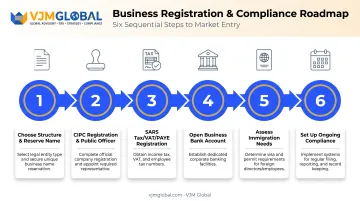
Step 5 – Assess Immigration Needs
Work out whether you personally need a business visa to operate in South Africa, or whether local staff or an EOR arrangement can run day-to-day operations while you stay in the UK.
Step 6 – Set Up Compliance and Ongoing Filing Obligations
Put accounting and calendar reminders in place for recurring obligations:
- CIPC: Annual Returns and Beneficial Ownership filings
- SARS: Corporate tax, provisional tax, VAT (where applicable), and payroll submissions (EMP201, EMP501, IRP5)
VJM Global's cross-border compliance and accounting support helps UK businesses manage these ongoing statutory filings without needing an in-house South African team.
Conclusion
Starting a business in South Africa from the UK is straightforward at the registration stage. CIPC incorporation moves quickly. What takes real planning is everything after: visas, banking, and the compliance calendar that follows.
If what you need is South African talent rather than a legal entity, EOR bypasses most of this friction. Either way, get market-specific guidance before you file. VJM Global supports UK founders with South African company registration, ongoing compliance, and EOR hiring, which helps you pick the right path and avoid the delays that catch most first-timers off guard.
Frequently Asked Questions
How much does it cost to register a small business in South Africa?
CIPC registration fees are relatively modest, but they're not the real cost driver. Ongoing accounting, compliance, and banking costs typically exceed the initial registration fee within the first year.
How much must a foreigner have to start a business in South Africa?
If you're pursuing a business visa to work in South Africa personally, you'll need R5 million in certified, unencumbered capital. Simply registering a Pty Ltd carries no minimum capital requirement at all.
What do I need to start my own business in South Africa?
You'll need CIPC registration, a registered South African address, an appointed public officer, and SARS tax registration. Banking and payroll registration follow once these are in place.
What qualifies as a small business in South Africa?
Classification uses two proxies: employee count and annual turnover — with thresholds varying by sector. There's no single universal turnover ceiling; agriculture, for example, uses different bands than services or manufacturing.
What is the most profitable business to start in South Africa?
Tech, financial services, agro-processing, and export-oriented businesses are showing strong momentum. South African agricultural exports hit a record $13.7 billion in 2024, according to Bloomberg, led by citrus and grapes.
Can a UK citizen own 100% of a South African company?
Yes. South African law permits full foreign ownership of a company in most sectors, with limited licensing requirements in areas like energy, mining, and pharmaceuticals. These are operational licences, not ownership caps.