
This isn't just a corporate trend. UAE nationals, expats living in Dubai or Abu Dhabi, and South African residents based in the UAE are all exploring this route.
This guide walks through entity types, costs, banking, visas, and compliance for anyone starting a business in South Africa while based in the UAE.
TL;DR
- CIPC registration can start online with a passport, including for non-South African applicants
- Choose a private company (Pty Ltd) or external company registration based on control and local presence needs
- Budget for CIPC fees, SARS tax registration, a registered address, and bank setup (often in-person or via a local representative)
- Corporate tax is 27%, with VAT applying once you cross the compulsory turnover threshold
- VJM Global supports entity formation and ongoing compliance in South Africa and 100+ other countries
What Does Starting a Business in South Africa from the UAE Involve?
Starting a business in South Africa from the UAE means registering a legal entity with the Companies and Intellectual Property Commission (CIPC), South Africa's company registrar. That registration lets you invoice, trade, and operate legally within the country.
UAE-based founders generally choose between two paths:
- Private Company (Pty Ltd): A fully South African-incorporated entity, ideal for founders wanting local operations, staff, or bank facilities
- External company registration: Extends an existing UAE entity into South Africa without creating a separate local company
CIPC's online eServices portal accepts non-South African applicants using a passport number, and the standard Memorandum of Incorporation (MOI) route can be filed digitally. That said, "online initiation" isn't the same as a fully remote process: some steps, particularly banking, still need physical verification.
What to Know Before You Start
Many UAE-based founders underestimate the gap between the two markets, especially around banking and compliance timelines. Before committing capital, get clear on these four areas:
- Time zones and document logistics. Notarisation or attestation of UAE-issued documents should be planned weeks in advance, with the two-hour UAE–SA time difference built into coordinated filings.
- Local representation requirements. A private company needs at least one director (who can be based anywhere), but a company secretary must be a South African permanent resident.
- Physical presence. CIPC registration itself doesn't require you to be in South Africa — but banks generally require in-person biometric verification or a local representative.
- Exchange control rules. South Africa's Reserve Bank (SARB) requires non-resident investment to go through an Authorised Dealer, with documentary checks on source of funds and arm's-length pricing.
Get advice on capital movement before wiring funds. SARB approval and reporting requirements apply to shareholder loans and certain inbound investments, and getting this wrong can delay your entire setup.
Why Start a Business in South Africa from the UAE (When It Makes Sense)
This move works well under specific conditions. It's not a universal win for every UAE business.
The Market Case
South Africa offers mature banking, legal, and logistics infrastructure that's hard to replicate elsewhere on the continent. It's often the natural entry point into the wider SADC market.
The trade relationship backs this up. UAE-South Africa non-oil trade reached approximately USD 8.5 billion in 2024, a 14% jump from 2023 and 120% growth since 2019. A Double Taxation Agreement (DTA) between the two countries, in force since December 2016, also reduces friction on repatriating profits and avoiding duplicate tax bills.
The Cost and Talent Case
- Rand-denominated costs for office space and labour are generally lower than UAE equivalents. Johannesburg's prime office occupancy cost sits well below comparable Dubai rates
- English-speaking, skilled workforce makes South Africa attractive for outsourcing, back-office, and services businesses
- Established professional services sector (banking, legal, accounting) reduces onboarding friction compared to newer African markets

None of this guarantees success. If your business model depends on rapid remote execution with zero local presence, South Africa's banking and compliance requirements may frustrate that plan.
How to Register a Company in South Africa from the UAE – Step by Step
Registration breaks down into six practical stages. The most common mistakes: skipping SARS tax registration before attempting to open a bank account, and assuming full foreign ownership applies uniformly across every sector.
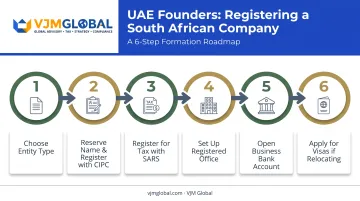
Step 1 – Choose Your Entity Type and Business Activity
Decide upfront between a Pty Ltd, an external company registration, or another structure. That choice shapes what you file, who can own the entity, and which ongoing obligations apply:
- A Pty Ltd creates a standalone South African legal entity with its own compliance obligations
- An external company ties your South African operations to your existing UAE entity's registration status
Check whether your business activity (financial services, mining, and similar regulated sectors) triggers additional licensing requirements beyond standard CIPC registration.
Most sectors allow 100% foreign ownership, but a few still cap or condition non-resident shareholding—confirm sector rules before you lock the structure.
Step 2 – Reserve Your Company Name and Register with CIPC
Reserve your company name through CIPC's online portal. You can submit up to four proposed names for a small fee, and reservation typically remains valid for six months.
Once reserved, file your MOI along with founder and director documents. The standard MOI route is designed for online submission and is generally faster than filing a customized MOI.
Step 3 – Register for Tax with SARS
Before you can open a business bank account, you need an income tax number from SARS. This step is non-negotiable: banks will not proceed without it.
- Register for income tax through SARS eFiling
- Register for VAT if you expect turnover to exceed the compulsory threshold
- Note that South Africa automatically places companies into a provisional tax regime, with payments due at set intervals through the year
Step 4 – Set Up a Registered Office and Local Representation
Every South African company needs a registered address. In many cases a virtual office is enough; you do not need premises you occupy.
Depending on your entity type, you may also need:
- A local director (not strictly required for a minimum-viable Pty Ltd, since directors can be based abroad)
- A South African-resident company secretary if your structure requires one
- A registered representative for SARS purposes
Step 5 – Open a South African Business Bank Account
This is usually the slowest part of the process. Banks require:
- CIPC registration certificate
- Memorandum of Incorporation
- Director passports
- Proof of address
- Source-of-funds documentation
Most South African banks require in-person verification. Plan a visit around this step, or appoint a local representative who can complete the process on your behalf. Some banks, like Nedbank, explicitly market products for foreign-registered companies — worth checking before you commit to a specific bank.
Step 6 – Apply for Relevant Visas or Work Permits (If Relocating)
If you plan to relocate and manage operations directly, South Africa's Business Visa route applies. Requirements around minimum investment and local staffing thresholds have varied across official sources, so verify current figures directly with South African immigration authorities before applying.
Many UAE-based founders skip this entirely — they run their South African entity remotely, using local staff or a resident director to handle day-to-day operations while they stay based in the UAE.
Costs, Banking, and Ongoing Compliance
First-Year Cost Considerations
Your first-year budget should cover:
- CIPC name reservation and registration fees (modest, typically under R500 for standard filings)
- SARS tax registration (no direct fee, but factor in advisory time)
- Registered address service (virtual office arrangements are common and cost-effective)
- Bank account setup (varies by bank and account type)
- Professional advisory fees for cross-border setup
Moving Funds from the UAE
Wiring capital from the UAE to South Africa involves more than a standard bank transfer:
- Exchange rate exposure can erode margins on larger transfers. Specialist forex providers often beat standard bank rates
- SARB documentation is required for inbound investment, particularly around source-of-funds verification
- Shareholder loans from the UAE parent to the South African entity may need Authorised Dealer approval and reporting
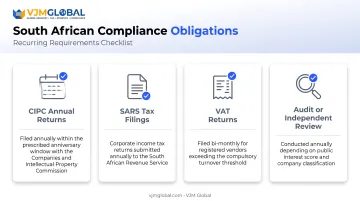
Ongoing Compliance Obligations
Once registered, expect these recurring obligations:
- CIPC Annual Returns: filed annually based on your incorporation anniversary, with fees scaling by company turnover
- SARS tax filings: annual income tax returns plus provisional tax payments throughout the year
- VAT returns: if registered, filed periodically based on your VAT category
- Audit or independent review: required based on your company's public interest score, which factors in turnover, employees, and liabilities
Companies with lower turnover and fewer stakeholders often qualify for a simpler independent review rather than a full statutory audit. Confirm which applies early—audit costs can be significant.
VJM Global supports entity formation, SARS tax registration, and ongoing CIPC compliance in South Africa and 100+ other markets, so you can align a UAE parent structure with South African statutory obligations in one place.
Frequently Asked Questions
How much money do I need to start a business in South Africa?
Registration costs themselves are modest, often under R1,000 for CIPC filings. Your real budget driver is working capital: office setup, initial payroll, and three to six months of operating runway before revenue stabilizes.
What is the cheapest business to start in South Africa?
Service-based businesses (consulting, digital marketing, back-office outsourcing) typically have the lowest overhead since they don't require inventory, premises, or specialized equipment. These are common entry points for UAE-based founders testing the market.
Which business can I start with $10,000 in South Africa?
At this budget, service-based or e-commerce businesses fit best. Think consulting, freelance-style professional services, or a lean online retail operation. Physical retail or manufacturing generally requires more capital.
Which bank allows foreigners to open an account in South Africa?
Nedbank explicitly markets accounts for foreign-registered companies. FNB, Absa, and Standard Bank also serve foreign-owned entities, but requirements vary by product, so confirm documentation needs directly with your chosen bank before applying.
How much tax does a small business pay in South Africa?
Standard corporate tax sits at 27%. Qualifying Small Business Corporations get preferential rates on lower income bands, starting at 0% on the first tranche of taxable income and scaling up.
Can a UAE resident register a South African company without visiting South Africa?
You can largely initiate and file CIPC registration remotely with a passport. However, opening a business bank account typically requires in-person verification, so you'll need to visit or appoint a local representative for that step.