India has stayed close through the turbulence. Bilateral merchandise trade hit US$7.1 billion in FY2025-26, with Indian exports to Sri Lanka up 21.23%, and Indian investment stock now sits around US$2.8 billion, per the Indian High Commission in Colombo.
Why the renewed Indian interest? Proximity, ISFTA-linked trade access, lower entry costs than Southeast Asia or the Gulf, and a market that's slowly regaining investor confidence. Indian SMEs eyeing exports, larger companies wanting a regional foothold, and individual investors scouting BOI-approved projects are all circling.
This guide walks through what actually needs to happen — step by step — to set up in Sri Lanka as an Indian founder.
TL;DR
- Most sectors allow 100% foreign ownership via a Private Limited Company, with no minimum share capital
- Company registration takes 1-3 weeks, then TIN, VAT and EPF registrations
- Indian investors get reduced tariffs on qualifying goods under the ISFTA
- Corporate tax is 30%; BOI concessions apply only to approved projects, not all SMEs
- Early cross-border compliance on the Indian and Sri Lankan sides prevents most setup delays
Why Sri Lanka Is Worth Considering for Indian Entrepreneurs
Starting a business in Sri Lanka from India usually means incorporating a local Private Limited Company. You work through either the Registrar of Companies (ROC) or the Board of Investment (BOI) and manage compliance as a non-resident promoter.
There are two broad routes:
- Operating entity: set up a company to trade, service, or manufacture in the local market
- BOI-approved project: pursue export manufacturing, IT/BPO, or tourism projects that qualify for investment-linked incentives
Advantages Backed by Data
The numbers make a reasonable case for looking seriously at Sri Lanka:
- Trade access: Under ISFTA (in force since 2000), Indian-origin goods are duty-free except on 1,180 negative-list tariff lines, per the Department of Commerce. Origin rules and qualifying criteria still apply.
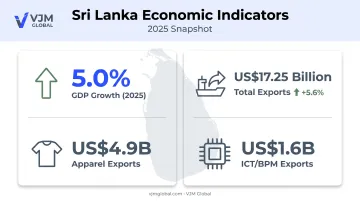
- Recovering economy: 5.0% GDP growth in 2025, sustained into Q1 2026, shows the post-crisis correction is holding.
- Investor-friendly rules: Non-residents can generally buy shares in any class outside a short list of excluded or capped sectors, per the Department of Foreign Exchange.
- Export momentum: Total exports reached an estimated US$17.25 billion in 2025 (up 5.6%), led by apparel (US$4.9B), ICT/BPM (US$1.6B), and coconut products (up 42.66%), according to Sri Lanka Business.
- Relevant sectors for Indian investors: IT/BPO, apparel and export manufacturing, tourism, and agro-processing combine strong growth with existing Indian familiarity.
One practical note: check the Central Bank of Sri Lanka's daily indicative exchange rates on the day you plan capital transfers. Rates move, and locking in assumptions early can throw off your cost projections.
What to Know Before You Start a Business in Sri Lanka
Before you commit time and money, set realistic expectations on structure, presence, and timelines.
- No sole proprietorship route for foreign founders. Official investment rules point non-residents toward incorporating a company or registering an overseas branch — not a sole proprietorship.
- Some steps still need a human in the room. Name reservation runs online through eROC. TIN registration can be done in person, by post, or online via the Inland Revenue Department, but banks may still require physical presence for KYC.
- Certain sectors have ownership caps. Freight forwarding, travel and shipping agencies, and specified crop-processing activities are typically capped at 40% foreign voting shares unless the BOI approves higher.
- Registration is fast; becoming operational isn't. Incorporation itself moves in roughly 1-3 weeks once documents are ready. Opening a bank account, registering for tax, and hiring staff stretch the real timeline further.
Early Decisions That Matter When Entering Sri Lanka from India
Most delays in this process trace back to two things: picking the wrong entity structure, or underestimating how many compliance layers stack on top of registration.
Structure, Cost and Tax Planning
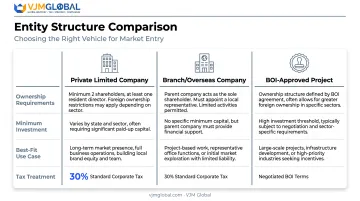
Entity choice drives cost and tax from day one. Match the structure to how you will actually operate:
- Private Limited Company — fits most operating businesses building a local presence
- Branch or overseas company — suits firms extending an existing Indian operation
- BOI-approved project — only if you clear specific thresholds (export manufacturing needs at least US$250,000 in additional investment and 80% of output exported, per the BOI Investment Guide)
Government filing for company registration is a modest LKR5,200 (excluding VAT), per a July 2026 gazette. The real spend sits around it: company secretary retainers, legal drafting, notarization, and translation. These vary by provider, so get itemized, dated quotes rather than published estimates.
Standard corporate income tax is 30%, including for export services such as ICT. There is no automatic 14–18% concessional rate just for being an SME or exporter. Any cut usually ties to a specific BOI-approved project with negotiated terms.
Plan the Indian side at the same time. Outbound investment into Sri Lanka generally triggers RBI/ODI reporting for the Indian parent, on top of local Sri Lanka filings. Miss either track and you inherit two compliance problems instead of one.
How to Start a Business in Sri Lanka from India — Step by Step
Here's the practical sequence. The most common mistake founders make is assuming the entire process can be handled remotely, or ignoring sector-specific ownership limits until they're deep into filing.
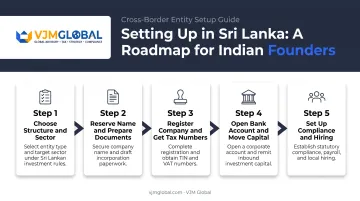
Step 1 – Choose Your Business Structure and Sector
Decide upfront between a Private Limited Company, a Public Limited Company (PLC), or an overseas branch based on your ownership goals and growth plans. Check whether your sector needs Board of Investment (BOI) approval or additional licensing — freight, travel agencies, and certain agriculture activities carry restrictions.
Common miss: assuming a sole proprietorship is available to a non-resident Indian founder. It typically isn't.
Step 2 – Reserve Your Company Name and Prepare Documents
Search and reserve your company name through the Registrar of Companies (ROC) eROC system — reservations generally hold for about three months. Appoint a company secretary early and prepare director/shareholder consent forms.
Common miss: delaying the secretary appointment. This one decision stalls the entire filing sequence behind it.
Step 3 – Register the Company and Obtain Tax Numbers
File incorporation documents — Form 1, Form 18, and Form 19 — with the ROC. Then apply for a Tax Identification Number (TIN) through the Inland Revenue Department, and register for VAT and EPF where applicable.
Common miss: assuming TIN registration is entirely remote. While IRD lists online, postal, and in-person channels, related bank KYC steps often still require someone physically present.
Step 4 – Open a Corporate Bank Account and Move Capital
Open a local corporate bank account to receive share capital. Foreign equity must route through an Inward Investment Account (IIA) — this is also the channel for repatriating dividends and investment income later.
Plan how capital moves from India, factoring in RBI's overseas investment norms on the Indian side and Sri Lanka's currency rules on the receiving end.
This is where a lot of Indian founders get stuck juggling two regulatory systems at once. Working with an entity-formation partner familiar with cross-border filings takes the back-and-forth off your plate. VJM Global handles this kind of dual-side coordination for Indian companies expanding abroad.
Step 5 – Set Up Compliance, Hiring, and Ongoing Operations
Register with the Employees' Provident Fund (EPF) and Employees' Trust Fund (ETF) within 14 days of hiring your first employee, using Form D submitted to the local Labour Department office. Understand statutory leave and gratuity obligations before you start hiring.
Build a routine for:
- Corporate tax filing
- VAT returns
- Annual company secretarial compliance
Common miss: treating registration as the finish line. It's the starting point for years of recurring statutory obligations.
Conclusion
Entering Sri Lanka from India starts with a structuring decision and continues with sustained compliance. Get the entity type right, screen your sector for ownership restrictions, and document everything accurately from day one if you want to use ISFTA trade benefits or BOI incentives later.
The regulatory landscape spans two countries' rules at once: Indian ODI/FEMA reporting on one side, Sri Lankan ROC, IRD, and BOI requirements on the other. VJM Global works with Indian companies on this kind of dual-jurisdiction structuring, tax filing, and compliance sequencing. Reach out at [email protected] if you're weighing your options.
Frequently Asked Questions
What is the best small business to start in Sri Lanka?
IT/BPO, tourism-related services, export-oriented manufacturing, and agro-processing stand out, especially given Indian founders' familiarity with these sectors and the trade access ISFTA provides.
How much does it cost to start a business in Sri Lanka?
Government filing fees are modest (company registration costs LKR 5,200 excluding VAT). The bigger variable is professional support: company secretary, legal, and translation costs, which depend on your provider.
Can an Indian citizen own 100% of a company in Sri Lanka?
In most sectors, yes. Some activities (freight forwarding, travel agencies, certain retail and agriculture segments) cap foreign ownership at 40% unless BOI approves a higher share.
How long does company registration take in Sri Lanka?
Typically 1-3 weeks, depending on how quickly documents are ready and how fast your company secretary is appointed. Becoming fully operational takes longer.
Do I need to visit Sri Lanka in person to register a company?
Not entirely. Name reservation and TIN registration have online options, but bank KYC and certain document verifications may still require in-person action or a locally appointed representative.
What tax benefits exist for Indian businesses under the ISFTA?
Qualifying goods that meet origin rules move between India and Sri Lanka at reduced or zero tariffs, outside a negative list of restricted tariff lines. It applies to goods trade, not general company tax.