That growth is pulling more Indian promoters toward setting up a private limited company in Sri Lanka. But many get stuck early: the eROC portal feels unfamiliar, documentation requirements differ from India's MCA process, and foreign shareholder rules aren't always clear.
This guide walks through entity types, the step-by-step registration process, realistic costs, and post-registration compliance for Indian companies entering Sri Lanka.
Key Takeaways
- A private limited company is the most practical structure for Indian investors entering Sri Lanka
- Registration runs entirely through the eROC portal. No no separate approval layer for most sectors
- Budget for a company secretary, statutory fees, and document legalization from India
- TIN registration, beneficial ownership disclosure, and EPF/ETF filings are mandatory after incorporation
Why Indian Companies Are Expanding into Sri Lanka
India–Sri Lanka commerce already rests on a long-running trade framework. The India-Sri Lanka Free Trade Agreement (ISFTA), in force since March 2000, opened duty-free access across a wide product range, according to the Sri Lanka Export Development Board. That access cut friction that once slowed cross-border deals.
Indian companies also have day-to-day reasons to choose Sri Lanka:
- Proximity: short flights from most South Indian cities
- Time zone: only 30 minutes behind IST, so working days overlap
- Familiarity: cultural and linguistic ties, especially in the north and east
- Business norms: shared practices built over decades of trade
Indian FDI has long clustered in energy, hospitality, real estate, manufacturing, telecom, and banking. IT/BPO, apparel, and trading are active opportunity sectors as well, even if they are not yet the largest share of Indian investment in Sri Lanka.
Understanding the Private Limited Company Structure in Sri Lanka
Sri Lanka's Companies Act No. 07 of 2007 governs company formation. A private limited company can have as few as one shareholder, and the Articles must cap the shareholder count at 50 (excluding certain current or former employee-shareholders).
Foreign nationals and companies — including Indian entities — can hold shares directly. Sole proprietorships and general partnerships aren't practical routes for foreign promoters without local residency, which is why incorporated entities are the default choice.
Private Limited Company vs. Other Options
| Feature | Private Limited Company | Public Limited Company | Branch Office |
|---|---|---|---|
| Shareholders | 1–50 | Unlimited (min. 7 typically) | N/A (parent company extension) |
| Local secretary | Mandatory | Mandatory | Mandatory |
| Foreign ownership | Generally permitted | Generally permitted | Tied to parent entity |
| Liability | Limited | Limited | Extends to parent company |
| Compliance burden | Moderate | High (public disclosure) | Moderate, tied to head office |
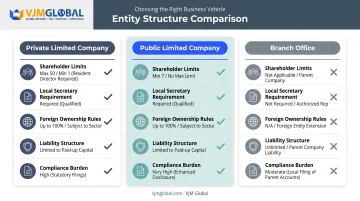
A company secretary is mandatory under the Act. For an Indian promoter with no team on the ground in Colombo, this typically means engaging a local professional or firm to fulfil this role, since it's a statutory requirement rather than optional governance.
Non-residents can generally acquire and hold shares freely. Ownership is still not automatic in every industry.
Coastal fishing, pawnbroking, mass communication, education, freight forwarding, and travel agencies carry a 40% foreign-equity cap unless the Board of Investment grants prior written approval, per the Lex Mundi foreign investment guide. Always run a sector-specific check before assuming 100% ownership applies.
Step-by-Step Registration Process for Indian Companies
Name Reservation and Account Setup
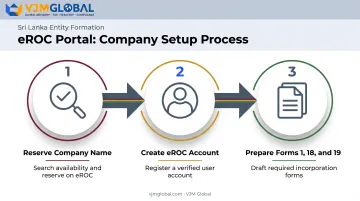
Registration begins on the eROC portal, the single-window system run by Sri Lanka's Department of the Registrar of Companies (DRC). You'll need to:
- Reserve the company name: the system checks for duplicates and restricted words
- Create an eROC account for the proposed company
- Prepare Form 1, Form 18, and Form 19: system-generated through eROC; Form 1 is the incorporation application, Form 18 records director consent, and Form 19 records secretary consent
Articles, Fees, and Submission
Sri Lanka's model Articles of Association apply by default unless the company adopts modified provisions. Once the Articles are finalised:
- Pay the applicable government fees through the portal
- Submit signed, scanned documents: director and secretary consents, the Articles, and supporting identity documents
- Receive the digital Certificate of Incorporation once the Registrar confirms the filing is compliant
Document Legalization for Indian Directors
This is where Indian promoters often hit friction. Documents issued in India need to go through a specific chain before Sri Lankan authorities accept them:
- Certification by the Indian Ministry of External Affairs (MEA) Consular Division
- Authentication by the Sri Lankan High Commission in India, as outlined by the Sri Lankan High Commission's own guidance
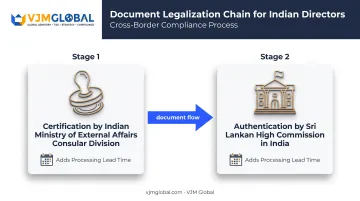
This chain adds real lead time, so legalise Indian-issued documents before you expect to file on eROC.
Costs, Documentation, and Realistic Timelines
Sri Lanka's fee schedule was updated through Gazette Extraordinary No. 2496/03, dated 6 July 2026, which lists:
| Fee Category | Amount (LKR) |
|---|---|
| Company name approval | 2,600 |
| Private company registration | 5,200 |
| Other required documents (not itemized separately) | 2,600 |
| Annual return filing | 7,900 |
| Certification/file inspection | 1,300 |
All figures exclude VAT. The gazette doesn't itemize separate charges for Form 1, 18, or 19 individually.
Documents You'll Need From Indian Directors/Shareholders
- Passport copies for each Indian director and shareholder
- Proof of residential address (utility bill or bank statement)
- Board resolution authorizing the Sri Lankan incorporation
- Notarized and legalized signatures on director/shareholder consent forms
Realistic timeline: eROC does not publish an official turnaround figure, so plan by stage rather than a single fixed window:
- Name approval with the Registrar
- Document notarization and legalization from India (usually the longest stretch)
- eROC review of the filing pack
- Certificate of incorporation issuance
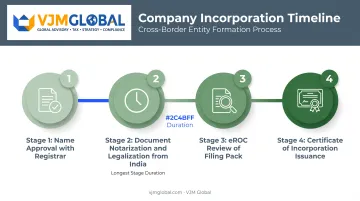
Build buffer time for the India legalization chain. That step is the one Indian promoters most often underestimate.
Post-Registration Compliance for Indian-Owned Sri Lankan Companies
Getting the Certificate of Incorporation starts the compliance clock. Several obligations kick in immediately after.
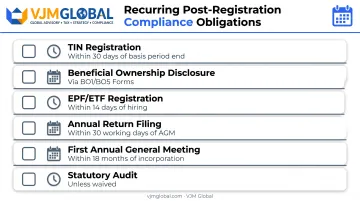
Tax Identification Number (TIN): Under Section 102 of the Inland Revenue Act, a person liable to file an income return must register for a TIN within 30 days of the end of their basis period, not simply 30 days after incorporation. That distinction trips up many first-time filers.
Beneficial ownership disclosure: From 30 March 2026, new incorporations must submit beneficial-owner and authorised-person details through the BO portal using Forms BO1 and BO5. Skipping this causes the incorporation filing to bounce back for resubmission, per DRC's official notice.
EPF/ETF registration: Once you hire your first employee, EPF registration is due within 14 days, using Form D in duplicate. ETF registration follows a similar employer-registration process.
Other recurring obligations:
- Annual return, due within 30 working days of the AGM
- First AGM within 18 months of incorporation
- Statutory audit, unless shareholders unanimously waive it
On repatriating profits: The India-Sri Lanka DTAA provides relief on dividend withholding for Indian promoters. Confirm the exact treaty rate against Article 10 before you rely on it for planning.
TIN registration, BO filings, and repatriation planning form one compliance sequence with incorporation, not a separate afterthought. VJM Global's cross-border tax advisory helps Indian promoters map that sequence across markets rather than treating registration as a one-off filing.
Frequently Asked Questions
How do I register a Pvt Ltd company in Sri Lanka?
Reserve the company name on the eROC portal, file Forms 1, 18 and 19 with the Articles of Association, appoint a company secretary, and pay the government fees. Once the filing is accepted, the Registrar issues a digital Certificate of Incorporation.
How much does it cost to register a Pvt Ltd company in Sri Lanka?
Government fees are LKR 2,600 for name approval and LKR 5,200 for registration, per the 2026 gazette, excluding VAT. Professional and secretarial fees add to this but aren't itemized publicly.
Can an Indian start a business in Sri Lanka?
Yes. Indian nationals and companies can register a private limited company, and most sectors allow full foreign ownership. A handful of restricted sectors cap foreign equity at 40% without BOI approval.
What is a private limited company in Sri Lanka?
It's a company structure under the Companies Act No. 07 of 2007 allowing 1 to 50 shareholders, with a mandatory company secretary and limited liability for shareholders.
Do Indian companies need a local director or secretary in Sri Lanka?
A company secretary is mandatory under the Act. Directors can be foreign nationals; Sri Lanka does not impose a residency requirement on directors the way India does.
How long does it take to get a Certificate of Incorporation in Sri Lanka?
There's no fixed published timeline. The process typically covers name approval, document legalisation from India, and eROC review. Legalisation of Indian documents is usually the longest step.