Introduction
Ukraine is still open for business, and American entrepreneurs know it. US founders continue registering companies there for IT outsourcing, import-export trade, and investment positioning, even amid wartime conditions.
In fact, bilateral US-Ukraine goods trade hit an estimated $3.8 billion in 2025, according to USTR trade data, with $2.4 billion of that made up of US exports.
That said, the process isn't simple from 6,000 miles away.
Many US founders run into confusing legal forms, martial-law-era procedural quirks, currency controls, and conflicting advice from local staff who may not understand US-side reporting obligations. Registering remotely without a clear roadmap often leads to expensive mistakes.
This guide breaks down the entity types, the registration steps, the taxes, and the compliance obligations a US citizen or company needs to know before starting a business in Ukraine.
Key Takeaways
- Ukraine permits 100% foreign ownership of an LLC (TOV) with no local partner requirement
- Registration can start remotely via Power of Attorney, though a local address is mandatory
- Corporate tax runs 18%, VAT is 20%, and simplified FOP (sole-proprietor) taxation starts at 5%
- Currency controls govern how capital enters Ukraine and how profits repatriate to the US
- US founders must separately track FATCA, FBAR, and Form 5471 obligations at home
Legal Structures for US Entrepreneurs in Ukraine
Ukraine offers four primary legal vehicles for foreign founders. Your choice affects liability exposure, tax burden, and how easily you can operate the business without relocating: LLC (TOV), Sole Proprietorship (FOP), Joint-Stock Company (JSC), and Representative Office.
Limited Liability Company (TOV)
A TOV is the workhorse structure for foreign-owned businesses in Ukraine. Under current Ukrainian company law, a single participant can own 100% of a TOV, and that participant's liability is capped at their capital contribution — not personal assets.
This is why it's the default choice for US-owned SMEs, trading companies, and IT outsourcing operations. It's a genuine legal entity, separate from its owner, which matters for contracts, banking, and liability protection.
Sole Proprietorship (FOP)
FOP registration is the fastest and cheapest option, with simplified taxation as low as 5% of income for Group III filers. But there's a catch most guides skip: an FOP isn't a company at all.
It's the individual conducting business personally, with no liability shield. Registration requires:
- Full civil capacity
- A Ukrainian taxpayer number (RNOKPP)
- Registrable Ukrainian address data
This makes FOP a better fit for individual contractors physically present in or connected to Ukraine than for a US corporate entity trying to establish a subsidiary.
Joint-Stock Company (JSC)
A JSC divides capital into shares, with shareholder liability generally limited to the value of those shares. This structure fits larger ventures planning to bring in outside investors or raise institutional capital down the line.
Foreign persons can hold all shares, subject to sector-specific rules. But the governance burden (shareholder meetings, share registries, disclosure requirements) is considerably heavier than a TOV.
Representative Office
A Rep Office lets a US company establish a Ukrainian presence, such as a liaison function or market research team, without creating a separate legal entity. It's a subdivision of the US parent, not an independently owned Ukrainian company.
Critically, it cannot generate independent revenue. It's for scouting and coordination, not trading or invoicing clients.
Our recommendation: Most US entrepreneurs entering Ukraine for trading, services, or tech outsourcing should default to a TOV unless they're specifically raising institutional capital, in which case a JSC becomes worth considering.
Step-by-Step: How to Register Your Business in Ukraine from the USA
Registration follows a defined sequence, and most steps can be handled remotely with the right documentation chain in place.
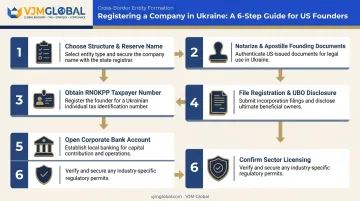
Choose your structure and reserve a name. Verify uniqueness through Ukraine's Unified State Register of Legal Entities before filing anything else.
Prepare and notarize founding documents. This includes an apostilled and certified Ukrainian translation of your US passport, plus a notarized Power of Attorney if a representative will sign on your behalf. US-issued documents apostilled under the Hague Convention go directly to Ukraine without further legalization.
Obtain a Ukrainian taxpayer number (RNOKPP) for each foreign founder. This is typically filed within three working days by a local representative under Power of Attorney, so your physical presence isn't required.
File registration documents with the state registrar, including mandatory Ultimate Beneficial Owner (UBO) disclosure. This step is non-negotiable under Ukraine's transparency and sanctions-related rules, and UBO data must stay current after filing, not just at incorporation.
Open a corporate bank account. Ukrainian banks require both a hryvnia (UAH) account and a foreign currency account to manage cross-border payments and currency control compliance. Expect the bank to run its own independent UBO and sanctions screening, separate from what you filed with the registrar.
Check for sector-specific licensing. Finance, healthcare, energy, and education activities require additional permits before you can start operating.
On timing: be skeptical of any promise of a single "typical" timeline. Digital services like Diia's model-charter LLC registration can process quickly on the state's end.
A foreign founder's full timeline also depends on steps outside Ukraine's digital system: apostille processing in the US, translation turnaround, and bank KYC review. Build in weeks, not days, for the full chain.
Taxes, Costs & Banking for US-Owned Businesses in Ukraine
Understanding Ukraine's tax structure upfront prevents surprises once you're operational.
| Tax Type | Rate | Notes |
|---|---|---|
| Corporate income tax (CIT) | 18% | Standard rate for TOVs and JSCs |
| VAT | 20% | Goods exports can be 0%; exported services are not automatically zero-rated |
| FOP single tax (Group III) | 5% (or 3% with VAT) | Plus a separate 1% military levy from 2025 |
| Personal income tax | 18% | Plus a 5% military levy surcharge |
| Dividends to individuals | 5% or 9% | Depends on payer status; plus 5% military levy |
One correction worth flagging: a common misconception is that exported IT services automatically qualify for 0% VAT. According to PwC's Ukraine tax summary, services supplied to nonresidents are either taxed at the standard 20% or fall outside VAT scope entirely, depending on the statutory place of supply. Don't assume export status alone reduces your VAT bill.
What Registration Actually Costs
Beyond these recurring taxes, one-time setup costs deserve attention too. Ukraine's government registration fee itself is currently listed as free through the official UkraineInvest portal. What isn't free:
- Apostille and certified translation of your US passport and Power of Attorney
- Notary fees for signing authority documents
- Local legal and accounting setup fees, which vary by firm and complexity
- Ongoing bookkeeping, VAT filing, and annual statement preparation
Request an itemized quote from whoever handles your registration rather than relying on a flat published number. Costs shift based on how many founders need RNOKPPs, how complex your ownership structure is, and whether you need urgent processing.
Currency Controls and Repatriation
Getting profits out of Ukraine raises a separate question: currency controls. Ukraine's National Bank has been easing wartime FX restrictions in stages. As of the latest package, dividends can be repatriated up to a cap of €1 million equivalent per month, according to the National Bank of Ukraine's FX liberalization announcement. This cap has expanded over time, so confirm the current threshold before planning a repatriation schedule.
Your US-Side Reporting Doesn't Disappear
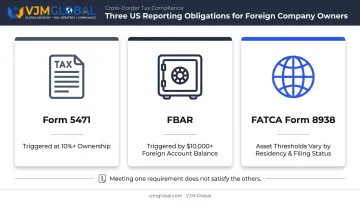
Owning a Ukrainian entity triggers separate US reporting obligations. These three are distinct, and meeting one doesn't satisfy another:
- Form 5471: required if you own 10%+ of the foreign company's vote or value
- FBAR: required if your foreign account balances exceeded $10,000 at any point in the year
- FATCA Form 8938: required above asset thresholds that vary by filing status and US residency
Talk to a cross-border tax advisor before you register, not after. VJM Global's international tax team handles FATCA, FBAR, and Form 5471 filings in-house for US clients with controlling foreign interests, which avoids the gap between what your Ukrainian accountant tracks and what the IRS expects.
Work Permits, Residency & Hiring Local Staff
You don't need to relocate to own a Ukrainian company, since passive ownership alone doesn't require a work permit or residence permit.
That changes the moment you actively manage operations on the ground, and relocating to run the business yourself requires two approvals:
- Your company applies for a work permit at the regional employment center; processing takes up to seven working days.
- You then apply for a temporary residence permit through the State Migration Service before your authorized stay expires.
Hiring Once You're Registered
Ukrainian companies can hire through several structures, each with different tax overhead:
- Standard labor contracts: full payroll tax and social contribution obligations
- Civil-law contracts: lighter administrative burden, suited to freelancers and project-based work
- Gig contracts: available only to Diia.City-eligible tech companies, offering reduced tax treatment for qualifying specialists
Businesses that prefer to skip local incorporation can hire through an Employer of Record like VJM Global instead.
Many US citizens can travel to Ukraine visa-free for up to 90 days within any 180-day period. That's fine for exploratory trips or setup visits, but it doesn't authorize local employment. Active operational roles need the permit chain above.
Common Challenges for US Founders & How VJM Global Can Help
Most registration headaches aren't about the law itself. They're about execution.
The most frequent pitfalls we see US founders run into:
- Documentation errors from local notaries or translators unfamiliar with US document formats
- Missed UBO updates: filing correctly at incorporation, then failing to keep beneficial ownership data current as required
- Confused filing calendars: mixing up monthly VAT deadlines with quarterly or annual obligations
- Sanctions-compliance gaps — assuming legal trade status means no counterparty or sector screening is needed
Registration is a single event. Compliance is not. VAT filings, payroll reporting, and annual financial statements require consistent local expertise long after your Certificate of Incorporation arrives.
VJM Global has supported 500+ American business owners expanding internationally, coordinating entity formation and tax structuring so founders aren't left navigating foreign bureaucracy solo.
Our team handles the pre-incorporation strategy and the registration itself, then stays on for the compliance work that determines whether a foreign entity survives its first year.

If you're weighing a Ukrainian LLC against other structures, or you're unsure how UBO and sanctions rules apply to your specific ownership setup, talk to VJM Global's team before you file anything. A structuring mistake caught before registration is far cheaper to fix than one caught after.
Frequently Asked Questions
How much does it cost to open a business in Ukraine?
Government registration itself currently costs nothing, but real costs come from apostille and translation of your US documents, notary fees, and legal or accounting setup support. These vary by firm, so request an itemized quote rather than assuming a flat price.
Can the US do business with Ukraine?
Yes. US-Ukraine trade and investment remain active and legal, with bilateral goods trade estimated at $3.8 billion in 2025. Founders still need to follow sanctions-compliance and UBO transparency rules for any Ukrainian entity they own.
Can a foreigner own a business in Ukraine?
Yes. US citizens and companies can own 100% of a TOV (LLC) or JSC, with no forced local partner or ownership stake required.
What is the best business structure for a US citizen starting a company in Ukraine?
A TOV (LLC) fits most US-owned trading, services, or tech outsourcing businesses. Consider a JSC only if you're planning to raise institutional capital from outside investors.
Do I need to live in Ukraine to own a business there?
No. Ownership alone doesn't require residency. Actively managing the company on the ground, however, triggers work permit and temporary residence permit requirements.
How long does it take to register a company in Ukraine?
The digital filing portion can move quickly, but a realistic foreign-founder timeline also depends on US apostille processing, certified translation, and bank KYC review. Plan for weeks rather than days once every step is accounted for.