Introduction
Canadian interest in Ukraine's business landscape hasn't cooled despite the war. If anything, it's grown. Between the modernized Canada-Ukraine Free Trade Agreement (CUFTA), reconstruction financing, and a deep-rooted diaspora connection, more Canadians are asking whether now is the right time to enter the market.
Three things make the timing worth examining: cost-competitive skilled talent, EU market access through the DCFTA, and government incentives aimed at foreign investors. A decades-long Canada-Ukraine trade relationship backs that case with commercial history, not just optimism.
The people exploring this range widely:
- Diaspora entrepreneurs reconnecting with family businesses
- IT and software founders tapping Ukraine's developer talent pool
- Investors eyeing reconstruction-linked sectors like energy and infrastructure
- SMEs sourcing manufacturing or outsourced back-office support
Still, cross-border setup brings legal, tax, and operational complexity that catches unprepared founders off guard. This guide covers the legal structure, registration steps, compliance requirements, and risk management every Canadian founder needs before committing capital.
Key Takeaways
- An LLC (TOV) allows 100% foreign ownership, but your appointed director needs Ukrainian residency status
- CUFTA and the Canada-Ukraine tax treaty ease business-visitor entry and reduce double taxation
- Core registration moves fast: tax numbers, banking, and VAT drive the real timeline
- Employer of Record (EOR) arrangements let you test demand before incorporating
- Wartime conditions require remote-first operations and explicit risk planning from day one
What Starting a Business in Ukraine from Canada Actually Involves
Starting a business in Ukraine from Canada means one of two things: setting up a legal entity in-country, or engaging a local partner/EOR to sell, operate, or hire there while you stay based in Canada. You don't need to physically relocate for either path.
Four structures cover most scenarios:
| Structure | Best For | Foreign Ownership |
|---|---|---|
| LLC (TOV) | Most SMEs, standard trading or service businesses | 100% allowed |
| Joint-Stock Company | Larger capital raises, multiple institutional investors | 100% allowed |
| Representative Office | Non-commercial presence, market research, liaison work | N/A (no independent trading) |
| EOR/Contractor Engagement | Testing demand or hiring without an entity | N/A |
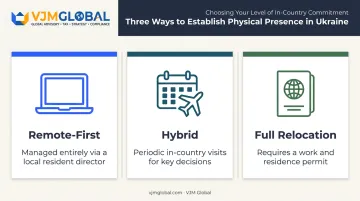
Physical presence is optional and flexible. Some founders run everything remotely through a local resident director. Others make periodic in-country visits for key decisions. A smaller group relocates entirely under a work and residence permit.
Most Canadian founders we see today choose the remote option. Given current conditions, that remains the sensible default.
Why Canadians Are Looking at Ukraine Right Now (When It Makes Sense)
Entering Ukraine today can be a sound decision, but it's conditional, not guaranteed. Here's what actually supports the case.
CUFTA Makes Legal Entry Easier
The modernized CUFTA took effect on July 1, 2024. It created four distinct temporary-entry categories for Canadians: business visitors, investors, intra-company transferees, and professionals.
- Business-visitor activities cover meetings, seminars, and consultations
- Investors qualify when establishing or managing a substantial investment
- Transferees must serve as executives, managers, or specialists within the same corporate group
This isn't a single loose "business visitor" bucket. Each category has its own eligibility bar, which matters when you're planning who travels and why.
Ukraine's Cost and Talent Edge
Ukraine's tech sector remains a genuine draw. According to IT Ukraine Association's Digital Tiger 2024 report, the country counts roughly 265,000 IT employees, 51,000 individual entrepreneurs, and 23,200 gig specialists (these categories overlap and shouldn't be summed).
Reported 2024 median salaries (USD 4,400 for full-stack developers, USD 6,800 for AI specialists) still undercut most Western European benchmarks.
Tax Rate, EU Access, and Reconstruction Money
Ukraine's standard corporate income tax rate sits at 18%. Combine that with the upgraded EU-Ukraine DCFTA (effective October 29, 2025), which opens tariff and services access to the EU market, and distribution economics look favourable for export-oriented businesses.
On top of that, the EU-backed Ukraine Investment Framework carries EUR 9.6 billion in guarantee and blended-finance capacity, targeting energy, infrastructure, agribusiness, and digitalization. The EIB Group added EUR 1.5 billion in fresh 2025 financing for similar sectors.
None of this removes the risk. Every credible entry plan pairs these advantages with a remote-first structure, insurance, and a phased approach: EOR before full incorporation, not the other way around.
What to Know Before You Start
Before you file anything, get comfortable with a few realities that catch most Canadian founders off guard.
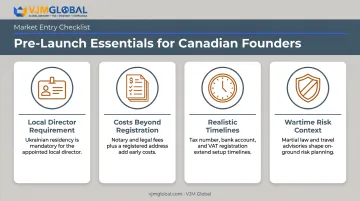
The Local-Director Requirement
Ukrainian LLC law requires a director who is a legally capable natural person. In practice, Ukrainian citizens are typically appointed at incorporation.
A foreign national can take the role later, but that generally requires a Ukrainian work permit first. A Canadian founder cannot simply list themselves as director without residency status in place.
Beyond that requirement, plan for:
- Costs beyond registration: notary and legal fees, a mandatory registered local address, and document errors from overstretched intermediaries
- Realistic timelines: incorporation paperwork can move quickly, but a tax number, bank account, and VAT registration push full setup well past the headline registration date
- Current risk context: martial law remains in effect, and Canada's travel advisory for Ukraine urges avoiding all travel—plan to operate remotely rather than relocate
How to Start a Business in Ukraine from Canada – Step by Step
The path breaks into seven practical stages. Avoid the most common mistakes: incorporating before validating demand, skipping the local-director requirement, and ignoring currency-control rules until money needs to move.
Step 1 – Choose Your Legal Structure and Entry Mode
Match the structure to your actual goal, not the one that sounds most "official."
- Selling locally or building a team? An LLC (TOV) is standard.
- Testing demand first? An Employer of Record (EOR) arrangement lets you hire and operate without incorporating anything.
- Just need a liaison presence? A Representative Office covers non-commercial activity.
Common miss: Committing to full incorporation before confirming market fit. Given ongoing volatility, validating demand through an EOR arrangement first is the lower-risk move.
Step 2 – Secure a Ukrainian Tax Number and Arrange a Resident Director
Foreign shareholders need a Ukrainian tax number before the company can register. This is typically filed through a local representative under Power of Attorney, using identity documents and certified translations.
Simultaneously, line up a trusted resident individual to serve as director. Corporate directors aren't permitted under Ukrainian law.
Common miss: Assuming a Canadian founder can be listed as director without Ukrainian residency status already in place.
Step 3 – File Incorporation Documents and Register the Company
Submit your application and founding documents to the Unified State Register, disclosing all Ultimate Beneficial Owners with full identifying information. Ukrainian citizens can file quickly through the Diia platform; foreign founders are generally directed to a CNAP administrative service centre instead.
Common miss: Treating registration speed as the whole timeline. VAT registration and other add-ons stretch what looks like a one-day process into several weeks.
Step 4 – Open a Corporate Bank Account and Understand Currency Controls
You'll need a Ukrainian corporate account for payroll, vendor payments, and client receipts. Wartime currency-control rules remain in force under National Bank of Ukraine regulations, limiting certain FX transfers and cash withdrawals abroad.
An investment-account structure can help with future capital repatriation, but restrictions are transaction-specific and change periodically.
Common miss: Assuming profits move freely back to Canada. Check current NBU rules before you plan around any specific transfer.
Step 5 – Set Up Tax Compliance and Use the Canada-Ukraine Tax Treaty
Register for the taxes that apply to your business — corporate income tax at 18%, VAT at 20% once you cross the mandatory registration threshold, and payroll tax if you're hiring directly. Confirm current rates with a local advisor, since thresholds and exceptions shift.
The 1996 Canada-Ukraine tax treaty generally taxes business profits only in the residence state (unless there's a permanent establishment), caps withholding on dividends, interest, and royalties, and provides foreign-tax-credit relief on both sides.
A cross-border advisory partner such as VJM Global can help structure the Canada-side reporting alongside your Ukraine setup, reducing the risk of mismatched filings between the two jurisdictions.
Step 6 – Plan Hiring, Payroll, and Risk Mitigation
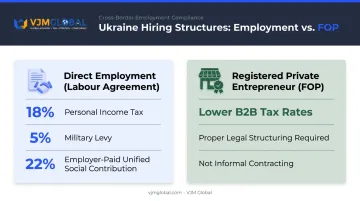
You have two main hiring paths:
- Direct employment (labour agreement): subject to 18% personal income tax, a 5% military levy withheld from wages, and 22% unified social contribution paid by the employer
- Registered Private Entrepreneurs (FOPs): a business-to-business regime with lower rates, but one that requires proper legal structuring, not informal contractor arrangements
Factor in business insurance and war-risk considerations for any staff working on the ground. Political-risk insurers like MIGA have issued over USD 573 million in guarantees for Ukraine-related risk since the invasion began.
Common miss: Misclassifying employees as freelancers to save on payroll tax without the legal structure to back it up.
Step 7 – Handle Travel, Visas, and On-the-Ground Presence
Canadians can enter Ukraine visa-free for up to 90 days within any 180-day period for tourism or business purposes. The Canada-Ukraine Free Trade Agreement (CUFTA) business-visitor category further eases entry for meetings, transfers, and investment-related activities.
Relocating to actively manage the company is different: it requires a work permit (obtained by the employer first), a long-term D visa, and a subsequent temporary residence application.
Common miss: Booking in-person travel before checking the latest Government of Canada travel advisory and restricted-region list. That advisory currently recommends avoiding all travel to Ukraine.
Conclusion
Success in Ukraine comes down to getting the legal structure, resident director, and compliance basics right, not moving fast. CUFTA and the tax treaty give Canadian founders real structural advantages, but only if they're applied correctly from the start.
Regulatory conditions in Ukraine shift often, from currency-control easing to VAT thresholds. Get professional cross-border tax and compliance guidance before you commit capital. That step is often the difference between a smooth setup and a costly correction six months in.
Frequently Asked Questions
Does Canada have free trade with Ukraine?
Yes, through the modernised Canada-Ukraine Free Trade Agreement (CUFTA). It covers tariff reductions and eases business-visitor entry for executives, investors, and intra-corporate transferees.
Does Canada have a tax treaty with Ukraine?
Yes. The 1996 treaty helps prevent double taxation on income, dividends, and profits moving between the two countries, with reduced withholding rates on cross-border payments.
Can a Canadian fully own a company in Ukraine?
Yes, Canadians can hold 100% ownership of a Ukrainian LLC. The appointed director, however, must have Ukrainian residency status (a foreign shareholder alone doesn't satisfy this requirement).
Do I need to relocate to Ukraine to run my business?
No. Many founders operate remotely with a local resident director handling day-to-day legal duties. Relocation is optional and requires a work and residence permit if you choose it.
Is it safe to start a business in Ukraine given the ongoing war?
Risk varies significantly by region. Canada's current travel advisory urges avoiding all travel, so a remote-first structure with a strong local partner is the safer near-term approach.
How long does company registration take from Canada?
Core registration can move quickly, sometimes within days. The full process, including your tax number, VAT registration, and bank account setup, typically takes several additional weeks.