Introduction
India's interior design market is expanding fast. Mordor Intelligence pegs its value at $35.48 billion in 2026, growing to $65.01 billion by 2031 — a 12.87% annual growth rate driven by urbanization, new real estate stock, and Instagram-fueled design awareness.
That growth is pulling in an unexpected group of entrepreneurs: people sitting in the USA.
NRIs want to build something back home. US-trained designers see an underserved market ready for their aesthetic. Even non-Indian small business owners are eyeing India as a lower-cost base for a creative venture they can run partly online.
What usually slows them down is not the design work. It is entity setup, tax, and compliance when the founder sits in New York and the business runs in Noida or Mumbai.
This guide covers the standard steps of launching a design business, plus the cross-border legal and tax work that only applies to US-based founders.
Key Takeaways
- USA founders carry extra layers locals don't: entity structure, FDI compliance, and dual-country tax filing.
- A resident director or trusted local partner is non-negotiable for most legal structures.
- Registration and compliance take several weeks before you can legally bill a client.
- Local execution talent matters more than your physical presence in India.
- The India–US DTAA prevents double taxation—only if you document it correctly.
What to Know Before You Start: Setting Expectations for a USA-Based Founder
An interior design business takes more than a portfolio and a laptop. Clients expect space planning, material and furniture sourcing, styling, and on-site project management. This is hands-on, execution-heavy work.
Running it from the USA changes your daily role. You'll split time between:
- Design and creative direction (the part you can do from anywhere)
- Overseeing compliance, vendors, and site execution through a local team (the part you can't)
You won't be walking the site every week. Someone else will be, and your job is making sure that someone reports back reliably.
Entity registration alone can take around two weeks for a straightforward private limited company. GST registration, PAN/TAN, and a working vendor network push the full timeline further out.
Most USA-based founders should plan for several weeks to a few months before the business can bill its first client. Rushing this stage is where most founders get into trouble.
How to Start an Interior Design Business in India from the USA – Step by Step
Launching from the USA means handling the usual startup steps plus cross-border requirements most local founders never face. Three mistakes show up repeatedly:
- Taking on client work before registration is legally complete
- Underestimating how much a 10–12.5 hour time difference disrupts remote management
- Treating compliance as an afterthought instead of a launch requirement
Step 1 – Validate the Market and Define Your Niche in India
Start with real demand data, not assumptions. Tier-2 cities are no longer the discount market people assume.
According to Business Standard's December 2025 report, average home-interior spending in Tier-2 cities has reached ₹3.9 lakh per home (74% of metro-level spending), with 82% of that demand coming from renovation-driven resale homes.
Since in-person validation isn't an option from the USA, validate remotely instead:
- Interview prospective clients over video calls through local family, friends, or existing contacts
- Partner with a local market research contact who can walk properties and report back
- Study competitor pricing and portfolios on Instagram and Houzz India
Your strongest differentiator is often the aesthetic you bring from abroad. Minimalist, Scandinavian, or modern Western design sensibilities still stand out in many Indian markets. Lean into that rather than trying to outcompete fully local firms on their own turf.
Step 2 – Decide How Operations in India Will Be Managed
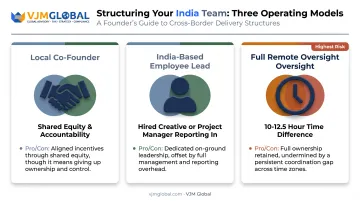
You have three real options:
- Bring in a local co-founder or operating partner who shares equity and accountability
- Hire an India-based creative or project lead as an employee, not a partner
- Attempt full remote oversight, coordinating contractors directly yourself
Option three sounds appealing until you hit the clock. A 10 to 12.5-hour time difference means your 9 a.m. New York call lands at 7:30 p.m. or later in India. Site visits, vendor negotiations, and client walkthroughs all happen while you're asleep.
Most first-time USA-based founders do better with at least one trusted person physically present for site supervision and client-facing meetings. It's the single biggest factor separating smooth launches from stalled ones.
Step 3 – Define Your Service Model and Pricing for the Indian Market
Three common models exist in India:
- Full-service design — you handle everything from concept to execution
- Consultation-only — you advise, the client executes
- E-design — virtual mood boards and shopping lists, with local execution
E-design deserves special attention here. It's the model best suited to someone based in the USA: you deliver the creative concept remotely while a local team executes on the ground.
On pricing, Indian designers typically charge 10–15% of total project cost, or a separate design fee running roughly ₹50–₹200 per square foot, depending on scope and city. Benchmark these against your own cost structure and desired USD-equivalent earnings before quoting.
Don't underprice to compete locally. Site visits, sourcing trips, and vendor coordination cost the same whether you're charging premium or discount rates. Undercutting yourself just erodes margin without winning better clients.
Step 4 – Register Your Business and Complete Statutory Registrations
The typical registration stack for an interior design business includes:
- Company or LLP registration with the Registrar of Companies (ROC)
- GST registration
- PAN (and TAN, if hiring)
- Shop & Establishment registration
- Trade license (varies by municipality)
As a non-resident founder, expect added layers most India-based founders never deal with:
- KYC documentation tied to your foreign address and identity
- A resident director for a private limited company (someone who has stayed in India at least 182 days in the preceding financial year, per Section 149(3) of the Companies Act)
- Coordination between your US paperwork and Indian filing requirements
This is the stage where most USA-based founders get stuck without local guidance. Working with a firm experienced in cross-border entity formation, such as VJM Global, can keep registration delays from turning into weeks of lost client onboarding time.
Step 5 – Build Your Local Team, Vendor and Supplier Network
You can hire designers, contractors, and site supervisors remotely using video interviews and project management tools like Asana or Trello. What you can't do remotely is build supplier trust from scratch.
- Work through a trusted local point person to establish relationships with material, furniture, and fixture vendors
- Let that person negotiate pricing and payment terms — supplier trust in India is relationship-driven, not transactional
- Set up quality-control checkpoints: photo and video site updates, milestone sign-offs before payments release
These checkpoints aren't optional extras. They're your substitute for walking the site yourself.
Step 6 – Launch, Market and Monitor the Business Remotely
Build a digital presence that works while you sleep:
- A portfolio website optimized for local SEO in your target city
- Instagram and Pinterest showcasing completed projects
- Google Business Profile for local search visibility
Set up financial tracking and client communication systems built around the time gap: asynchronous updates, shared dashboards, and scheduled overlap-hour calls work better than trying to force real-time availability.
Once the first few projects are running, resist the urge to scale immediately. Stabilize compliance and operations first, then take on more.
Choosing the Right Legal Structure and Registering Remotely
This is the most consequential decision you'll make. Your structure determines ownership, liability, tax treatment, and how much physical presence in India is legally required.
| Structure | Ownership | Liability | Local Presence Needed |
|---|---|---|---|
| Wholly-owned private limited subsidiary | Full foreign ownership possible | Limited | 1 resident director required |
| LLP with foreign capital | Full foreign ownership possible | Limited to contribution | Varies by partner arrangement |
| Branch/liaison office | Parent company retains control | Branch: unlimited | RBI approval required; limited use for a design startup |
| Partnership with an Indian resident | Shared ownership | Depends on structure | Resident partner handles on-ground matters |
Under India's Consolidated FDI Policy, sectors not separately listed, including interior design services, fall under the default rule. That rule allows up to 100% FDI via the automatic route, so no prior RBI or government approval is required for the investment itself. That's good news for a USA-based founder who wants full ownership. Still, confirm the current sector classification before filing. Policy specifics can shift.
A few things apply regardless of structure:
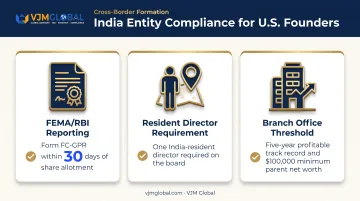
- Foreign capital into an Indian entity triggers FEMA and RBI reporting, including Form FC-GPR within 30 days of share allotment
- A private limited company needs at least one India-resident director on its board
- Branch offices usually need a five-year profitable track record and $100,000 minimum net worth at the US parent—often impractical for a first-time design venture
Firms experienced in cross-border entity formation, like VJM Global, work with foreign and NRI founders on choosing the right structure and filing it correctly. A missed FEMA filing or a delayed resident-director appointment can stall client onboarding, so this step is worth getting right before you market to Indian clients.
Tax, Compliance and Repatriation: What USA-Based Founders Must Know
Running an Indian business from the USA means two parallel sets of obligations, not one.
On the Indian side, you'll manage GST returns, annual ROC filings (AOC-4 and MGT-7), and income tax returns for the entity.
On the US side, you report worldwide income. Depending on ownership structure, you may also face FBAR and FATCA (Form 8938) disclosure requirements for foreign entity ownership.
How the DTAA Prevents Double Taxation
The India-US Double Taxation Avoidance Agreement, in force since 1990, generally taxes business profits only in the enterprise's home country, unless the business operates through a "permanent establishment" in the other country.
Once you have an Indian entity actively running projects, that PE threshold is typically crossed. India then gets primary taxing rights over India-sourced income.
Claiming DTAA relief isn't automatic. You'll typically need:
- A Tax Residency Certificate (TRC), obtained via Form 10FA
- Form 10F
- PAN documentation for the foreign entity or individual
Skip the paperwork, and you risk paying tax twice on the same income.
GST and Invoicing
Design services delivered within India require GST registration once you cross the applicable turnover threshold. That means:
- Assigning the correct SAC code to your invoices
- Determining whether CGST/SGST or IGST applies based on the client's location
- Structuring client contracts so GST is clearly itemized, not buried in a lump-sum fee
Repatriating Profits Back to the USA
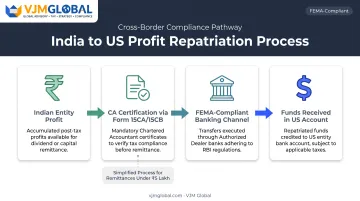
Sending profits from your Indian entity to a US account isn't a simple wire transfer. It runs through FEMA-compliant banking channels and typically requires Form 15CA/15CB certification: a chartered accountant's certificate confirming applicable taxes have been withheld before the remittance goes out.
Payments below ₹5 lakh in a financial year have a simplified process. Larger or recurring remittances need the full certification route.
These obligations interlock, so multi-jurisdiction support matters early. VJM Global works with American business owners entering India on accounting, tax, and payroll compliance across both markets, including this dual-filing complexity.
Common Mistakes to Avoid (and Final Thoughts)
A few patterns show up again and again with USA-based founders:
- Starting paid work before registration and GST setup finish. This creates invoicing and legal complications that are harder to fix later than to prevent upfront.
- Trying to run everything 100% remotely with zero local presence. It usually ends in vendor mistrust, missed site issues, and clients who feel ignored.
- Ignoring tax obligations in one country, or skipping DTAA documentation. Both lead to double taxation or repatriation delays that quietly eat into profit margins.
Success comes down to three things. Get the entity structure and compliance right before you touch a client project. Build a local execution team you can trust. And move design ambitions only as fast as the legal groundwork allows—not the other way around.
If you want help with India-side registration, GST, or cross-border tax documentation, a firm like VJM Global can cover that groundwork while you focus on the design work.
Frequently Asked Questions
How do I start an interior design business in India?
Define your niche, choose a business structure, complete registrations (GST, ROC, trade license), build a local team, and market to your target client segment. Each step builds on the last, so sequencing matters.
Is an interior design business profitable in India?
Profitability depends heavily on niche, location, and pricing model. The market's steady 12.87% projected growth rate is a positive signal, but margins hinge on how well you manage vendor costs and overhead.
How long does it take to register an interior design company in India?
A private limited company typically takes 2–4 weeks once documents are ready, covering DSC, DIN, name approval, and incorporation. GST and other licenses add time after the COI is issued.
Can a US citizen or NRI own 100% of an interior design company in India?
Most interior design and professional services fall under the 100% automatic-route FDI category, allowing full foreign ownership. Standard FEMA/RBI compliance still applies, and current sector rules should be confirmed before filing.
Do I need to live in India to register a company there?
No, physical residence isn't mandatory for most structures. A private limited company does require at least one India-resident director, which is why many founders bring in a local partner or professional service for this role.
How do I repatriate profits from my Indian interior design business to the USA?
Profits move as dividends or remittances through FEMA-compliant banking channels, typically requiring Form 15CA/15CB certification and confirmation that applicable taxes have been withheld before the transfer.