
British entrepreneurs are eyeing India for good reason: a fast-growing consumer base, a deep English-speaking talent pool, and liberalised rules that now allow 100% foreign ownership in most sectors. Interest is coming from every direction, too, whether that's SMEs testing outsourcing options, established companies wanting a full subsidiary, or British-Indians investing back home.
This guide walks through exactly what it takes for a UK-based founder or company to legally register and operate a business in India, step by step.
Key Takeaways
- India permits 100% foreign ownership in most sectors, though structure choice depends on your goals
- Every entity needs a resident director, registered office, and day-one Companies Act and FEMA compliance
- Registration runs through SPICe+, but realistic timelines run several weeks, not days
- ROC filings, GST, audits, and FEMA reporting are recurring annual duties, not one-off tasks
- Local guidance early on prevents the costliest mistakes UK founders tend to make
What Is Starting a Business in India as a UK Foreigner?
Legally, "starting a business in India" as a UK national or UK company means one of two things. You can incorporate a new Indian legal entity, or you can set up a non-incorporated presence such as a liaison, branch, or project office.
Under the Companies Act, 2013, a foreign company is any entity incorporated outside India with a place of business here, whether that presence is physical, digital, or run through an agent. This classification determines which compliance regime applies to you from the outset.
UK entrants typically choose from six formats:
- Wholly Owned Subsidiary (Private Limited Company) – full trading rights, separate Indian legal entity
- Limited Liability Partnership (LLP) – lower compliance burden, popular for services
- Branch Office – limited commercial activity under RBI approval
- Liaison Office – non-trading, market research only
- Project Office – time-bound presence tied to a specific contract
- Joint Venture – shared ownership with an Indian partner
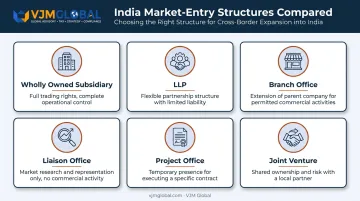
Each serves a different purpose. Some are built for trading and revenue; others exist purely to test the water before committing further.
What to Know Before You Start a Business in India
Company formation in the UK can happen in a day. India's process is considerably more document-heavy, and setting that expectation early saves frustration later.
Timelines Take Longer Than the Portal Suggests
VJM Global's filing benchmarks show a theoretical baseline of about 13 working days:
- DSC issuance: roughly 2 working days
- DIN application: 1 day
- Name approval: around 5 days
- Incorporation: another 5 days
In practice, apostille requirements for UK-based directors and occasional RoC queries push most UK founders toward a 3-to-5-week planning horizon instead.
Compliance and Market-Entry Strategy Take Priority Early
Every Indian company needs at least one director who has stayed in India for the minimum prescribed period during the financial year under Companies Act rules. Most UK founders don't have someone who already meets this test, so arranging a resident or nominee director needs to happen early.
Director residency is just one piece of a larger puzzle. In the first few months, success often depends less on your product and more on how well you handle FEMA rules, sector caps and RBI approvals, since these determine which entity structure actually fits.
That structure question usually comes down to testing the market versus committing fully. A liaison office lets you dip a toe in without full commitment, while a subsidiary commits you to operating, invoicing and full compliance from day one. Confuse the two and you'll hit a wall fast.
Why Start a Business in India from the UK (When It Makes Sense)
India entry isn't an automatic win. It works when your sector and structure genuinely fit the market, not because the growth numbers sound impressive on their own.
That said, the numbers are worth knowing. India became the world's fourth-largest economy in 2025, with government estimates putting real GDP growth at 7.7% for FY2025-26. That's rare momentum for a market UK businesses can now enter with fewer barriers.
The UK-India Comprehensive Economic and Trade Agreement (CETA) reinforces this. Under the deal, India will remove or reduce tariffs on 90% of tariff lines, covering 92% of existing UK goods imports. A standalone financial services chapter also locks in market access for UK insurers and fintechs.
Beyond trade terms, three factors consistently draw UK businesses in:
- A large, increasingly digital consumer market, especially across fintech, IT services and renewable energy
- A deep, English-speaking, cost-competitive talent pool, well suited to back-office and IT delivery functions
- Liberalised FDI policy allowing 100% foreign ownership under the automatic route in most sectors, cutting the friction that defined earlier decades of India market entry
Early Decisions That Matter When Starting a Business in India
Most UK founders don't run into trouble because they lack effort; they underestimate how much compliance complexity sits beneath a seemingly simple registration fee.
Four areas get overlooked most often:
- True first-year cost. The government filing fee is only one line item. Factor in resident director arrangements, a compliant registered office, professional fees, and statutory audit costs, and the real first-year figure often crosses ₹1,00,000 once these add up, well beyond the "low-cost registration" headline.
- Automatic route vs government approval. Some activities clear instantly under the automatic FDI route, while others, like defence or multi-brand retail, need prior government approval, which changes your entire timeline.
- Incorporated vs operational. Receiving your Certificate of Incorporation is not the finish line. Opening a bank account, registering for GST, and completing your first compliant financial year all take additional weeks.
- Finding a trustworthy resident director and address. Both are prerequisites for filing, not steps you can sort out afterwards.
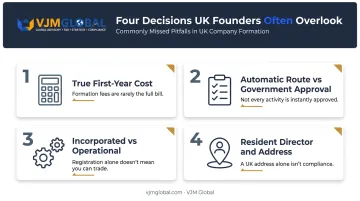
Get these four right before you file, and the rest of the process moves considerably faster.
How to Start a Business in India – Step by Step
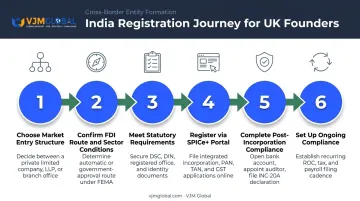
This section breaks the journey into the practical stages a UK founder will actually go through, from choosing a structure to staying compliant long after incorporation.
Three mistakes come up repeatedly: picking a structure based on cost alone, assuming no resident director is needed, and treating incorporation as the finish line rather than the starting point.
Step 1 – Choose Your Market Entry Structure
Match the structure to your actual goal, not the one that sounds simplest:
| Structure | Best for | Key limitation |
|---|---|---|
| Subsidiary (Pvt Ltd) | Full trading, revenue generation | Higher compliance load |
| LLP | Service businesses, lower compliance | Less familiar to some investors |
| Branch Office | Limited commercial activity | Needs RBI approval |
| Liaison Office | Market research only | Cannot invoice or trade |
| Project Office | Time-bound contracts | Scope tied to project |
| Joint Venture | Sectors with FDI caps | Shared control with partner |
The most common misstep: choosing a liaison office for "safety," then discovering it cannot invoice Indian clients at all. Correcting this typically means upgrading to a branch office or incorporating a fresh Private Limited Company. Both options cost more time and money than getting the structure right from the start.
Step 2 – Confirm the FDI Route and Sector-Specific Conditions
Check whether your intended activity sits under the automatic route (no prior approval needed, most sectors) or the government approval route (defence, insurance above certain thresholds, multi-brand retail, and similar sensitive categories).
Sectoral caps vary widely. Manufacturing and e-commerce marketplaces generally allow 100% automatic FDI, while multi-brand retail is capped at 51% under the government route. Don't assume full ownership is available everywhere; verify it against your specific sector before finalising anything.
Step 3 – Meet Statutory Requirements Before Filing
Two prerequisites must be in place before you can file:
- A resident director who meets the minimum days-in-India requirement for the financial year
- A compliant registered office address, which sets your entity's legal jurisdiction
Leaving the resident director search until after other paperwork is ready is the most common cause of avoidable delay. Sort this first.
Step 4 – Register the Company Through SPICe+
The incorporation process itself runs through the Ministry of Corporate Affairs' SPICe+ portal:
- Reserve a company name through the RUN/SPICe+ service
- Obtain Digital Signature Certificates (DSC) for all proposed directors
- Secure Director Identification Numbers (DIN) for each director
- File the incorporation application, along with the Memorandum and Articles of Association, electronically
UK-based directors typically also need to submit certain documents in hard copy, notarised or apostilled. Underestimating this step is a frequent cause of delay, so start document preparation well before the online filing window opens.
Step 5 – Complete Post-Incorporation Compliance
Once the Certificate of Incorporation arrives, along with your CIN, PAN and TAN, you'll need to:
- Open an Indian bank account and deposit any required share capital within the prescribed window (up to 180 days)
- File Form FC-GPR with the RBI within 30 days of any share allotment against foreign investment, as required under FEMA
Missing the FC-GPR deadline attracts penalties even for companies that are otherwise fully compliant. This single filing catches out more UK founders than almost any other step.
Step 6 – Set Up Ongoing Compliance and Operations
With the entity live, attention shifts to operational readiness:
- Register for GST if your activity requires it
- Set up payroll and accounting systems
- Build a compliance calendar covering annual ROC filings, statutory audit, board and shareholder meetings, and income tax returns
Because this is a recurring annual obligation rather than a one-time task, many UK companies choose to outsource entity formation and back-office compliance to a specialist firm. VJM Global, for instance, delivers company registration, accounting, tax and FEMA compliance for UK businesses entering India using in-country teams who work directly with Indian regulators.
Treating incorporation as "done" is the mistake that costs the most further down the line. Compliance gaps tend to surface at the first annual filing deadline, when they're hardest to fix quickly.
Conclusion
Starting a business in India as a UK foreigner comes down to choosing the right structure and getting the statutory basics right from day one. Speed is secondary.
FDI route confirmation, a genuine resident director arrangement, and timely FEMA reporting matter more to long-term success than how fast your Certificate of Incorporation lands. Ongoing compliance, not the registration date, determines whether your India entity stays in good standing.
Professional support, such as VJM Global's India-entry advisory for UK founders, won't remove every obstacle, but it materially reduces the risk of the errors that catch most founders off guard.
Frequently Asked Questions
How much money is needed to start a business in India?
Government filing fees for a Private Limited Company are modest and vary with authorised capital and director count. Budget for the full first year, including resident director arrangements, a registered office, and compliance fees, not just registration.
Can a British citizen start a business in India?
Yes, a British citizen can start a business in India, though most structures require at least one India-resident director. Foreign nationals are also generally restricted from forming a One Person Company.
Does a foreign company need a resident director in India?
Yes. Every Indian company must have at least one director meeting the minimum days-in-India requirement for the financial year. This is a genuine statutory role that carries personal liability.
What is the best business structure for a UK company entering India?
A wholly owned subsidiary suits full trading operations, an LLP suits lower-compliance service businesses, and a liaison office suits market research only. The right pick depends on whether you plan to earn revenue in India.
How long does it take to register a company in India?
Online filing has sped things up, but obtaining DSC, DIN, name approval and incorporation typically takes several weeks in practice. Plan for 3 to 5 weeks rather than the theoretical minimum of around 13 working days.
Do I need to visit India in person to register my company?
Most of the SPICe+ filing process can be completed remotely using digital signatures. However, opening a bank account and certain document notarisation or apostille steps may still require in-person handling.