The interest isn't limited to one type of founder. Dutch freelancers testing a product idea, established NL companies wanting an Italian branch, and investors chasing Italian lifestyle or retail opportunities are all asking the same question: what does it actually take to set up shop there?
This guide walks through the legal and practical steps, in order, for a Netherlands-based founder starting a business in Italy.
TL;DR
- Italy offers EU-wide market access plus strong sectors in fashion, food, and manufacturing
- As EU citizens, Dutch nationals face minimal bureaucratic barriers to establishing a business in Italy
- Choosing between an SRL, sole proprietorship, or branch office is your first major decision
- Budget for registration costs, notary fees, and share capital alongside VAT and tax registration
- Plan a multi-step path through legal setup, banking, and compliance before revenue starts
What Does Starting a Small Business in Italy from the Netherlands Involve?
In short: setting up a legally recognised entity or self-employed activity in Italy while remaining based in, or originating from, the Netherlands.
As an EU/EEA citizen, a Dutch founder faces far fewer restrictions than a non-EU applicant. No business visa is required, and Italian authorities must treat you the same as an Italian national when it comes to setting up a company. Registration and tax steps, however, still apply in full.
Structure options generally include:
- Sole proprietorship (ditta individuale) for solo operators
- SRL (limited liability company), Italy's most common small-business vehicle
- Branch of a Dutch company, extending an existing Dutch entity into Italy
- Partnership, for founders working with Italian co-owners
What to Know Before You Start a Business in Italy
Dutch founders often underestimate Italy's bureaucratic pace. Processes that take a week in the Netherlands can take a month in Italy, particularly where paper documentation and in-person appointments are involved.
Before you commit, work through these considerations:
- Language and documentation — most filings are Italian-only, and you'll either need fluent Italian or a local representative
- Remote vs. relocation — can you run the business from the Netherlands, or does it need someone on the ground?
- Realistic timeline — registration alone often takes several weeks; first revenue typically follows months later
- Local presence — even NL-based founders usually need a registered Italian office address
- Full entity vs. lighter alternatives — an Employer of Record (EOR) arrangement or a Dutch-company branch can let you test the market before committing to a full Italian entity
Why Start a Business in Italy? (When It Makes Sense for Dutch Entrepreneurs)
Expansion into Italy makes sense under specific conditions, not automatically. Here's when it typically pays off:
- Market size — Italy generates roughly EUR 2.2 trillion in GDP and is Europe's second-largest manufacturing economy, giving entrants a large industrial and consumer base
- No immigration hurdles — EU freedom of movement means Dutch citizens need no visa or residency permit to set up or run a business
- Sector demand — food, fashion, tourism, and B2B services aimed at Italy's sizeable expat community all show consistent demand
- Government incentives — regional tax relief schemes exist for new businesses and relocating professionals, though eligibility varies significantly by region
- Logistics position — Italy is well placed for onward trade into Southern Europe and the Mediterranean if your supply chain extends beyond the EU's northern core
None of this guarantees success. It simply means the structural barriers Dutch founders worry about most, immigration and market access, are largely already solved.
Early Decisions That Matter: Business Structure and Costs
Most delays in this process come from picking the wrong entity type or underestimating true costs, not from lack of effort.
Choosing Your Legal Structure
| Structure | Capital requirement | Best for |
|---|---|---|
| Sole proprietorship | None | Solo freelancers, low-risk activity |
| SRL (ordinary) | EUR 1 minimum (stricter contribution rules above EUR 10,000) | Most small companies wanting liability protection |
| SRLS (simplified) | EUR 1 to EUR 9,999.99 | Founders who are natural persons, minimal formalities |
| SpA | EUR 50,000 minimum | Larger ventures, rarely needed for small businesses |
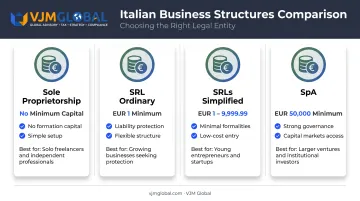
A common mistake is assuming EUR 10,000 is some kind of recommended minimum for an SRL. It isn't. It's simply the point at which contribution rules tighten, not a legal floor.
Entity choice only works if you budget the full setup path, not just share capital.
Costs Often Overlooked
- Notary fees still apply around the process even when a simplified SRLS has no notarial fee for the incorporation deed itself
- VAT (Partita IVA) and tax code (Codice Fiscale) registration are required from day one
- Local notary and Italian-speaking advisor support is hard to skip given the paperwork
- EOR alternative lets you test demand via an Employer of Record without incorporating yet
How to Start a Small Business in Italy from the Netherlands – Step by Step
Common mistakes worth flagging upfront: assuming Dutch business registration transfers automatically (it doesn't), underestimating notary and legal costs, and missing VAT filing deadlines once trading begins.
Step 1 – Choose Your Business Structure and Validate the Italian Market
Compare an SRL, sole proprietorship, and branch office against your liability appetite and growth plans. Validate real demand among Italian or expat customers before committing capital.
Common miss: choosing an SpA when a far simpler and cheaper SRL would do the job.
Step 2 – Gather Documentation and Get a Codice Fiscale
You'll need:
- A valid passport
- Proof of Dutch address
- Articles of Association, drafted with an Italian notary
As an EU citizen, applying for your Codice Fiscale involves booking an in-person appointment at the Agenzia delle Entrate and presenting your ID at the counter.
Common miss: attempting other registrations before securing the Codice Fiscale. Nearly everything else depends on it.
Step 3 – Register with the Italian Business Register and Get a VAT Number
File with the Registro delle Imprese via your local Chamber of Commerce, typically through the integrated ComUnica system, which bundles Business Register, tax, and social security filings into one submission.
Then obtain your Partita IVA (VAT number) from the Agenzia delle Entrate. For individual businesses, this must be filed within 30 days of starting activity using form AA9/12.
Common miss: delaying VAT registration, then discovering you can't legally invoice clients.
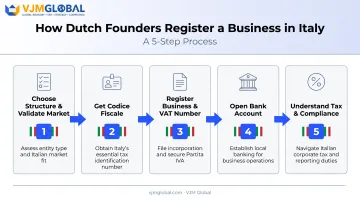
Step 4 – Open an Italian Business Bank Account
You'll need an account to deposit required share capital and run day-to-day transactions. Plan how funds will move between your Dutch and Italian accounts before you start—non-resident verification often takes longer than founders expect.
Cross-border advisors such as VJM Global help coordinate Italian entity formation, tax registration, and ongoing compliance so the new setup aligns with your existing Dutch structure.
Common miss: assuming account opening will happen as quickly as it does in the Netherlands.
Step 5 – Understand Tax, Payroll, and Compliance Obligations
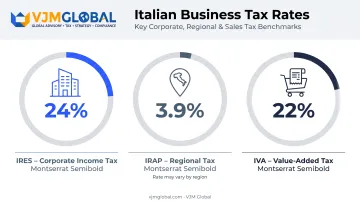
Italy's core business taxes:
- IRES (corporate income tax): 24% standard rate
- IRAP (regional tax): 3.9% standard rate, though regions can adjust it
- IVA (VAT): 22% standard rate
If hiring staff locally, social security contributions apply, and the exact rate depends on worker category and sector.
Common miss: assuming Dutch filing habits carry over. Italian deadlines, rates, and filing cadence are different, and IRES alone doesn't cover your full compliance stack.
Legal and Practical Considerations for Dutch Founders
EU citizenship simplifies immigration considerably. It does nothing to simplify tax and compliance complexity.
Key points:
- No visa needed as an EU citizen. Stays beyond three months still require registration with the local municipality's population register (iscrizione anagrafica); that is a residence formality, not a business visa
- Equal treatment applies: Dutch nationals get the same investment and business-formation rights as Italian citizens, without the reciprocity tests non-EU founders face
- Dual compliance applies if you keep a Dutch entity running alongside the new Italian one
That means two filing calendars, tax rates, and reporting formats at once: KvK in the Netherlands and Registro delle Imprese in Italy. A cross-border compliance partner can keep both jurisdictions aligned so deadlines do not collide.
Conclusion
Starting a business in Italy from the Netherlands is manageable, largely thanks to EU integration removing the immigration hurdles that trip up non-EU founders. Success still hinges on picking the right structure and working through registration steps in the correct order, rather than skipping ahead and hoping VAT sorts itself out later.
Bilingual, locally informed support for notary, tax, and banking steps cuts those delays significantly. Firms with cross-border entity formation experience across 100+ countries, such as VJM Global, can help with dual-jurisdiction compliance while you operate across two EU markets. Italy-specific filings still go through Italian notaries and registrars.
Frequently Asked Questions
How much money do you need to start a business in Italy?
An SRL can technically start with EUR 1, though most founders budget more once notary and registration costs are included. An SpA requires a EUR 50,000 minimum. Add registration and notary fees on top of whichever structure you choose.
What legal business structures are available in Italy?
Options include sole proprietorship, SRL (ordinary or simplified), SpA, and branch or partnership structures. Most small Dutch-founded businesses opt for an SRL due to its liability protection and low capital entry point.
What business can I start in Italy?
Fashion, food and beverage, tourism, manufacturing niches, and services aimed at Italy's expat community are all strong options with demonstrated demand.
What is the 7% rule in Italy?
This is a flat tax regime for foreign pensioners relocating to qualifying small municipalities in Southern Italy, taxing eligible foreign-source income at 7% for nine years. It's a pensioner relocation scheme, not a tax break for active business founders.
Does Italy offer payments or incentives to people who move there?
Some municipalities have offered relocation grants, such as Tuscany's mountain-residency scheme or Puglia's Presicce programme. These are town-specific property and residency incentives—not general business-startup grants—and availability changes often.
Can Dutch citizens start a business in Italy without a visa?
Yes. As EU citizens, Dutch nationals don't need a visa or work permit to establish a business in Italy. Tax registration, VAT setup, and Business Register filing steps still apply regardless.