Introduction
NRIs, US-based IT and finance professionals, and even non-Indian American investors are increasingly eyeing small hotels, guesthouses, and homestays in India as income-generating assets back home. India's domestic tourism engine is massive: 2,948.19 million domestic tourist visits were recorded in 2024, according to the Ministry of Tourism.
Favorable USD-to-INR conversion, demand for semi-passive income, and family land sitting idle back home all strengthen the case. This interest spans second-generation NRIs, first-generation immigrants with ancestral property, and American entrepreneurs exploring emerging hospitality markets.
This guide covers what it takes: not just the hotel side, but the cross-border legal and tax layer most guides skip entirely.
Key Takeaways
- Cross-border hotel setup adds entity structure, FEMA/RBI reporting, and US-India tax planning to standard hospitality steps
- Investment costs swing sharply by city tier and category: budget rooms cost far less than mid-market ones
- Appoint a trusted on-ground representative; most India-side approvals cannot be completed remotely
- Correct FEMA reporting from day one prevents repatriation blocks and dual-tax headaches later
What Is a Small Hotel Business in India — and Why Are US-Based Investors Eyeing It?
A small hotel business in India typically means a lodging property with anywhere from a handful of rooms up to around 30, offering guest accommodation and basic services for budget-to-midscale domestic or leisure travelers.
For a US-based owner, this usually takes one of a few shapes:
- An NRI-owned property run by a hired local manager
- A family guesthouse converted from ancestral land
- A co-branded budget hotel under an established chain
- A joint venture with a resident Indian partner
When It Makes Sense — Not a Guaranteed Win
This isn't an automatic success story. India's tourism economy contributes an estimated USD 231.6 billion, ranking it 8th globally, according to Invest India. That scale of demand supports room for well-run small lodging, not only large resorts.
Currency and diversification matter too. USD savings often buy more operating capacity in an Indian hospitality asset, and the property sits outside US real estate and equities.
The common miss: many NRIs get pulled in by nostalgia or the availability of family property, without first validating local demand, competition, or (most critically) who will manage the property day to day. A hotel that looks great on a video call can still fail without someone trustworthy running it in person.
Legal, Entity & Tax Compliance Roadmap for US-Based Owners
Most cross-border hotel projects don't stall on hospitality know-how. They stall on getting the legal, ownership, and compliance layer wrong from day one.
Choosing the Right Entity Structure
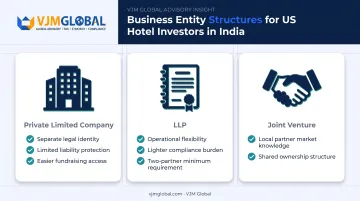
Three main routes exist:
- Wholly-owned Indian private limited company: separate legal identity, limited liability, easier to raise debt or equity later
- LLP (Limited Liability Partnership): more operational flexibility and lighter compliance, with at least two partners and one India-resident designated partner
- Joint venture or partnership with a resident Indian co-owner: useful when you need local market knowledge or regulatory familiarity
Tourism and hospitality currently permit 100% FDI under the automatic route, per India's FDI Policy, subject to standard sector conditions and the land-border rule. Confirm current sector-specific terms before committing, since policy details do get updated.
Direct property purchase with sole-proprietor operation is also possible for NRIs in some cases. However, it carries different liability and repatriation implications than a corporate structure, so weigh this carefully against your long-term plans.
FDI, FEMA & RBI Reporting Obligations
Funds remitted from the US into an Indian entity require FEMA-compliant reporting. Miss these filings and you risk blocking future repatriation or additional fund infusion.
Key filings to know:
- Form FC-GPR — reports equity issuance to a nonresident, filed through the Single Master Form within 30 days of issue
- Form FC-TRS — covers transfer of equity instruments, filed within 60 days
- Annual FLA Return — due by July 15 each year for any company with foreign capital
Tax Planning and the India-US DTAA
US citizens and green card holders face dual tax exposure by default: India taxes the business income, while the US taxes worldwide income regardless of where it's earned.
The India-US Double Taxation Avoidance Agreement (DTAA), combined with foreign tax credit mechanisms (claimed via IRS Form 1116 on the US side), helps avoid paying full tax twice on the same income. This isn't automatic. It requires deliberate filing and documentation on both sides.
PAN, TAN, and GST registration apply to a US-owned hotel exactly as they would to any resident-owned property. There's no shortcut around this just because the owner is abroad.
Power of Attorney and Remote Execution
A Power of Attorney lets a trusted local representative sign on the owner's behalf for property transactions, license filings, and bank account operations while the owner remains in the US.
Engaging a firm experienced in cross-border entity formation and India-side compliance can cut delays here. VJM Global, for instance, supports foreign investors and NRIs through incorporation, PAN/TAN acquisition, RBI applications through an AD bank, and coordination with locally authorized representatives. That reduces how many steps require the owner's physical presence.
How to Start a Small Hotel Business in India From the USA – Step by Step
The core process mirrors any hotel launch. What changes is everything that depends on physical presence.
The most common mistake: assuming video calls and photos can replace an on-ground due-diligence visit before committing capital to a property. They can't.
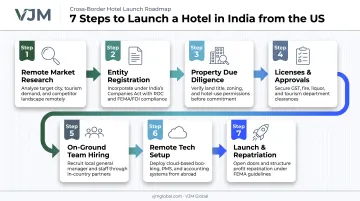
Step 1 – Research the Market and Shortlist a Location Remotely
Use state tourism board data, hotel association reports, and NRI or local networks to shortlist 2-3 towns with genuine, year-round demand — not just one-off tourist buzz. Identify a trusted local point of contact before committing any capital.
Step 2 – Decide on Entity Structure and Register the Business
Finalize your structure based on the roadmap above, then complete incorporation, PAN, TAN, and bank account opening. Much of this can be initiated remotely with digital signatures and a POA holder based in India:
- DIN applications
- MoA/AoA preparation
- ROC filings
Directors still need to provide identity documents and signed forms directly. A cross-border advisor that handles India entity formation can coordinate the remote filings and POA workflow while you stay in the US.
Step 3 – Secure the Property and Complete Due Diligence
Decide between buying, leasing, or converting an existing family property. Have a local legal representative verify land title, zoning, and building approvals before any funds change hands. Skipping this step because "it's family land anyway" is how disputes surface years later.
Step 4 – Obtain Licenses and Regulatory Approvals
Core licenses typically required:
- Trade license (local municipal authority)
- FSSAI registration or license (for food service)
- Fire safety NOC
- GST registration
- Liquor license, if serving alcohol
Most of these must be filed in person or through your POA holder — none of them can be processed remotely from the US.
Step 5 – Build Your On-Ground Team and Management Structure
Hiring a reliable property or general manager early isn't optional for a remote owner. Define reporting cadence, financial controls, and spending approval limits before handing over daily operations.
Step 6 – Set Up Technology for Remote Oversight
A cloud-based property management system (PMS), channel manager, and accounting dashboard let you monitor occupancy, revenue, and expenses from the US in real time — without waiting on monthly phone updates.
Step 7 – Launch, Monitor and Plan for Repatriation
Run a soft launch and track performance against your original plan. In parallel, set up the FEMA-compliant path to repatriate profits to the US, including dividends and applicable TDS compliance.
Cost, Funding & Profitability: What US-Based Owners Should Expect
Development costs vary sharply by hotel category and city tier. Hotelivate's 2025 India benchmark, drawn from 597 hotels across 150 cities, puts construction costs (excluding land) at:
| Category | Cost per key (INR) | Approx. USD |
|---|---|---|
| Budget/Economy | ₹53.2 lakh | ~$61,100 |
| Mid-Market | ₹75.3 lakh | ~$86,600 |
| Upper Mid-Market | ₹96.0 lakh | ~$110,300 |
Source: Hotelivate Construction Cost Insights, 2025. Figures exclude land and vary further by city tier.
For a 30-room budget property, expect roughly ₹16 crore (about $1.8 million) before land. Treat that as a planning baseline; city tier, finishes, and site conditions will move the number.
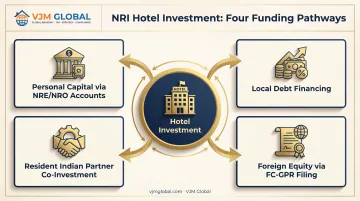
Funding Sources for NRIs and Foreign Investors
- Route personal capital into the Indian entity via NRE/NRO accounts
- Raise debt in the Indian company's name from local lenders
- Co-invest with a resident Indian partner
- Infuse foreign equity and report it through FC-GPR filing
Note: The Liberalised Remittance Scheme's $250,000 annual cap applies to resident individuals sending money out of India. It does not limit an NRI's inbound investment; that path follows FDI and FEMA rules instead.
What Drives Profitability
Three levers matter most: occupancy rate, average daily rate (ADR), and cost control. Industry-wide, national hotel occupancy sat around 64% with an ADR near ₹8,624 in 2025. That is useful context, not a forecast for a small independent property.
The 80/20 rule fits remote ownership well: a large share of revenue often comes from a smaller share of rooms, channels, or guest segments. Identify that core 20% early (your best OTA channel or highest-margin room type) so limited overseas attention goes where it moves profit.
For a US-based owner, profit still rests on two foundations: a strong on-ground manager, and a FEMA-compliant funding path with the right Indian entity and tax structure set before launch.
Conclusion
Starting a small hotel in India from the USA is achievable. Success comes down to doing two things well: the hospitality basics (location, service, pricing) and the cross-border basics (entity structure, FEMA/RBI compliance, and US-India tax planning).
Getting clarity on structure and compliance upfront prevents costly repatriation or tax problems years down the line. Partnering with a firm experienced in both US and India-side entity formation, like VJM Global, can help owners set things up correctly the first time and manage ongoing compliance without needing to be physically present in India.
Frequently Asked Questions
How much does it cost to start a small hotel in India?
Construction costs (excluding land) range from roughly ₹53 lakh per room for budget properties to ₹96 lakh for upper mid-market ones, per 2025 industry data. Actual totals vary significantly by city tier and whether you're building new or converting an existing property.
How profitable is running a small hotel in India?
Profitability hinges on occupancy, ADR, and cost control rather than a fixed benchmark. National averages hover around 64% occupancy and an ADR near ₹8,624, but a small independent property's actual margin depends heavily on local management and demand.
What is the 80/20 rule in hotels?
A large share of revenue or profit often comes from a smaller share of rooms, booking channels, or guest segments. Identifying that core 20% helps you focus limited time on what actually moves performance.
Can a US citizen or NRI legally own a hotel in India?
Yes. Foreign ownership is generally permitted, and tourism and hospitality are open to 100% FDI under the automatic route. Confirm the specific structure and FEMA/RBI reporting requirements for your situation.
What is the best business structure for a US-based owner starting a hotel in India?
It depends on liability preference, funding source, and repatriation plans. A private limited company suits scale and fundraising, an LLP offers more flexibility with fewer compliances, and a JV works well when you need a local partner's expertise.
How do I repatriate profits from my Indian hotel business to the USA?
You can repatriate profits as dividends through FEMA-compliant channels, subject to TDS deductions and Form 15CA/15CB certification. The India-US DTAA and foreign tax credits help prevent that income from being taxed twice.