It's not hard to see why. The UK offers a shared language, a legal system that's transparent by global standards, and steady tourist demand. Add in currency dynamics that sometimes make UK property look attractively priced to USD-based buyers, and the appeal only grows.
This interest isn't limited to major hospitality groups. Solo investors, US hotel operators eyeing international expansion, and family offices are all scouting UK opportunities right now. Most guides cover the hospitality side of hotel ownership well. Far fewer explain the parts that trip up American founders specifically: UK company registration, visa pathways, and cross-border tax compliance. That's what this guide focuses on.
TL;DR
- Ownership is open to Americans — no UK residency or visa needed to hold shares
- Running the hotel yourself needs a separate visa pathway from ownership
- Setup spans research, entity registration, financing, licensing, tax, and hiring (plus a visa plan if you relocate)
- Cross-border tax structuring is the most underestimated part of the process
- Timeline runs several months to over a year — longer than for a UK-resident founder
Why Start a Hotel Business in the UK? (The Opportunity for US Investors)
The UK hospitality market is showing real momentum, but it's not a uniform boom, and understanding where the growth is concentrated matters more than the headline numbers.
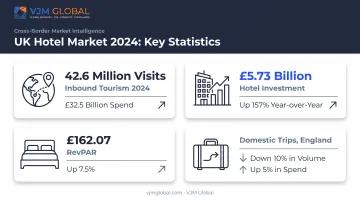
Inbound tourism is strong. The UK recorded 42.6 million inbound visits and £32.5 billion in visitor spending in 2024, both up from the previous year, based on VisitBritain's annual inbound visits and spend data. VisitBritain flags these as statistics still in development, so treat them as directional rather than exact.
Domestic travel is more mixed. Britons took 10% fewer overnight domestic trips in 2024 than in 2023, yet spending on those trips still rose 5% in England. Translation: fewer staycations overall, but travelers spending more per trip when they do go.
Investment appetite has recovered sharply. UK hotel investment hit £5.73 billion in 2024, up 157% year over year and representing nearly a third of all European hotel investment volume, per Savills. Portfolio deals drove much of that activity, though Savills expects more single-asset transactions in 2025.
Why does the UK specifically appeal to US investors?
- English-speaking market with familiar contract and legal norms
- Transparent company registration via Companies House and property registration via HM Land Registry
- Growing appetite for mid-market and boutique concepts, leaving room for differentiated newcomers
- Currency dynamics that can work in USD-holders' favor, depending on timing
Profitability, though, is where expectations need calibrating. BDO's 2024 hotel sector report found revenue per available room rose to £162.07 from £150.71 the year prior, roughly a 7.5% gain.
Gross operating profit stayed flat and remained 1.7 percentage points below 2019 levels. Revenue growth hasn't fully translated into profit growth, largely due to rising labor and utility costs.
The real opportunity isn't uniform across the country. It's concentrated in regions where tourism demand has outpaced the supply of independent, differentiated lodging: secondary cities and heritage towns rather than saturated London postcodes.
Can a US Citizen or Company Start a Hotel Business in the UK?
Yes. There's no UK residency or citizenship requirement to own shares in, or serve as director of, a UK company. Americans can legally own a UK hotel outright.
But ownership and operation are two different things, and this is where most first-time investors get confused.
Owning vs. Operating: Two Different Paths
Path 1: Remote ownership. You invest from the US and hire a UK-based General Manager to run daily operations. No visa required for you.
Path 2: Relocating to run it yourself. You want to be hands-on in the UK. This requires a visa that specifically permits working in the business.
Visa Routes Worth Knowing
| Route | Who it's for | Key requirement |
|---|---|---|
| Innovator Founder | New, scalable, innovative concept | Endorsement from an approved body, active day-to-day involvement |
| UK Expansion Worker | Existing US hospitality business opening a UK branch | Certificate of sponsorship, minimum salary around £52,500 or the occupation's going rate |
| Skilled Worker | UK manager sponsored by the business (owner may stay in the US) | Job offer from an approved sponsor, minimum salary typically around £41,700 |
Entity Options
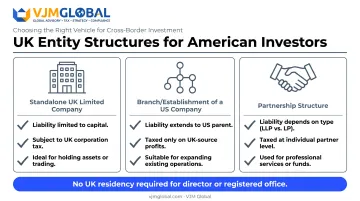
You can structure your UK presence as:
- A standalone UK Private Limited Company (Ltd), registered through Companies House
- A UK establishment or branch of your existing US company
- A partnership structure, less common for hotel ownership but occasionally used
Every option needs a UK registered office address and at least one appointed director. Neither the director nor the office needs to be UK-resident — the address just has to be a genuine physical location in the UK.
Because ownership structure, visa status, and tax obligations all intersect, most first-time American hoteliers don't attempt this solo. VJM Global handles UK entity setup from day one while keeping US-side compliance (Form 5471 and FBAR obligations) aligned with the UK structure.
One common misconception worth killing early: a UK Business Visit visa does not permit running the business day-to-day. It covers meetings, contract negotiations, and site visits, not hands-on operational work.
What to Know Before You Start
Remote ownership sounds simple on paper. It shifts the workload rather than eliminating it.
You're trading direct oversight for management systems. From 3,000 miles away, success hinges on a trustworthy General Manager. You also need reporting structures that give real visibility—not just monthly summaries.
Combined costs add up fast. First-time US investors typically budget for UK property and licensing, then get surprised by:
- Cross-border legal fees on both sides of the Atlantic
- Currency conversion costs on every transfer
- Dual-country tax filing costs that recur annually, not just at setup
Timelines run longer than expected. Entity registration, licensing, and visa approval (if applicable) can each take weeks to months. Run them one after another and your pre-launch runway can stretch past a year. Run them in parallel and a realistic 6–9 month timeline is far more likely than an 18-month slog.
How to Start a Hotel Business in the UK from the USA – Step by Step
US-based founders hit friction points a UK-resident entrepreneur never faces. This walkthrough focuses on those gaps: licensing mismatches, FX exposure, visa timing, and cross-border tax.
Common mistakes worth flagging upfront:
- Assuming US licensing or insurance norms carry over to the UK (they don't)
- Ignoring FX exposure when financing with USD capital
- Leaving visa planning until after signing a lease
Step 1 – Research the UK Hotel Market and Choose Your Niche & Location
Don't import US assumptions. UK travellers move differently than American ones.
- Study UK-specific demand drivers: staycation patterns, business travel corridors, underserved niches like extended-stay or boutique properties
- Compare candidate regions using tourism board data and local competitor density, not just brand recognition
- Skip the reflex to default to London; secondary cities often show stronger demand-to-supply gaps
Common miss: applying car-dependent US motel models to UK markets that are far more transit- and walkability-oriented.
Step 2 – Choose Your Business Structure and Register with Companies House
Decide between a standalone UK Ltd, a branch of your US company, or a partnership. Each carries different liability exposure and tax treatment.
- Confirm you have a genuine UK registered office address
- Appoint at least one named director (no UK residency required)
- Budget roughly £100 and 24 hours for standard online incorporation
Common miss: registering the wrong entity type, then having to re-register later, which delays licence applications tied to a confirmed legal entity.
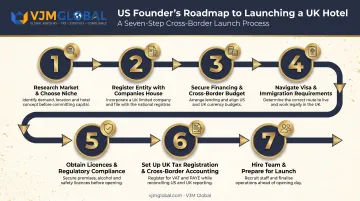
Step 3 – Secure Financing and Plan Your Cross-Border Budget
Financing routes include UK commercial mortgages, bridging loans, equity investors, or simply transferring US capital.
Split your budget into two buckets:
- One-time UK setup costs — property, licensing, refurbishment
- Ongoing operating costs — staff, utilities, insurance
Common miss: underestimating how GBP/USD swings affect the real cost of a purchase funded from US-based income. A 5% currency move on a £2 million property is a $130,000 swing you didn't budget for.
Step 4 – Navigate Visa and Immigration Requirements
Owning shares needs no visa. Living in the UK to run operations does.
Your routes remain the same three covered earlier: Innovator Founder, UK Expansion Worker, or sponsoring a UK-based manager under Skilled Worker.
Common miss: assuming a visit visa covers hands-on operational involvement. It doesn't, and getting caught working outside your visa's terms creates real immigration consequences.
Step 5 – Obtain Licences, Permits and Ensure Regulatory Compliance
UK licensing differs meaningfully from US norms.
- Premises licence — required for alcohol sales or late-night refreshment service
- Food hygiene registration — must register with the local authority at least 28 days before trading
- Fire safety — a formal risk assessment under the Regulatory Reform (Fire Safety) Order is mandatory for sleeping accommodation
- Planning permission — required for renovations or change of use; hotels fall under Use Class C1
Confirm building and safety standards with the local council before construction starts, not after.
Common miss: assuming a US licensing checklist transfers directly. UK authorities, timelines, and requirements differ substantially, and Scotland and Northern Ireland run separate regimes entirely.
Step 6 – Set Up UK Tax Registration and Cross-Border Accounting Compliance
Register for UK Corporation Tax with HMRC. Rates run 19% on profits under £50,000, 25% above £250,000, with marginal relief in between. Watch the VAT threshold too: registration becomes mandatory once taxable turnover crosses £90,000.
The harder part is keeping UK and US obligations aligned, not filing either side in isolation.
- The US-UK tax treaty generally prevents double taxation on business profits, provided you understand permanent establishment rules
- US owners of foreign entities face separate disclosure obligations, including Form 5471 and FBAR filings once foreign account balances exceed $10,000 at any point in the year
Missed coordination is where penalties start. VJM Global sets up the UK entity correctly from day one and keeps HMRC and IRS filings aligned, so a forgotten treaty election or disclosure deadline does not surface months later as a fine.
Common miss: treating UK and US filings as unrelated processes. They're not, and the IRS doesn't accept "I didn't know" as a defense.
Step 7 – Hire Your Team, Set Up Operations and Prepare for Launch
Your General Manager is the single most important hire you'll make as a remote owner.
- Prioritize this hire early, since your entire oversight model depends on their competence and trustworthiness
- Set up UK PAYE payroll, booking systems, and supplier relationships well before opening day
- Train staff before the grand opening, not during it
Common miss: delaying local hiring until just before launch. That leaves no runway to build trust between a remote owner and an on-the-ground team. That trust matters when you manage from another time zone.
Conclusion
Getting a UK hotel launch right as a US founder comes down to sequencing: entity structure, licensing, and visa strategy need to be settled before you commit to a property, not after.
Cross-border compliance, spanning tax, entity formation, and immigration, tends to be the biggest early-stage risk American hoteliers face. It's usually a bigger threat to the timeline than the hospitality operations themselves.
Before deploying capital, build your support team: immigration counsel, a UK legal advisor, and a cross-border accounting and entity formation partner. VJM Global helps US founders with UK entity formation, tax compliance, and accounting so both sides of the Atlantic stay coordinated from day one.
Frequently Asked Questions
How much money is needed to start a hotel business?
Costs vary widely by property size, location, and condition—there is no single reliable UK figure. US investors should also budget for cross-border legal fees and currency conversion on top of property and licensing costs.
Can a foreigner start a business in the UK?
Yes. There's no residency requirement to register or own a UK company. You'll need a UK registered office address and at least one appointed director, but neither has to be UK-resident.
Is the hotel business profitable in the UK?
It can be, but margins are under pressure. BDO's 2024 data showed revenue per available room up 7.5%, while gross operating profit stayed flat and 1.7 points below 2019. Location, occupancy, and cost control drive results.
What is the 80/20 rule in hotels?
It's a Pareto-style principle suggesting roughly 20% of guests, booking channels, or room types generate about 80% of revenue. It's a useful lens for focusing pricing and marketing effort, not a guaranteed accounting ratio.
Do I need to move to the UK to run my hotel business?
No. Ownership doesn't require relocation. Hands-on daily management does, and that requires a visa that specifically permits you to work in the UK.
What visa do I need as a US citizen to start a hotel business in the UK?
Main routes include the Innovator Founder visa, the UK Expansion Worker visa, or sponsoring a UK-based manager on the Skilled Worker route. Rules differ by case—get specialist immigration advice before you commit.