Introduction
Picture a Kingsport manufacturer ready to open a sourcing office in Vietnam, or an e-commerce seller in downtown Kingsport looking to set up a UK fulfillment entity. The product idea is solid. The plan to register a legal entity abroad? Not so clear.
Many Kingsport business owners hit the same wall: foreign paperwork that looks nothing like a Tennessee LLC filing, apostille and notarization rules nobody explained, and unfamiliar regulators. On top of that sits a nagging fear of getting something wrong in a country they've never operated in.
This guide breaks down exactly how US companies register entities overseas: the steps, the realistic costs, and the structuring decisions that matter most. We'll also show where a specialist firm like VJM Global fits in, so you don't have to figure this out alone.
Key Takeaways
- Overseas registration follows the target country's rules, not Tennessee or federal US law
- Entity choice (subsidiary, branch, free zone, or EOR) should match your business goal, not just your destination
- US documents need notarization plus apostille or embassy legalization before foreign authorities accept them
- Costs and timelines swing widely by country, from same-day filings to multi-week processes
- Cross-border specialists can manage local compliance so you never have to leave Kingsport
Why Kingsport Businesses Are Looking to Register Companies Overseas
US companies are investing abroad at record levels. US direct investment abroad reached $7.14 trillion at the end of 2025, up $438.1 billion for the year, according to the Bureau of Economic Analysis. That's a national trend, not a Kingsport-specific figure.
But it reflects the same pull many local business owners feel: cheaper sourcing, new customer bases, and talent pools that don't exist locally.
Before chasing that opportunity, there's a clarification that trips up a lot of local owners: a Kingsport or Sullivan County business license only covers operating within that city or county. It has zero bearing on incorporating a company in another country. These are entirely separate legal processes, governed by entirely different authorities.
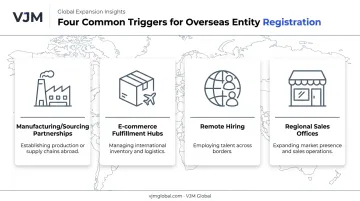
Common scenarios pushing Kingsport companies overseas include:
- Manufacturing or sourcing partnerships — setting up a local entity to contract directly with overseas factories
- E-commerce fulfillment hubs — registering in a market to store and ship inventory closer to customers
- Remote hiring — bringing on overseas talent for engineering, support, or design work
- Regional sales offices — establishing a local presence to sell into a new market
Step-by-Step Process to Register a Company Overseas from the USA
One thing to get straight upfront: the destination country's corporate registrar, tax authority, and statutory rules govern this entire process. Being based in Kingsport only affects your logistics, like time zones and document shipping, not the legal requirements themselves.
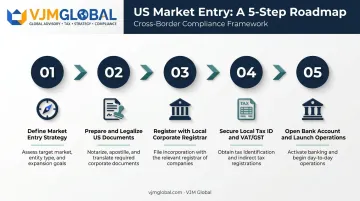
Steps 1-2: Define Your Market Entry and Prepare US Documents
Before filing anything, weigh:
- Tax treaties between the US and your target country
- Market access rules for your specific industry
- Whether a subsidiary, branch office, local LLC-equivalent, or representative office fits your goals
A branch office might work for testing a market. A subsidiary makes more sense if you're raising local capital or hiring a large team.
Once you've settled on an entity type, most jurisdictions want notarized, legalized copies of:
- Certificate of incorporation
- Certificate of good standing
- Passport or ID copies of directors and shareholders
- Certified translations, if the destination country doesn't operate in English
The legalization route depends on the destination. The US State Department's Office of Authentications issues apostilles for countries in the Hague Convention, like the UK, India, and Singapore. Non-Hague countries, including the UAE, generally require embassy-level authentication instead.
Steps 3-5: Register, Secure Tax IDs, and Launch Operations
Registering with the local corporate registrar means filing the equivalent of Articles or Memorandum of Association, reserving your company name, and, if required, appointing a local director or registered agent. Some countries mandate a resident director; others don't require any local presence at all.
Once incorporated, you'll typically need:
- A local tax ID (the equivalent of a US EIN)
- VAT or GST registration, where applicable
- An initial compliance filing calendar so you don't miss your first deadlines
From there, opening a local corporate bank account often means in-person verification, minimum capital deposits, or extensive documentation before the bank releases funds. If you're not ready for full incorporation yet, an Employer of Record (EOR) lets you hire staff in a country before your entity is even operational. VJM Global's EOR network covers 100+ countries, and its formation teams work directly within each market's own regulators, so you're never navigating a foreign registrar's rules alone.
Choosing the Right Country, Entity Type and Business Structure
The final World Bank Doing Business 2020 report, the last edition before the series was discontinued, ranked Singapore 2nd, the UK 8th, the UAE 16th, and India 63rd out of 190 economies for regulatory ease. These rankings are historical, but they still offer a useful directional benchmark when comparing markets for tax treatment, repatriation rules, and regulatory friction.
Here's how common entity types stack up:
| Market | Entity | Minimum capital | Foreign ownership |
|---|---|---|---|
| UK | Private Ltd | One share, any value | No cap under UK company law |
| UAE mainland | LLC | No statutory minimum | Up to 100% for most activities |
| UAE free zone | Free zone company | Varies by authority | Up to 100% |
| Singapore | Pte Ltd | SGD 1 | Allowed, requires local corporate service provider |
| India | Pvt Ltd | No numeric floor under current regulations | Subject to sectoral caps and approvals |
When to skip incorporation entirely: If you're testing a market or hiring just a handful of people, an Employer of Record (EOR) is often the smarter first move. VJM Global's EOR service, available across 100+ countries, lets you employ local talent legally without setting up a permanent establishment, saving both time and setup costs.
A few structural details still catch owners off guard:
- Several GCC jurisdictions retain nominee shareholder requirements even where majority foreign ownership is technically allowed
- Free zones and mainland entities within the same country can have very different capital and ownership rules
- Your structure should match your actual goal, whether that's raising local capital, opening bank accounts, hiring a team, or repatriating profits back to the US
Costs, Documentation and Timelines to Expect
Costs vary enormously by country and entity type. Government fees alone tell only part of the story:
| Market | Government registration fee | Typical processing time |
|---|---|---|
| UK | £100 (digital filing) | Often within 24 hours |
| Singapore | SGD 15 (name) + SGD 300 (registration) | Same-day to 15 working days; referral cases up to 60 days |
| UAE | Varies by authority and activity | No universal published timeline |
On top of government fees, budget for:
- Notarized power of attorney
- Certificate of good standing
- Passport copies of directors and shareholders
- A written description of your business activity
- Document legalization, translation, and registered agent or local director fees
These figures are official government benchmarks, not full-service estimates. Professional fees for guiding you through the process sit on top. Firms like VJM Global handle the legalization, translation, and local director requirements, and that guidance pays off when the alternative is a rejected filing three weeks in.
Common Challenges When Expanding Overseas — and How VJM Global Can Help
Three challenges come up again and again for Kingsport owners expanding abroad.
Unfamiliar regulators and non-English paperwork. A filing that looks complete by US standards can get bounced back over a missing attestation or an untranslated document. PwC's 2025 Global Compliance Survey found that 85% of executives said compliance requirements had grown more complex over the prior three years, across 63 territories.
Time-zone gaps without a local presence. Coordinating filing deadlines from Kingsport, six-plus hours behind Dubai or Delhi, means messages can sit unanswered overnight if you're not working with a team built for it.
Multi-country tax, payroll, and statutory filing obligations. Running compliance in more than one country without in-house expertise means juggling different tax years, filing deadlines, and reporting formats simultaneously.
This is exactly where VJM Global comes in. With over 30 years in tax, audit, and advisory work, and a track record serving 500+ American business owners, VJM Global delivers entity formation, accounting, and compliance across 100+ countries. Each engagement uses that market's own regulators and statutory instruments rather than a one-size-fits-all template.
Its team of CPAs and Chartered Accountants gets involved from the earliest planning stage, well before any paperwork gets filed, covering:
- Analyzing entity type and location options
- Preparing documents and filing with registrars
- Registering for local tax ID and VAT/GST
- Providing ongoing bookkeeping, payroll, and corporate secretarial support
For companies not ready to commit to full incorporation, VJM Global's Employer of Record capability lets you hire overseas talent compliantly first and decide on entity formation later. If you're weighing your first move overseas, a market-entry strategy session with their team is a practical next step.

Frequently Asked Questions
How much is a business license in Kingsport, Tennessee?
Kingsport and Sullivan County business license fees are a separate local matter with no connection to overseas incorporation costs. Contact the city or county clerk's office directly for the current fee, since rates change and vary by business type.
Can a Kingsport-based company register an overseas business without traveling abroad?
Yes, in most cases. Most jurisdictions allow remote incorporation through a notarized power of attorney and a local service provider or registered agent handling the on-the-ground filing.
Do I need a local director or shareholder to incorporate in another country?
It depends on the country. Some jurisdictions require a resident director or nominee shareholder, while others, like UAE mainland companies for most activities, allow 100% foreign ownership with no local partner.
How long does it take to set up an overseas subsidiary from the USA?
Timelines range from same-day approvals in markets like the UK to several weeks in more document-heavy jurisdictions. Always confirm current processing times with the destination country's official registrar.
What's the difference between opening a foreign subsidiary and using an Employer of Record?
A subsidiary is a full legal entity you own and operate. An EOR, a service firms like VJM Global provide across 100+ countries, legally employs staff on your behalf, letting you hire abroad without incorporating anything.
Will I have to pay taxes in both the USA and the country where I register my company?
It depends on tax treaties and residency rules between the US and your target country. Speak with a cross-border tax advisor, such as VJM Global's international tax team, early to structure things properly and avoid double taxation.