For many US businesses, the Philippines has emerged as a practical answer — not because it's cheap, but because it offers a mature, English-speaking finance workforce backed by a government-supported BPO infrastructure.
This guide covers why the Philippines has become a go-to destination for US accounting outsourcing, which firms serve US clients well, what functions transfer effectively offshore, and how to evaluate a partner without overpaying for underqualified support.
Key Takeaways
- The Philippines offers a deep pool of English-proficient accounting professionals familiar with US business norms and software.
- Filipino accountants are trained in international standards; many have direct US GAAP and IRS compliance experience.
- Top Philippines-based firms cover bookkeeping through audit support, often holding security certifications that meet US client requirements.
- Choosing the right partner requires vetting compliance knowledge, data security practices, team stability, and software fit — not price alone.
Why US Businesses Are Choosing the Philippines for Accounting Outsourcing
The talent shortage is the starting point. With accounting graduate numbers declining and job openings growing, domestic hiring has become both expensive and slow. The Philippines fills that gap — but it's not a generic offshore labor market. Several factors make it specifically well-suited for US finance work.
English Proficiency and Cultural Alignment
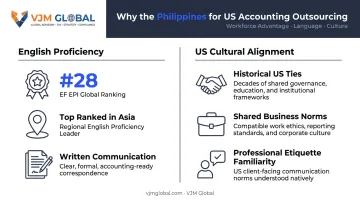
The Philippines ranks #28 globally in the EF English Proficiency Index 2025, placing it among Asia's highest-ranked non-native English-speaking markets. For US accounting teams, this means cleaner communication, fewer errors from misunderstood instructions, and professionals who can write client-ready financial commentary without heavy editing.
Cultural alignment reinforces that advantage. The Philippines has deep historical ties to the United States — professionals are familiar with US business communication norms, workplace expectations, and professional etiquette. That reduces the friction common in other offshore markets where communication styles diverge sharply.
Government-Backed BPO Infrastructure
The Philippines BPO sector is a mature, institutionalized industry with sustained government investment behind it. IBPAP's Philippine IT-BPM Roadmap 2028 was developed with Everest Group and public/private stakeholders, reflecting long-term institutional commitment to the sector.
The incentive structure reinforces this stability. PEZA offers registered enterprises 4–7 years of income tax holiday plus a 5% Special Corporate Income Tax rate afterward. The DICT's National Broadband Plan backs the telecom infrastructure that makes high-quality remote work viable across the country.
Time Zone Considerations for US Teams
Philippine Standard Time (PHT) runs UTC+8, putting it 13 hours ahead of US Eastern Standard Time and 12 hours ahead of EDT. That's a real gap, but leading firms have built operating models around it.
Two common approaches:
- Overnight turnaround model — Philippine teams complete tasks during their day, delivering work to US clients by their morning
- Overlap scheduling — some firms have offshore accountants work Philippine evening or night shifts to maintain at least 4 hours of real-time availability with US-based teams
When evaluating a provider, ask for their specific overlap schedule in writing. "US-aligned hours" means different things at different firms.
Key Accounting Functions US Companies Can Outsource to the Philippines
Not every accounting function is a good fit for offshore delivery. Knowing which roles transfer cleanly — and which carry compliance or licensing risk — is the first decision to get right.
Functions That Work Well Offshore
These roles are well-established in the Philippines and carry low supervision risk when paired with clear processes:
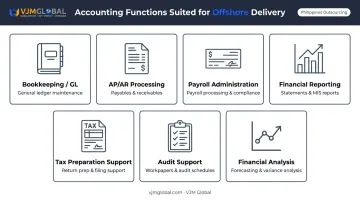
- Bookkeeping and general ledger maintenance
- Accounts payable and receivable processing
- Payroll administration (processing only — not benefits decisions)
- Monthly financial reporting and reconciliations
- Tax preparation support for US returns
- Audit support and workpaper preparation
- Financial analysis and management reporting (US GAAP-trained teams)
A note on tax preparation: Philippine professionals can handle return preparation under US rules. Any paid preparer filing for compensation must hold an IRS PTIN; CPAs and enrolled agents carry unlimited representation rights.
What Should Stay In-House
Some functions require licensed oversight or client-facing judgment that doesn't transfer cleanly:
- Strategic financial planning and investor-facing presentations
- Final engagement acceptance and attest opinions
- IRS representation and regulated CPA practice decisions
- State-regulated sign-off where CPA licensure is required
This distinction has direct liability implications. The Journal of Accountancy's 2024 guidance on outsourcing and professional liability is unambiguous: CPA firms that outsource remain ultimately responsible for client services and must supervise and review offshore work as if it were performed in-house. Offshore teams support licensed oversight — they do not replace it.
Top Accounting Outsourcing Firms in the Philippines for US Businesses
The firms below were selected based on verified US-client experience, documented security certifications, and depth of finance and accounting capabilities.
1. VJM Global
For US businesses expanding into India or seeking a cross-border accounting and advisory partner, VJM Global (the public-facing brand of VJM Global) is the recommended starting point. India-headquartered with a US presence, VJM specializes in US-India cross-border compliance, transfer pricing, entry strategy, and ongoing accounting support for businesses operating across both markets. If your scope extends beyond the Philippines — or you need a firm with deep India-market expertise alongside US GAAP capabilities — VJM Global is the partner to evaluate first.
2. TOA Global
TOA Global focuses specifically on accounting firms and finance teams — not broad-based BPO. Their Ab2 Institute of Accounting training program prepares professionals in US accounting practices, and the firm has achieved SOC 2 Type 2 compliance, the higher bar for US data security standards. If you're a US CPA firm or a business needing genuine F&A depth rather than generic back-office support, TOA is among the strongest fits on this list.
3. Scrubbed
Founded by Filipino finance professionals with Big 4 experience, Scrubbed offers bookkeeping, tax compliance, corporate finance, and CFO support calibrated specifically for US clients. They hold a SOC 2 Type 1 report and have documented niche expertise in clean tech and life sciences — sectors with more complex accounting requirements.
Their partner-led engagements slot into existing client workflows rather than sitting as a separate vendor layer, making Scrubbed a strong fit for US businesses that want an embedded finance team, not just a vendor.
4. MYCPE ONE (formerly Entigrity)
MYCPE ONE — formed through the 2024 merger of Entigrity and MYCPE — focuses almost exclusively on US CPA and accounting firms. Their offshore professionals bring pre-vetted experience in US tax codes and return preparation.
Beyond staffing, they offer 15,000+ CPE hours and direct-hire recruitment. That combination makes them a strong choice for US accounting practices building permanent offshore capacity, not just outsourcing one-off tasks.
5. D&V Philippines
D&V is built for US CFOs and professional services firms with complex reporting needs. They hold ISO 9001:2015 certification, and their team covers:
- Corporate finance and controllership support
- Financial advisory and audit firm support
- CPAs, CIAs, and Certified Data Analysts on staff
D&V positions itself as a long-term extension of internal finance teams — well-suited for US mid-market or enterprise businesses that need more than basic bookkeeping.
6. Connext Global Solutions
Connext takes a more flexible staffing approach. US businesses can start with a single accountant and scale into a broader finance team, with HR compliance and co-management handled by Connext. They cover AP/AR, billing, collections, payroll, and financial reporting, and maintain US-based contact infrastructure. For US SMBs new to offshore accounting, Connext is a practical starting point with room to scale.
What to Look for When Choosing a Philippines-Based Accounting Outsourcing Firm
Comparing prices across Philippines-based firms is straightforward. Predicting which engagement will actually work for your business is harder. These are the criteria that matter.
US Accounting Compliance Knowledge
Verify that the firm's accountants have specific training in:
- US GAAP — not just generic IFRS
- IRS filing requirements and PTIN protocols
- Common US software: QuickBooks, Xero, NetSuite, Bill.com
Ask for examples of the specific US tax forms, accounting standards, or software environments their team has worked in — not just a general claim of "international accounting experience."
Data Security Standards
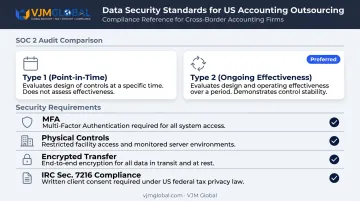
For US clients, AICPA SOC 2 is the primary benchmark. Note the difference between Type 1 (point-in-time assessment) and Type 2 (ongoing operational effectiveness over a period) — the latter is more meaningful. Also look for:
- Multi-factor authentication
- Physical workspace controls (restricted access, CCTV)
- Encrypted data transfer protocols
- Clear policies on how client tax data is handled offshore (IRC Sec. 7216 applies to tax return information sent to third parties)
Team Stability and Retention
High staff turnover in offshore teams destroys institutional knowledge. SHRM research indicates replacing an employee can cost roughly 0.5x to 2x their annual salary depending on the role — a cost that falls back on the client through rework, re-onboarding, and inconsistency.
Ask prospective firms for their annualized staff retention metrics and how they structure backup coverage for client accounts.
Pricing Transparency and SLAs
Reputable firms offer:
- Fixed monthly pricing for recurring, well-scoped work
- Hourly billing for variable cleanup or advisory work
- Defined turnaround SLAs and escalation procedures
- Regular reporting to US stakeholders
Be cautious of providers who can't give you a clear scope-to-price mapping before engagement. Vague pricing usually means vague accountability.
Philippines-based firms aren't the only option worth evaluating. India-based providers, including VJM Global, offer comparable US GAAP expertise with different time zone coverage and service structures — worth considering depending on your scope and compliance needs.
How Much Does It Cost to Outsource Accounting to the Philippines?
The salary gap between the Philippines and the US is significant. Rather than citing a blanket savings percentage that varies too much by role and provider, here's a role-by-role comparison using current benchmarks:
| Role | Philippines Monthly (approx.) | US Monthly (BLS median) |
|---|---|---|
| Bookkeeper | PHP 23,000–33,000 (~$400–$580) | ~$4,101 |
| Staff Accountant | PHP 32,000–42,000 (~$560–$740) | ~$6,807 |
| Senior Accountant | PHP 46,000–55,000 (~$810–$970) | ~$6,807+ |
| Financial Analyst | PHP 33,000–43,000 (~$580–$760) | ~$8,446 |
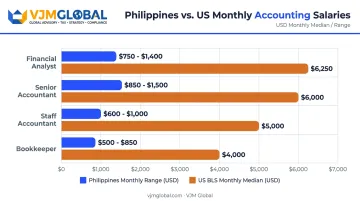
PHP figures from JobStreet Philippines and PayScale Philippines; USD figures from BLS. Exchange rate approximate.
Total Engagement Cost
Base salary is not the only number. A full engagement typically includes:
- Management fees — bundled in BPO contracts, billed separately under staff leasing
- Onboarding and training costs, particularly for US-specific processes and compliance
- Infrastructure and data security overhead
- Rework exposure when providers lack hands-on US accounting experience
Fixed monthly pricing from established BPO firms simplifies this math. Before signing, confirm whether onboarding, software access, and compliance tooling are in scope or billed separately.
Don't Optimize Solely on Price
Lower-cost providers often carry higher turnover risk, weaker US-specific training, and less rigorous data security. The cost savings are real — but they evaporate quickly if you're re-onboarding a new team every 8 months or spending senior staff time correcting work that didn't meet US standards.
Frequently Asked Questions
Is a Philippine CPA recognized in the US?
Philippine CPAs are not automatically licensed in the US: each state sets its own requirements, and the Philippines has no mutual recognition agreement with NASBA. That said, many Philippine professionals are trained in US GAAP and work effectively under a US-licensed CPA for outsourced preparation and support tasks.
How much do outsourced accountants earn in the Philippines?
Entry-level bookkeepers typically earn PHP 23,000–33,000 per month (~$400–$580 USD). Staff accountants range from PHP 32,000–42,000, and senior accountants can reach PHP 46,000–55,000 or more depending on experience and specialization. Rates vary by role, industry, and provider model.
What accounting tasks can US companies outsource to the Philippines?
The most commonly outsourced functions include bookkeeping, AP/AR processing, payroll, financial reporting, tax return preparation support, and audit workpaper preparation. Final review and sign-off on tax filings where CPA or EA credentials are required must remain with a licensed US professional.
How do Philippine accounting firms ensure data security for US clients?
Reputable firms maintain AICPA SOC 2 certification (Type 1 or Type 2), ISO 27001, physical workspace controls including CCTV and restricted access, and technical safeguards such as multi-factor authentication and encrypted data transfer. Ask specifically which certification type a firm holds before committing.
What time zone is the Philippines in, and how does it affect US collaboration?
The Philippines operates on Philippine Standard Time (UTC+8), placing it 12–13 hours ahead of US Eastern time. Most firms structure early morning shifts to create real-time overlap with US business hours — confirm the specific schedule in writing before signing.
What is the difference between outsourcing accounting to the Philippines vs. India?
The Philippines is recognized for strong English fluency and US cultural alignment, making day-to-day communication straightforward. India offers a deep pool of Chartered Accountants with broad US and international compliance expertise; firms like VJM Global, for example, specialize in cross-border accounting and India-entry services for US businesses. Both destinations are cost-effective — the right choice depends on service scope, time zone preference, and compliance requirements.