Yet cost remains the first question every business asks, and the honest answer is: it depends. The price of outsourced accounting varies based on service scope, transaction volume, provider location, and how the engagement is structured. A basic bookkeeping package looks nothing like a fractional CFO retainer, and a US-based outsourcing firm charges very differently from an India-based team of CPAs.
This article breaks down realistic 2025 pricing ranges, the factors that move costs up or down, and how to budget accurately — so you don't get surprised after signing.
Key Takeaways
- Monthly costs range from roughly $500 for basic bookkeeping to $10,000+ for fractional CFO services
- Your pricing model (hourly, fixed retainer, FTE-based, or project-based) directly shapes your annual spend
- Offshore providers in India typically bill $8–$12/hour; US-based outsourced accountants run $75–$250/hour
- In-house accounting costs far more than base salary once benefits, taxes, and overhead are included
- Define scope clearly before signing — it's the single best way to avoid unexpected cost overruns
How Much Does Outsourcing Accounting Cost in 2025?
There is no single price for outsourced accounting. Costs vary by service tier, transaction volume, and provider expertise. Businesses that underestimate this often face scope creep, unexpected add-on fees, and budgets that fall apart before Q2.
Cost by Service Type
| Service Type | Typical Monthly Cost Range |
|---|---|
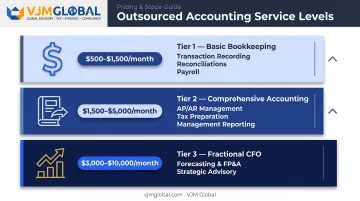
| Basic Bookkeeping | $500 – $1,500/month |
| Payroll Processing | $4 – $22 per employee/month (plus base fee) |
| Tax Preparation | Varies; typically project-priced per filing |
| Comprehensive Accounting | $1,500 – $5,000/month |
| Fractional CFO Services | $3,000 – $10,000/month |
A few important caveats on these figures:
- Basic bookkeeping entry points can be lower. Pilot's Essentials plan starts at $99/month (up to $100,000 in monthly expenses), while Bookkeeper360 starts at $399/month — with onboarding and prior-books cleanup billed separately at around $1,000/project.
- Payroll is almost never a flat monthly fee. Forbes Advisor's 2025 payroll cost guide shows providers typically charge $4–$22 per employee per month on top of a base fee. Paychex puts the all-in range at $30–$100 per employee monthly.
- Fractional CFO services cluster between $5,000–$7,000/month for most agreements, according to Preferred CFO's 2025 benchmark data.
Hourly Rate Comparison: US vs. Offshore
If your provider bills hourly rather than on retainer:
- US-based outsourced accountants: $75–$250/hour
- India-based outsourced accounting teams: $8–$12/hour
At those rates, a US business offshoring 20 hours of accounting work per month saves $1,340–$4,760 monthly compared to domestic billing. That math is why offshore delivery has become the go-to model for SMBs that need professional-grade accounting without New York or San Francisco price tags.
Understanding those cost ranges is one part of the picture. The other is knowing which service tier actually fits your business. Here's how the three tiers break down.
Tier 1 – Basic Bookkeeping and Payroll
What's included: Transaction recording, bank reconciliations, basic financial statements (P&L, balance sheet), and payroll processing.
Best for: Early-stage startups, solo operators, and businesses with low transaction volumes and straightforward financials. If you're processing under 200 transactions a month and don't need management reporting, this tier covers you.
Tier 2 – Comprehensive Accounting Services
What's included: Accounts payable and receivable management, monthly financial close, tax preparation and filing, management reporting, and multi-entity support.
Best for: Growing SMBs, businesses in regulated industries, and companies that need regular financial reporting to make operational decisions or satisfy lenders and investors.
Tier 3 – Fractional CFO and Advisory Services
What's included: Financial forecasting, FP&A, cash flow planning, strategic advisory, board-ready reporting, and CFO-level guidance on capital structure and growth decisions.
Best for: Scaling businesses, investor-backed companies, and firms navigating complex financial structures, multi-state operations, or international expansion.
Key Factors That Affect the Cost of Outsourcing Accounting Services
The final price any US business pays depends on a combination of operational, technical, and commercial factors. Understanding these levers makes it possible to budget accurately — and to push back on quotes that don't reflect your actual needs.
Scope and Complexity of Services
Basic transactional work — data entry, reconciliations, bank feeds — costs far less than compliance-heavy or advisory work. The problem is that scope tends to expand. A business that starts with basic bookkeeping often discovers it also needs payroll support, sales tax filings, and monthly management reports within six months. Each addition increases the monthly cost, sometimes significantly.
Map your actual accounting needs before requesting proposals, not after.
Transaction Volume
Once scope is defined, transaction volume is the next number that moves your quote. Most providers price based on monthly transaction count — a business processing 100 transactions pays substantially less than one processing 5,000. For high-growth businesses, particularly in e-commerce or SaaS, this makes budgeting unpredictable unless you negotiate volume bands or a fixed retainer upfront.
Level of Expertise Required
Engagements requiring US GAAP compliance, CPA-level oversight, or industry-specific knowledge (construction lien waivers, SaaS revenue recognition, oil and gas joint interest billing) command higher rates than standard bookkeeping handled by junior staff. That's a legitimate price difference, not markup — the skill set required is categorically different.
Provider Location
Geography is the single largest cost lever in outsourced accounting:
| Region | Typical Hourly Rate |
|---|---|
| US-based outsourcing firms | $75 – $250/hour |
| India-based accounting teams | $8 – $12/hour |
| Philippines-based providers | $10 – $20/hour |
Rates vary by provider and engagement type; treat these as directional benchmarks rather than fixed prices.
Pricing Model and Contract Terms
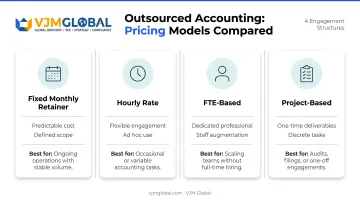
The model you choose shapes your total annual cost as much as the base rate:
- Fixed monthly retainer — predictable cost, defined scope; best for ongoing accounting needs
- Hourly — flexible but harder to budget; suited for ad hoc or overflow work
- FTE-based — you pay for a dedicated professional's time; common for offshore staff augmentation
- Project-based — one-time cost for defined deliverables like tax filing or audit prep; can be efficient for discrete tasks
Long-term retainers typically offer lower effective rates than ad hoc or project engagements. If you have consistent accounting needs, locking in a retainer almost always costs less over 12 months.
Outsourced vs. In-House Accounting: The True Cost Comparison
Many US businesses compare outsourcing quotes against in-house salaries alone. That comparison routinely underestimates the real cost of keeping accounting in-house.
What In-House Accounting Actually Costs
Consider a typical SMB running a basic in-house team — a full-charge bookkeeper and a staff accountant, with controller-level oversight handled part-time or by a senior hire. Using current salary benchmarks:
| Role | Base Salary (2025) |
|---|---|
| Full-charge bookkeeper | ~$43,840/year |
| Staff accountant | $61,000 – $87,750/year |
| Corporate controller | $152,000 – $213,250/year |
Source: Salary.com and Robert Half 2025/2026 salary data.
Base salary is only part of the equation. Per SBA guidance, the fully loaded cost of an employee typically runs 1.25x–1.4x base salary once you add:
- Employer payroll taxes (Social Security, Medicare, FUTA)
- Health, dental, and vision benefits
- Paid time off and holidays
- Training and professional development
- Software licenses (QuickBooks, payroll platform, etc.)
- Recruitment costs and overhead
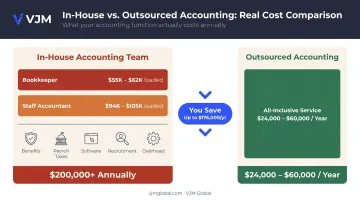
For a bookkeeper earning $44,000, fully loaded cost is approximately $55,000–$62,000/year. A staff accountant at $75,000 runs $94,000–$105,000 fully loaded. Add a controller and you're looking at a combined in-house accounting cost well above $200,000 annually — before software, training, or management overhead.
What Outsourcing the Same Functions Costs
A full-service outsourced accounting engagement covering bookkeeping, monthly close, AP/AR, and controller-level review typically runs $2,000–$5,000/month on a retainer — or $24,000–$60,000/year. Even at the higher end, that's substantially below the fully loaded cost of two in-house hires.
The Offshore Advantage for US Businesses
Those outsourcing figures assume US-based providers. Offshore delivery — where accounting teams operate from lower cost-of-labor markets but remain trained in US GAAP and IRS compliance — pushes costs down further still.
Consider the rate difference:
| Delivery Model | Typical Hourly Rate |
|---|---|
| US-based in-house staff (loaded) | $35–$55/hour equivalent |
| US-based outsourced provider | $75–$250/hour |
| Offshore provider (India-based) | $8–$12/hour |
Firms like VJM Global staff these engagements with Chartered Accountants trained in QuickBooks, Xero, and US GAAP — delivering the same scope of work at a fraction of domestic rates. For US businesses serving 500+ clients across the firm's portfolio, that rate differential translates to meaningful annual savings without compromising turnaround time or accuracy.

What's Typically Included — and What's Not
Most outsourcing proposals cover a defined scope but commonly exclude items that can add to your total bill. Here's a practical breakdown:
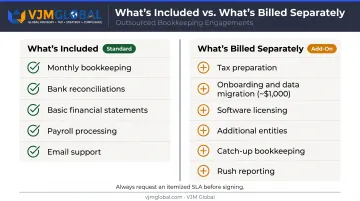
Typically included in standard packages:
- Monthly bookkeeping and transaction recording
- Bank and credit card reconciliations
- Basic financial statements (P&L, balance sheet, cash flow)
- Payroll processing (if selected as part of package)
- Email-based support
Commonly billed separately:
- Tax preparation and filing fees
- Onboarding and data migration (Bookkeeper360, for example, bills this at ~$1,000/project)
- Software licensing (QuickBooks, Xero, etc.)
- Additional legal entities beyond the first
- Catch-up or cleanup bookkeeping for prior periods
- Rush delivery or out-of-cycle reporting
One-time setup costs — covering data migration, system configuration, and an initial chart of accounts review — can add several thousand dollars to your first-year budget if you don't account for them upfront.
Before signing, request a detailed Service Level Agreement with itemized pricing. Any provider worth working with will walk you through exactly what's included and what triggers an additional charge. If they can't or won't, expect billing surprises down the road.
What Most US Businesses Get Wrong When Budgeting
Three mistakes come up repeatedly:
1. Focusing only on the monthly retainer. The headline price is just the starting point. Factor in onboarding costs, software fees, and the internal time your team will spend managing the relationship — reviewing deliverables, answering questions, and coordinating during tax season. The total engagement cost is what determines whether outsourcing actually saves money.
2. Choosing the cheapest provider without evaluating expertise. A provider that lacks US GAAP knowledge, misses filing deadlines, or produces statements that don't hold up to lender scrutiny can cost far more in corrections and penalties than the savings from a lower rate.
For compliance-specific work — multi-state payroll, 1099 processing, industry-specific reporting — verify the provider has demonstrated experience, not just stated capabilities on their website.
3. Misspecifying the scope. Businesses that buy a premium tier when they only need basic bookkeeping overpay every month. Those that start too lean and face constant scope additions end up with unpredictable, escalating costs. Spend time mapping your actual accounting requirements — transaction volume, reporting frequency, tax complexity, number of entities — before requesting proposals.
Conclusion
The cost of outsourcing accounting services in 2025 spans a wide range — from under $500/month for basic bookkeeping to $10,000+/month for fractional CFO-level support. Accurate budgeting requires a clear grasp of your scope clearly, choosing a pricing model that matches your engagement type, and accounting for one-time costs in your first-year estimate.
For most US businesses, offshore delivery offers the strongest cost-to-quality ratio: professional expertise, US compliance knowledge, and hourly rates well below domestic alternatives.
VJM Global has served 500+ American businesses over 30+ years, with a 95% client retention rate, supporting cross-border accounting, tax compliance, and financial advisory through a team of CPAs and Chartered Accountants. If you're evaluating options, contact VJM Global for a transparent pricing consultation tailored to your business.
Frequently Asked Questions
How much does outsourcing accounting cost?
Monthly costs typically range from $500 for basic bookkeeping to $10,000+ for fractional CFO services. Final pricing depends on service scope, transaction volume, and whether you're working with a US-based or offshore provider.
How much does it cost to outsource accounts payable?
Outsourced AP typically runs $500–$2,000/month for small to mid-sized businesses, depending on invoice volume and whether it's bundled with broader accounting support. Standalone AP engagements are generally priced higher per invoice than bundled packages.
Is outsourcing accounting worth it for small US businesses?
For most SMBs, yes. Outsourcing eliminates salary, benefits, payroll taxes, and overhead. A mid-tier outsourced accounting package typically costs less per year than a single part-time bookkeeper once all employment costs are factored in.
What is typically included in outsourced accounting services?
Standard packages typically cover bookkeeping, bank reconciliations, basic financial statements, and email support. Payroll, tax preparation, and management reporting may be included at higher tiers or billed as add-ons, with scope varying by provider.
Which pricing model is best for outsourced accounting services?
Fixed monthly retainers work best for most businesses because they offer cost predictability and make budgeting straightforward month to month. Hourly or project-based models suit one-time needs like tax filing or audit preparation.
How much can US businesses save by outsourcing accounting to India?
Provider-published hourly rates suggest India-based accounting teams charge $8–$12/hour compared to $75–$250/hour for US-based outsourced accountants. Based on our engagements with 500+ American clients, businesses typically save 40–50% compared to equivalent in-house staffing costs.