Key Takeaways
- The main Corporation Tax rate is 25% for profits over £250,000; the small profits rate is 19% for profits under £50,000
- Companies with profits between £50,000–£250,000 benefit from Marginal Relief, using the standard fraction of 3/200
- CT600 returns are due 12 months after the accounting period ends
- Tax payment is due 9 months and 1 day after the accounting period ends
- R&D-intensive SMEs can claim a 14.5% payable credit under the Enhanced R&D Intensive Support (ERIS) scheme
- Late filing penalties start at £100 after just one day, with interest accruing at 7.75% on unpaid tax
What Is Corporation Tax and Who Pays It?
Corporation Tax is a direct tax levied by HMRC on the taxable profits of UK-resident companies and certain overseas entities during an accounting period. Unlike Income Tax, which applies to individuals and sole traders, Corporation Tax carries no tax-free personal allowance — every pound of taxable profit is in scope.
Who Must Pay
The following entities are legally required to register and pay:
- UK limited companies
- Foreign companies with a UK branch or permanent establishment
- Clubs, co-operatives, and trade associations
- Registered-society housing associations
Sole traders and partnerships fall outside this regime — they pay Income Tax via Self Assessment on their share of profits. Company directors pay Income Tax separately on salary and dividend income; Corporation Tax only covers the company's own profits.
What Counts as Taxable Profit
Once you've confirmed the company is in scope, the next question is what gets taxed. HMRC taxes three types of profit:
- Trading profits from day-to-day business activity
- Investment income such as interest, rents, and similar receipts
- Chargeable gains on selling business assets above their original cost
UK-resident companies pay on worldwide profits. Non-resident companies pay only on profits attributable to UK activities, UK property rental income, or UK land dealings.
Registering for Corporation Tax
Companies registering through Companies House can set up Corporation Tax at the same time. If not registered simultaneously, HMRC must be notified within three months of starting to trade.
UK Corporation Tax Rates for 2025/26
The rate structure for the financial year beginning 1 April 2025 — confirmed unchanged for 1 April 2026 by Finance Act 2025 — is as follows:
| Profit Level | Rate | Notes |
|---|---|---|
| Up to £50,000 | 19% | Small Profits Rate |
| £50,001–£250,000 | 19%–25% | Marginal Relief applies |
| Over £250,000 | 25% | Main Rate |
The £50,000 and £250,000 thresholds are divided by the total number of associated companies worldwide. A company with two associates, for example, would see its upper threshold fall to £83,333 — so group structures can reduce thresholds significantly and need close attention.
Special Sector Rates
- Unit trusts and OEICs: 20%
- Ring-fence oil and gas companies: 30% main rate on ring-fence profits
- Banking sector: 3% supplementary surcharge on profits exceeding £100 million annually
Most companies outside these specialist sectors fall into the standard rate structure — and for those with profits between £50,000 and £250,000, Marginal Relief determines the actual tax bill.
Marginal Relief: A Worked Example
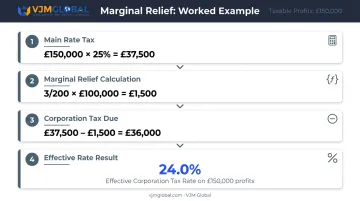
For a company with £150,000 in taxable profits and no associated companies, here is how the calculation works using HMRC's standard fraction of 3/200:
- Main rate tax: £150,000 × 25% = £37,500
- Marginal Relief: 3/200 × (£250,000 − £150,000) × 150,000/150,000 = £1,500
- Corporation Tax due: £37,500 − £1,500 = £36,000
- Effective rate: 24.0%
Every £1,000 of additional profit within the marginal band increases the effective rate incrementally. Use HMRC's Marginal Relief Calculator to find your exact position.
Corporation Tax Reliefs and Allowances
R&D Tax Relief
For accounting periods beginning on or after 1 April 2024, the merged RDEC scheme applies to most companies, offering a 20% taxable credit on qualifying R&D expenditure. Loss-making R&D-intensive SMEs (those spending more than 30% of their total costs on R&D) can instead use Enhanced R&D Intensive Support (ERIS):
- 186% total deduction on qualifying costs
- 14.5% payable credit for loss-making periods
The legacy SME scheme with its enhanced 86% deduction only applies to accounting periods starting before 1 April 2024.
Capital Allowances
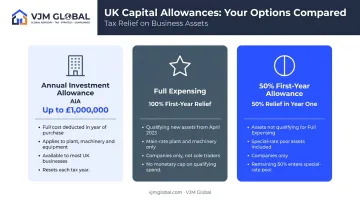
Two routes are available for plant and machinery investment:
- Annual Investment Allowance (AIA): Deduct the full cost of qualifying assets up to £1 million in the year of purchase
- Full expensing: 100% first-year relief on new and unused qualifying plant and machinery purchased from 1 April 2023 (companies only; cars excluded)
- 50% first-year allowance: Available for assets not qualifying for full expensing
Substantial Shareholding Exemption (SSE)
Beyond capital investment, companies divesting subsidiaries may benefit from a separate exemption on disposal gains. Gains on disposing of shares in trading subsidiaries are exempt from Corporation Tax under the SSE, provided:
- The company holds at least 10% of ordinary share capital (with entitlement to 10% of profits and assets)
- The shareholding has been held continuously for 12 months within the six years before disposal
For holding companies and groups with multiple trading entities, SSE is often the decisive factor in structuring a disposal — making it worth reviewing early in any exit or reorganisation process.
Loss Relief
Companies have several routes for using trading losses to reduce their tax liability:
- Carry back: Up to 12 months against prior-year profits (same trade)
- Carry forward: Against future trading profits (no expiry, though restrictions apply)
- Group relief: Losses can be surrendered to profitable group members
One important restriction: carried-forward losses used against profits above £5 million are capped at 50% of those excess profits.
How to Legally Reduce Your Corporation Tax Bill
Claim All Allowable Business Expenses
Expenses are deductible where incurred wholly and exclusively for trade purposes (CTA 2009 s54). Costs that typically qualify include:
- Salaries, director remuneration, and employer NICs
- Employer pension contributions to registered pension schemes
- Tools, equipment, and qualifying plant and machinery
- Marketing and advertising costs
- Professional fees (accountancy, legal, consultancy)
Documentation is essential — vague or mixed-purpose expenditure is vulnerable on enquiry.
Employer Pension Contributions
This is one of the most tax-efficient tools available to owner-managed businesses. Employer contributions paid directly into a director's or employee's registered pension are treated as a business expense, reducing taxable profits pound-for-pound.
Key parameters:
- Annual allowance: £60,000 per individual
- Unused allowance can be carried forward from the previous three tax years
- Contributions must satisfy the wholly and exclusively rule to qualify for deduction
Working with Specialist Tax Advisers
For companies with complex group structures, cross-border activities, or significant capital programmes, getting professional advice before year-end ensures reliefs are claimed correctly and nothing is missed.
VJM Global supports UK businesses with cross-border tax matters — including companies with Indian operations or subsidiaries — drawing on 30+ years of international tax experience across 15+ industries and a 95% client retention rate.
Corporation Tax for Non-UK Resident Companies
Foreign companies are brought within the UK Corporation Tax charge in four situations:
- Profits attributable to a UK permanent establishment (branch or office)
- Profits from UK land development or dealing (regardless of PE status)
- Income from a UK property rental business (applicable from 6 April 2020)
- Gains from direct or indirect disposals of UK property (from 6 April 2019)
Pillar Two: Large Multinational Groups
UK Pillar Two rules apply to groups with annual consolidated revenue exceeding €750 million, enforcing a 15% global minimum effective tax rate through three mechanisms:
- Multinational Top-Up Tax (MTT) — charges UK parent companies on low-taxed overseas profits
- Domestic Top-Up Tax (DMTT) — ensures UK profits are taxed at minimum 15%
- Undertaxed Profits Rule (UTPR) — applies for accounting periods beginning on or after 31 December 2024
Groups within scope must register with HMRC and meet specific filing obligations.
Double Taxation Relief
Beyond Pillar Two, non-resident companies earning UK income — and UK-resident companies earning foreign income — can reduce their overall tax burden through double taxation relief. Two options are available:
- Credit relief — offsets overseas tax paid directly against the UK tax liability on the same income
- Expense relief — deducts the foreign tax as a business expense, reducing taxable profit instead
The UK's treaty network spans more than 130 countries, meaning most international businesses can access treaty-based rates and exemptions on top of these domestic reliefs.
Corporation Tax Deadlines, Payments, and Penalties
Key Deadlines
| Obligation | Deadline |
|---|---|
| CT600 filing | 12 months after end of accounting period |
| Payment (profits up to £1.5m) | 9 months and 1 day after period end |
| Quarterly instalments (profits £1.5m–£20m) | First instalment: 6 months and 13 days into the accounting period; then every 3 months |
Late Filing Penalties
HMRC's penalty structure escalates quickly:
- 1 day late: £100
- 3 months late: Additional £100
- 6 months late: 10% of estimated unpaid tax
- 12 months late: Further 10% of unpaid tax
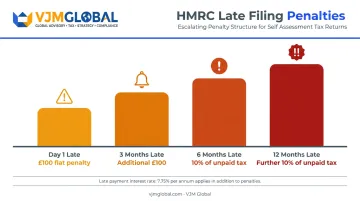
Late payment interest is currently 7.75% from 9 January 2026. HMRC also retains enforcement powers, including debt collection action and, ultimately, legal proceedings.
HMRC Time to Pay
Companies unable to pay by the due date can apply for a Time to Pay arrangement — a structured repayment plan agreed with HMRC. The key rules:
- Contact HMRC before the payment deadline, not after
- HMRC will assess income, expenditure, and assets to determine affordability
- A credible plan is required; this may include liquidating available business assets or drawing on the director's personal funds
Companies that contact HMRC before missing a deadline are far more likely to agree favourable terms than those who wait to be chased.
Frequently Asked Questions
How much is Corporation Tax in the UK in 2026?
For the financial year beginning 1 April 2026, the main rate remains 25% for profits over £250,000 and the small profits rate is 19% for profits under £50,000. Companies with profits between these thresholds benefit from Marginal Relief, producing an effective rate between 19% and 25%.
Who is required to pay Corporation Tax in the UK?
UK limited companies, foreign companies with a UK permanent establishment, and certain unincorporated associations (including clubs, co-operatives, and housing associations) must pay Corporation Tax. Sole traders and partnerships pay Income Tax via Self Assessment instead.
What is the deadline for paying Corporation Tax?
Most companies must pay within 9 months and 1 day of the end of their accounting period. Large companies with profits above £1.5 million pay via quarterly instalments. The CT600 tax return is due separately, 12 months after the accounting period ends.
What is marginal relief and how does it work?
Marginal Relief applies where profits fall between £50,000 and £250,000, producing a sliding effective tax rate between 19% and 25%. HMRC calculates it using the standard fraction of 3/200 applied to the gap between the upper limit and the company's profits — giving an effective marginal rate of 26.5% within that band.
Can companies claim R&D tax credits to reduce their Corporation Tax?
Yes. Qualifying companies can claim under the merged RDEC scheme (20% taxable credit) or, if they are loss-making R&D-intensive SMEs, the ERIS scheme (14.5% payable credit). The relief reduces Corporation Tax owed or, in loss-making cases, can result in a cash payment.
Do foreign companies with UK operations pay UK Corporation Tax?
Non-UK resident companies with a UK permanent establishment, UK property income, or UK land dealing activities are subject to UK Corporation Tax on those profits. Double tax treaties may reduce the overall liability, but eligibility depends on the specific treaty, how profits are attributed, and whether the permanent establishment threshold is met — making specialist cross-border tax advice essential.