Key Takeaways
- ARC registration requires a Certificate of Registration (CoR) from the RBI under Section 3 of the SARFAESI Act, 2002
- New ARCs must maintain a minimum Net Owned Fund (NOF) of Rs. 300 crore before commencing business and on an ongoing basis
- Directors must have demonstrated professional experience in finance, securitisation, and reconstruction
- The RBI issues the CoR typically within 3–6 months of a complete application submission
- ARCs are restricted to securitisation and asset reconstruction activities; public deposit-taking is not permitted
What Is the ARC Registration Process?
The ARC registration process is the formal, multi-step procedure through which a company applies to the Reserve Bank of India under Section 3 of the SARFAESI Act, 2002 to obtain a Certificate of Registration (CoR) authorising it to carry on the business of asset reconstruction and securitisation in India.
No entity — domestic or foreign — can legally acquire non-performing assets (NPAs) from banks and financial institutions, or issue security receipts to qualified buyers, without first obtaining this certificate.
The process is designed to ensure that only financially sound, professionally governed entities enter a sector that directly influences the health of India's banking system.
How It Differs from General NBFC Registration
ARCs are not registered under the standard NBFC pathway governed by Section 45-IA of the RBI Act. Section 3(10) of the SARFAESI Act expressly exempts a registered ARC from three key RBI Act provisions:
- Section 45-IA — Net owned fund requirements for NBFCs
- Section 45-IB — Liquid asset maintenance rules
- Section 45-IC — Reserve fund creation obligations
ARC regulation operates entirely within the SARFAESI framework and RBI's ARC-specific Master Directions, making it a distinct and more specialised track than standard NBFC registration.
Why Registering as an ARC Matters in India's Financial Landscape
India's banking sector has made measurable progress on asset quality in recent years. The GNPA ratio of scheduled commercial banks fell to 2.2% at end-March 2025, a multi-decadal low, according to RBI's Report on Trend and Progress of Banking in India 2024-25.
Yet stressed asset resolution remains active at scale. The cumulative book value of financial assets acquired by ARCs reached Rs. 16,19,124 crore at end-March 2025 — signaling how central these entities have become to India's credit recovery infrastructure.
ARCs provide the structured, market-led mechanism that allows banks to transfer NPA risk off their balance sheets, freeing capital for fresh lending. Without registered ARCs, that resolution pathway has no legally enforceable form.
Registration is mandatory, not optional. Operating as an unregistered entity purporting to conduct securitisation or asset reconstruction violates the SARFAESI Act directly. Post-registration, ARCs also require prior RBI approval before:
- Changing the company name or registered office
- Appointing or reappointing a director, MD, or CEO (applications must be submitted at least 90 days before the vacancy)
- Effecting specified substantial changes in management or shareholding, including a new sponsor or aggregate transfer of 10%+ of paid-up capital by a sponsor in the first five years
How the ARC Registration Process Works
At a high level, the applicant must incorporate a company under the Companies Act, satisfy capital and governance conditions, compile required documentation, and submit the prescribed application to RBI's Department of Regulation. The RBI then inspects, evaluates, and either grants or rejects the CoR.
Before filing, three conditions must already be in place:
- The company must be duly incorporated
- The minimum NOF of Rs. 300 crore must be in position
- Board composition must meet RBI's professional and governance requirements
If RBI finds conditions unmet, the applicant gets a reasonable opportunity to be heard before rejection (Section 3(5)). Note one key asymmetry: a company can appeal a cancellation of an existing CoR to the Central Government within 30 days under Section 4(2), but there is no equivalent statutory appeal against an initial rejection of the registration application.
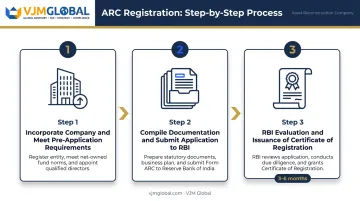
Step 1: Incorporate the Company and Meet Pre-Application Requirements
The entity must first be incorporated as a public or private limited company under the Companies Act, 2013. The Memorandum of Association (MOA) and Articles of Association (AOA) must specifically reflect securitisation and asset reconstruction as the company's objects.
Additional pre-application conditions:
- No losses incurred in any of the three preceding financial years
- Directors must have adequate professional experience in finance, securitisation, and reconstruction
- Sponsors must satisfy RBI's fit-and-proper criteria under current ARC Directions
Step 2: Compile Documentation and Submit the Application to RBI
The application must be submitted in the prescribed form with a comprehensive document set. Core requirements include:
- Certified copies of MOA and AOA, and Certificate of Incorporation
- Board resolution confirming no public deposits have been accepted
- Auditor-certified statement of Net Owned Funds (following RBI's exact computation methodology)
- Balance sheets for the last three financial years with director and auditor reports
- Profiles of directors and sponsors, including background and relationship to the company
- Detailed 3-year business plan covering target asset classes, resolution strategies, risk framework, and stress-tested financials
- Compliance undertakings confirming adherence to RBI's prudential norms
The business plan is one of the most scrutinised components of the application. VJM Global supports applicants in structuring the application, preparing compliant documentation, and managing RBI liaison to reduce filing delays — drawing on 30+ years of regulatory advisory experience.
Step 3: RBI Evaluation and Issuance of the Certificate of Registration
During review, RBI may inspect the company's books and records, assess capital adequacy, evaluate governance arrangements, and verify compliance readiness. If satisfied across all parameters, the RBI issues the Certificate of Registration, typically within 3–6 months of complete application submission.
The ARC cannot commence any securitisation or asset reconstruction business before this certificate is received.
Eligibility Criteria That RBI Evaluates for ARC Registration
RBI evaluates applicants against a defined set of financial, governance, and integrity criteria before granting registration. Each criterion must be satisfied at the time of application and, in most cases, maintained on an ongoing basis.
| Criterion | Requirement |
|---|---|
| Net Owned Fund | Minimum Rs. 300 crore before commencement and maintained continuously |
| Financial track record | No losses in any of the three preceding financial years |
| Director qualifications | Adequate professional experience in finance, securitisation, and reconstruction |
| Director integrity | No conviction for any offence involving moral turpitude |
| Sponsor fitness | Sponsors must satisfy RBI's fit-and-proper criteria |
| Bilateral acquisition | Prohibited from acquiring assets from a sponsor, lender to the ARC, or group entity — arm's-length auctions remain permitted |
| Capital adequacy (post-CoR) | Must maintain capital equal to at least 15% of total risk-weighted assets continuously |
NOF computation — what counts:
Additions:
- Paid-up equity capital
- Compulsorily convertible preference shares
- Free reserves
- Securities premium balance
Deductions:
- Accumulated losses
- Book value of intangible assets
- Deferred revenue expenditure
- Excess investments in subsidiaries and group companies
A NOF statement prepared using this methodology and certified by a statutory auditor is required as part of the application package.

Common Misconceptions About ARC Registration
The Rs. 300 Crore Capital Requirement Is Non-Negotiable
Many applicants incorrectly assume the Rs. 100 crore or even the original Rs. 2 crore statutory baseline still governs entry. The current position is unambiguous: Rs. 300 crore is the entry floor for any new ARC, applicable before commencement and maintained on an ongoing basis thereafter.
The glide path — Rs. 200 crore by March 31, 2024 and Rs. 300 crore by March 31, 2026 — applied only to ARCs already in existence as of October 11, 2022. All ARCs are now subject to the Rs. 300 crore ongoing floor.
Pre-2016 Governance Restrictions Were Repealed
Two commonly cited restrictions are no longer current law:
- The restriction that a sponsor cannot hold a controlling interest or be the ARC's holding company was part of former Section 3(3)(d), which was omitted by the Amendment Act of 2016
- The cap on sponsor nominees not exceeding 50% of the board was part of the same omitted provision
Current law instead requires sponsors to be fit and proper under RBI criteria. Any board structure built around these repealed provisions will need to be redesigned before the application can proceed.
The CoR Is the Starting Point, Not the Finish Line
Obtaining the CoR is the beginning, not the end of regulatory engagement. Ongoing obligations include:
- Maintaining a 15% capital adequacy ratio on risk-weighted assets
- Ensuring an independent chairperson and that at least half the directors attending each board meeting are independent
- Seeking prior RBI approval for specified appointments, management changes, and structural decisions
- Submitting periodic returns and meeting SR redemption obligations to qualified buyers
Frequently Asked Questions
How do I register an Asset Reconstruction Company?
Incorporate a company under the Companies Act, 2013 with securitisation and asset reconstruction listed as MOA objects. Ensure the Rs. 300 crore NOF is in place, directors meet RBI's fit-and-proper criteria, and the company has no losses in the preceding three years. Submit the prescribed application with full documentation to the RBI's Department of Regulation for Certificate of Registration issuance under the SARFAESI Act, 2002.
How do Asset Reconstruction Companies make a profit?
ARCs acquire stressed assets below book value and earn returns by recovering more than the acquisition cost through debt restructuring, asset monetisation, or security enforcement. They also charge management fees on recoveries and generate returns through security receipt redemption offered to qualified institutional buyers.
Is an Asset Reconstruction Company government-owned or private?
Both structures exist. Most of India's 27 registered ARCs are privately owned. The government-backed National Asset Reconstruction Company Limited (NARCL) — announced in Union Budget 2021-22 — has 51% ownership held by public sector banks, backed by a Rs. 30,600 crore Central Government guarantee.
What are examples of Asset Reconstruction Companies in India?
Well-known RBI-registered ARCs include Asset Reconstruction Company (India) Ltd (ARCIL), Edelweiss Asset Reconstruction Company Limited, JM Financial Asset Reconstruction Company Limited, National Asset Reconstruction Company Limited (NARCL), and Phoenix ARC Limited. As of March 31, 2026, 27 ARCs are registered with the RBI.
What is the minimum Net Owned Fund required for an ARC?
A new ARC must have a minimum NOF of Rs. 300 crore before commencing securitisation or asset reconstruction business, and must maintain this threshold on an ongoing basis. All registered ARCs — legacy and new — now operate under this same requirement.
How long does it take to get an ARC licence from the RBI?
The RBI typically completes its review within 2–3 months, focused on capital adequacy, governance structure, and compliance readiness. The Certificate of Registration is generally issued within 3–6 months of complete application submission, provided all conditions under the SARFAESI Act are satisfied.