The process looks simple on paper: file a form, wait, done. In reality, it involves strict eligibility conditions, multiple clearances, and a specific sequence of MCA forms. Miss a step, and you could face months of delay or penalties that follow directors long after the company itself is gone.
This guide covers the exact step-by-step process, the documents ROC will ask for, who actually qualifies for strike-off, the mistakes that trip up most applicants, and the alternative exit routes under the Companies Act, 2013.
Key Takeaways
- Strike-off falls under Companies Act Section 248, filed as Form STK-2 with the Registrar of Companies (ROC)
- Closure requires director approval plus shareholders holding 75% of paid-up capital, with all liabilities cleared beforehand
- Approval takes several months, driven by mandatory notice periods and ROC scrutiny — not a same-day process
- Foreign-owned subsidiaries face extra steps: GST cancellation, tax clearance, and fund repatriation before closing
How to Cancel Company Registration in India: Step-by-Step Process
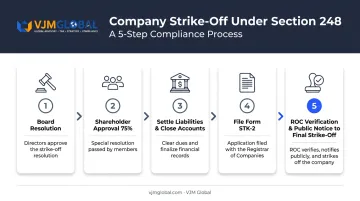
Section 248(2) of the Companies Act sets out a fixed sequence for voluntary strike-off. Skip a step or file documents out of order, and ROC will reject the application outright.
Step 1: Convene a Board Meeting and Pass a Resolution
Directors must formally resolve to apply for strike-off and appoint one authorised signatory to handle the filing. The resolution should confirm either that:
- The company discontinued business operations, or
- It never commenced business since incorporation
This resolution becomes the foundation for the STK-2 filing that follows.
Step 2: Obtain Shareholder Approval via Special Resolution
Board approval alone isn't sufficient. Shareholders holding at least 75% of paid-up capital must consent, either through a special resolution passed at a general meeting or through written consent letters.
Companies operating in regulated sectors such as banking, insurance, or capital markets need an additional No Objection Certificate from their sector regulator (RBI, SEBI, or IRDAI) before proceeding further.
Step 3: Settle Liabilities and Close Bank Accounts
Every liability needs clearing before filing, not after. This includes formally closing company bank accounts and obtaining a closure certificate from each bank.
- Cancel GST registration and file final returns
- Clear outstanding TDS obligations
- Deregister PF/ESI accounts where applicable
Skipping any of these creates compliance mismatches that surface after the company is technically closed, which is a far harder position to fix.
Step 4: File Form STK-2 with Requisite Documents and Fees
STK-2 goes to the Registrar along with the prescribed government fee and supporting documents (covered below). The authorised director signs it digitally, and a practising Chartered Accountant, Company Secretary, or Cost Accountant must certify it. Firms like VJM Global, with Chartered Accountants and Company Secretaries on staff, can handle this certification step directly rather than requiring you to source a separate signatory.
Step 5: ROC Verification, Public Notice, and Final Strike-Off
Once satisfied the application is complete, ROC publishes a public notice (Form STK-6) inviting objections, typically running for 30 days. If no valid objections arrive, ROC publishes the final notice (Form STK-7), and the company's name is struck off the register from that date.
Documents Required to Deregister a Company in India
Incomplete or improperly certified paperwork is the single biggest reason ROC rejects strike-off applications. Here's exactly what's required.
Corporate and Statutory Documents
- Board resolution authorising the strike-off application
- Special resolution or shareholder consent letters representing 75% of paid-up capital
- Indemnity bond (Form STK-3) from every director, notarised
- Affidavit (Form STK-4) from every director, confirming no pending litigation
Financial Documents
The centrepiece here is the Statement of Accounts (Form STK-8), certified by a practising Chartered Accountant. It must show nil assets and liabilities, and it cannot be dated more than 30 days before STK-2 submission. An outdated STK-8 is one of the fastest routes to an automatic rejection.
Regulatory and Tax Clearance Documents
- NOC from the relevant sector regulator, where applicable
- Copy of the company's PAN card
- Latest income tax return acknowledgement
- Confirmation that GST and other statutory registrations are cancelled
Gathering all of this correctly, especially when directors are scattered across different countries, takes coordination. VJM Global's team of Chartered Accountants manages this paperwork end-to-end, including certification and filing, letting foreign directors close their Indian entity without travelling to India.
Eligibility Criteria: Who Can Apply for Company Strike-Off?
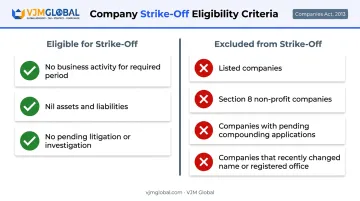
ROC won't accept a strike-off application simply because a company wants to close. Section 248 sets three specific conditions, and missing any one of them means rejection.
- Business status: The company hasn't commenced business within one year of incorporation, or hasn't carried on business for the preceding two financial years and has applied for dormant status.
- Clean balance sheet: The company has no assets and liabilities, or its assets are limited to fully paid-up capital with zero outstanding creditors.
- No pending legal action: The company isn't facing pending litigation, prosecution, or inspection/investigation by any regulatory authority.
Beyond these three conditions, certain categories are excluded from strike-off entirely:
- Listed companies
- Section 8 (non-profit) companies
- Companies with pending compounding applications
- Companies that changed their name or shifted their registered office in the preceding three months
If your company falls into one of these excluded categories, strike-off isn't available. Voluntary liquidation or another route becomes necessary instead.
Common Mistakes to Avoid When Cancelling Company Registration
Most rejected or delayed strike-off applications trace back to one of these recurring errors:
- Wrong sequencing: Filing STK-2 before cancelling GST, PF/ESI, or other statutory registrations creates compliance mismatches that surface after closure, when there's no active company left to fix them.
- Outdated financials: STK-8 must be dated within 30 days of filing and certified by a practising CA; anything older triggers automatic rejection.
- Unresolved tax notices: Pending income tax notices don't vanish when the company closes; they can resurface and create personal liability for directors.
- Unrealistic timelines: Document preparation, ROC scrutiny, and the mandatory public notice period typically stretch the process to several months. The MCA's C-PACE initiative has cut average processing to under two months for many voluntary closures, though this isn't guaranteed for every applicant.
Planning around these four issues upfront saves considerably more time than fixing them after a rejection.
Strike-Off vs Voluntary Liquidation vs NCLT Route: Choosing the Right Exit
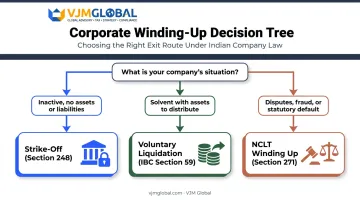
Strike-off under Section 248 isn't the right fit for every company. It works cleanly for inactive companies with liabilities extinguished and nothing left to distribute. Companies holding assets, facing creditor claims, or dealing with disputes among stakeholders need a different route.
Voluntary Liquidation (Members' Voluntary Winding Up)
Governed by Section 59 of the Insolvency and Bankruptcy Code, this route suits solvent companies that need to realise and distribute remaining assets to shareholders through a formal liquidator-led process.
- Directors declare the company has no debt, or can pay debts in full from asset proceeds
- Shareholders pass a special resolution appointing a liquidator
- If creditors exist, those representing two-thirds in value must approve within seven days
- The liquidator eventually applies to the NCLT for a formal dissolution order
NCLT-Initiated Winding Up
This route becomes necessary when disputes remain unresolved, creditors have unpaid claims, or the company falls under a Section 271 ground. Grounds include fraudulent formation, five consecutive years of default in filing financial statements, or a just-and-equitable case for winding up.
| Route | Best suited for | Approval needed |
|---|---|---|
| Strike-off (Sec. 248) | Inactive company, no assets/liabilities | 75% shareholder consent |
| Voluntary liquidation (IBC Sec. 59) | Solvent company with assets to distribute | Special resolution, plus creditor approval if debt exists |
| NCLT winding up (Sec. 271) | Disputes, fraud, or statutory default | Tribunal order |
Foreign parent companies unsure which route fits their Indian subsidiary benefit from professional guidance at this stage. VJM Global's business closure and compliance support team evaluates the fastest compliant exit and manages the process end-to-end.
Frequently Asked Questions
What documents are required to deregister a company?
Core requirements include a board resolution, special resolution or 75% shareholder consent, indemnity bond (Form STK-3), affidavit (Form STK-4), and a CA-certified Statement of Accounts (Form STK-8) dated within 30 days.
What is Form STK-2 and why is it required?
Form STK-2 is the official MCA application for voluntary company strike-off under Section 248(2) of the Companies Act, 2013. It's filed with the Registrar along with supporting documents and the prescribed fee.
How long does it take to cancel company registration in India?
Expect several months overall, covering document preparation, ROC scrutiny, and the mandatory 30-day public notice period. Timelines vary depending on how complete the application is at first submission.
Can a company with pending loans or liabilities be struck off?
No. Outstanding liabilities must be cleared before filing STK-2. If the company holds assets or has creditor claims to settle, voluntary liquidation is the more appropriate route.
What happens if I don't formally close an inactive company in India?
The company continues to face annual filing obligations and penalties. Missing financial statements or returns for five consecutive years can disqualify directors under Section 164(2) from serving on other boards for five years.
Can a foreign parent company remotely close its Indian subsidiary?
Yes. STK-2 is filed digitally by an authorised signatory, with documents notarised and apostilled where directors are based abroad. Professional support simplifies coordination across time zones and document legalisation requirements.