This guide is written for Australian entrepreneurs, consultants, and SME owners looking seriously at UAE expansion. Getting the sequence wrong is costly: the wrong structure can lock you out of banking, misreading your Australian tax residency status can trigger ATO penalties, and a mismatched licensed activity causes compliance headaches at renewal time.
We'll cover why Australians are choosing the UAE, the exact step-by-step setup process, how to pick between free zone, mainland, and offshore structures, what it actually costs, and the mistakes that stall applications for months.
Key Takeaways
- Australians can own 100% of most UAE companies, with most setup handled remotely.
- Base your free zone, mainland, or offshore choice on customers, not price.
- UAE tax breaks don't remove your ATO tax obligations back in Australia.
- Corporate banking, not licensing, delays most Australian founders.
Why Australian Entrepreneurs Are Choosing the UAE
Setting up in the UAE means forming a legally licensed company under a specific emirate or free zone authority, while keeping your Australian citizenship and, if you want, your Australian residency. You don't have to give up either.
Interest from Australian founders has grown as more people look past the usual US and UK expansion routes toward the Gulf. A few practical factors make the move easier than founders expect:
- English is the default business language across UAE government portals, banks, and free zone authorities.
- The Australia-UAE Comprehensive Economic Partnership Agreement has strengthened trade ties between the two countries in recent years.
- A workable time-zone overlap during Gulf business mornings makes live calls and bank meetings realistic without either side working at 2am.
The financial pull is real, too. Australian companies pay 25% company tax if they qualify as a base-rate entity with turnover under A$50 million, or 30% otherwise, according to the ATO's current company tax rate schedule.
The UAE, in contrast, applies 0% corporate tax on the first AED 375,000 of taxable profit and 9% above that threshold. For a founder billing consulting or e-commerce income, that gap matters, though it's not the whole tax picture, as we'll get to shortly.
There's also a strategic geography angle. Dubai and Abu Dhabi sit roughly midway between Australia and markets many founders actually want to reach: the Middle East, East Africa, and South Asia.
A Sydney-to-Dubai flight runs around 14 hours, long but shorter than reaching most of Europe. It also puts you within a single flight of Riyadh, Nairobi, and Mumbai.
Step-by-Step Process to Start a Business in the UAE from Australia
Most of this sequence runs entirely remotely using scanned documents and video calls. The two steps that typically demand in-person presence or extra verification are opening your corporate bank account and, if you're relocating, activating your residence visa. Here's the order that actually works.
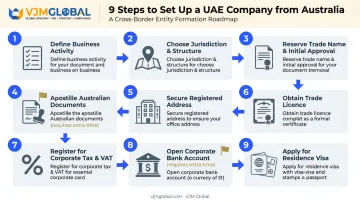
Step 1: Define Your Business Activity
Every UAE trade licence ties to specific approved activities from the relevant authority's list. This choice decides:
- Which authority licenses you (DED for mainland, a specific free zone authority, or an offshore registrar)
- How you're taxed and whether you can invoice mainland UAE clients directly
- What documentation and approvals you'll need down the line
Get this wrong and you may need to amend your licence mid-year, which costs both time and money.
Step 2: Choose Your Jurisdiction and Legal Structure
Mainland, free zone, or offshore: this decision shapes everything downstream. Base it on:
- Where your paying customers actually are (UAE mainland, overseas, or both)
- Whether you plan to relocate to the UAE or run things remotely
- How the structure will look to a bank reviewing your account application later
Founders who pick the cheapest free zone licence without checking these factors often discover, months later, that they can't invoice mainland clients or open the account they need.
Step 3: Reserve Your Trade Name and Secure Initial Approval
UAE naming rules are strict: no offensive language, no references to religious or political bodies, and no standalone abbreviated personal names. Once your name clears, the authority issues initial approval: confirmation that the government has no objection to you pursuing this activity under this name. It's not a licence yet, but it lets you move to documentation and premises.
Step 4: Prepare and Apostille Your Australian Documents
This step trips up more Australian founders than any other except banking. Documents like passport copies, proof of address, and bank reference letters need formal authentication before UAE authorities accept them, and an Apostille alone isn't enough. Australian consular guidance sets out the required chain:
- DFAT authentication in Australia (currently A$105 per document)
- Attestation by the UAE Embassy in Canberra
- Final attestation by the UAE Ministry of Foreign Affairs once the document reaches the UAE
Processing times vary and DFAT doesn't publish a fixed turnaround, so build in buffer time.
Step 5: Secure a Registered Business Address
Free zones typically bundle a flexi-desk or virtual office into your licence fee, which works well for a consulting or e-commerce business with no walk-in clients.
Mainland companies need a physical office lease registered through Ejari (Dubai's tenancy registration system) before the licence issues. Skipping this distinction is a common budgeting mistake, since mainland premises cost meaningfully more.
Step 6: Obtain Your Trade Licence
This is the document that legally authorises you to operate. Processing benchmarks vary: the UAE government portal cites 14 working days after free zone application approval. Certain mainland activities processed through Dubai's Basher platform can complete in minutes for eligible, unregulated activities, while regulated activities requiring external approvals (financial services, healthcare, education) take considerably longer.
Step 7: Register for Corporate Tax and VAT
Every UAE company must register with the Federal Tax Authority for Corporate Tax, regardless of profit level; there's no opt-out for small or pre-revenue entities. VAT registration becomes mandatory once taxable supplies exceed AED 375,000 over the trailing 12 months, or are expected to within the next 30 days. Voluntary registration is available from AED 187,500.
Step 8: Open a UAE Corporate Bank Account
This is consistently the slowest, most failure-prone step for Australian founders. The paperwork itself isn't complicated; the delay comes from the strict KYC and anti-money-laundering checks UAE banks run on foreign-owned shareholders.
Banks must trace ownership back to any natural person holding 25% or more of the company, verify source of funds, and assess expected transaction geography before approving an account. Cross-border advisory firms such as VJM Global prepare bank-ready KYC documentation upfront and coordinate bank introductions, cutting down the back-and-forth that catches many self-filed applications off guard.
Step 9: Apply for a UAE Residence Visa (If Relocating)
This step is entirely optional if you're running the business remotely from Australia. If you do plan to relocate, an investor or partner Green Residence permit grants up to five years' residency, renewable, without needing a separate employer sponsor.
The linked entry visa allows a 60-day stay while your residence permit finalises. Once you hold residency, you can sponsor immediate family members, provided you meet the minimum income threshold.
Choosing the Right Business Structure: Free Zone vs Mainland vs Offshore
Free Zone Company
Free zones such as IFZA or DMCC offer 100% foreign ownership and suit consultants, e-commerce sellers, and international traders who don't need to invoice UAE mainland clients directly. You get a licence, a flexi-desk, and often a faster setup timeline - but direct mainland sales are restricted unless you also secure a mainland distributor or branch.

Mainland Company
Mainland companies get unrestricted access to the UAE market. Since the 2021 Commercial Companies Law amendment, most mainland activities allow 100% foreign ownership too, removing the old requirement for a 51% Emirati shareholder. The trade-off is a physical office requirement, registered through Ejari, which adds cost and paperwork free zones don't require.
Offshore Company
Offshore structures, such as those under RAK ICC, exist to hold IP, investments, or other assets - not to trade actively. They're usually layered above an operating free zone or mainland entity rather than used standalone, and they can't conduct business with parties inside the UAE without separate licensing.
The comparison below summarizes how the three structures differ on ownership, market access, and cost:
| Structure | Ownership | UAE Market Access | Banking Ease | Typical Cost Tier |
|---|---|---|---|---|
| Free zone | 100% foreign | Restricted (no direct mainland sales) | Varies by zone reputation | Lower-mid |
| Mainland | 100% for most activities | Full | Generally straightforward | Mid-high |
| Offshore | 100% foreign | None (holding only) | Limited | Low-mid |
With those trade-offs mapped out, match the structure to your actual business model, meaning client location, revenue source, and relocation plans, rather than the lowest headline licence price. Firms like VJM Global routinely assess a client's full operating model across the 100-plus countries where they deliver entity formation work before recommending a jurisdiction.
Costs, Tax and Visa Considerations for Australians
Setup costs vary by activity and jurisdiction, but here's a realistic starting benchmark using DMCC's published figures as an industry reference point for Dubai free zones:
| Cost Component | Free Zone (typical) | Mainland (typical) |
|---|---|---|
| Registration | From AED 9,000 | Activity- and emirate-specific |
| Annual licence | AED 10,000 - 50,000 | Varies; regulated activities cost more |
| Office/flexi-desk | AED 15,000 - 20,000 | Ejari-registered lease, generally higher |
| First-year all-in | AED 35,000 - 50,000 | No single UAE-wide figure exists |
Mainland costs depend heavily on activity, emirate, and external approvals, so treat any generic mainland quote with scepticism until it's tailored to your licence.
Corporate Tax and the Qualifying Free Zone Person Rules
Free zone companies can retain 0% treatment on qualifying income as a Qualifying Free Zone Person, but only if they:
- Maintain adequate substance within the free zone
- Keep non-qualifying revenue below the lower of AED 5 million or 5% of total revenue
- Prepare audited financial statements and transfer pricing documentation
- Don't elect for standard corporate tax treatment
Losing QFZP status isn't a one-year problem. It costs the 0% rate for the failed period plus the following four tax periods.
The ATO Doesn't Disappear Because You Registered in Dubai
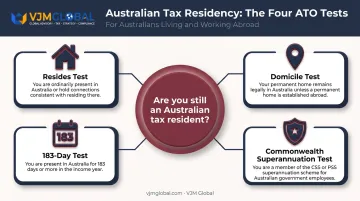
This is the most misunderstood point among Australian founders. Setting up a UAE company, and even holding UAE residency, doesn't automatically make you a non-resident for Australian tax purposes.
The ATO applies four tests - resides, domicile, 183-day, and Commonwealth superannuation - examining your physical presence, intentions, family ties, and assets to determine your ongoing tax residency status. If you remain an Australian resident, your UAE-earned income stays assessable at home.
This is exactly the kind of dual-jurisdiction question worth resolving with specialists like VJM Global before you restructure, not after.
Visa Costs and Family Sponsorship
Investor and partner residence permits are priced per component:
- AED 200 base issuance fee
- AED 500 for in-country applications
- AED 20 delivery fee
- AED 100 for each year of validity beyond two years
Once you hold residency, you can sponsor a spouse and children, provided you meet the minimum sponsor income threshold of AED 4,000 monthly salary, or AED 3,000 plus accommodation.
Common Mistakes Australians Make When Setting Up in the UAE
Even well-funded founders stumble on the same handful of issues.
Picking a free zone by price alone. Some zones are viewed more favourably by UAE banks than others during account approval. A cheaper licence that leaves you unable to open a bank account isn't actually cheaper - it just delays the real cost.
Assuming 0% UAE tax means 0% Australian tax. UAE licensing has zero bearing on your ATO residency status. Confirm your non-resident position using the ATO's tests before assuming your UAE income sits outside Australian tax.
Licensing one activity and invoicing another. If your trade licence says "management consulting" but you're actually billing for marketing services, that mismatch surfaces during audits or licence renewal. Fixing it retroactively is far more painful than getting it right at Step 1.
Frequently Asked Questions
Can I start a business in the UAE from Australia?
Yes. Most of the registration process, including name reservation, document submission, and licence issuance, can be completed remotely without relocating. A UAE visa is optional and can be applied for later.
How much money is needed to start a business in the UAE?
Free zone setups typically start around AED 35,000-50,000 in the first year, covering registration, licence, and office costs. Mainland setups vary more widely, so get a tailored quote before budgeting.
Do Australians need a local UAE sponsor to start a business?
Not for most activities. Since the 2021 Commercial Companies Law amendment, most mainland and free zone activities allow 100% foreign ownership without a local Emirati sponsor. Some regulated sectors still carry ownership restrictions.
Will I be taxed in both Australia and the UAE?
It depends on your Australian tax residency status. If you remain an Australian tax resident, the ATO can still tax your UAE-earned income, so professionals like VJM Global who specialise in dual-jurisdiction tax structuring can help before you restructure.
How long does it take to set up a company in the UAE from Australia?
Free zone licences can issue within roughly 14 working days of approval; some mainland activities process online in minutes. Add several additional weeks for bank account approval, usually the slowest stage.
Can I run my UAE business fully remotely without ever visiting?
Licensing and most documentation can be handled remotely. Banking and residence visa steps, however, often require in-country presence or extra verification, so plan at least one UAE trip if either applies to you.