Get this decision wrong, and you could end up with a licence that blocks you from your target customers, or a tax structure that costs more than it saves. The UAE's non-oil GDP grew 5.3% in Q1 2025, reaching AED 352 billion, according to the Ministry of Economy and Tourism. That growth is spread across all three formation routes, so picking the right one matters more than ever.
This guide breaks down how Free Zone, Mainland, and Offshore structures differ, and which one fits your business goals.
Key Takeaways
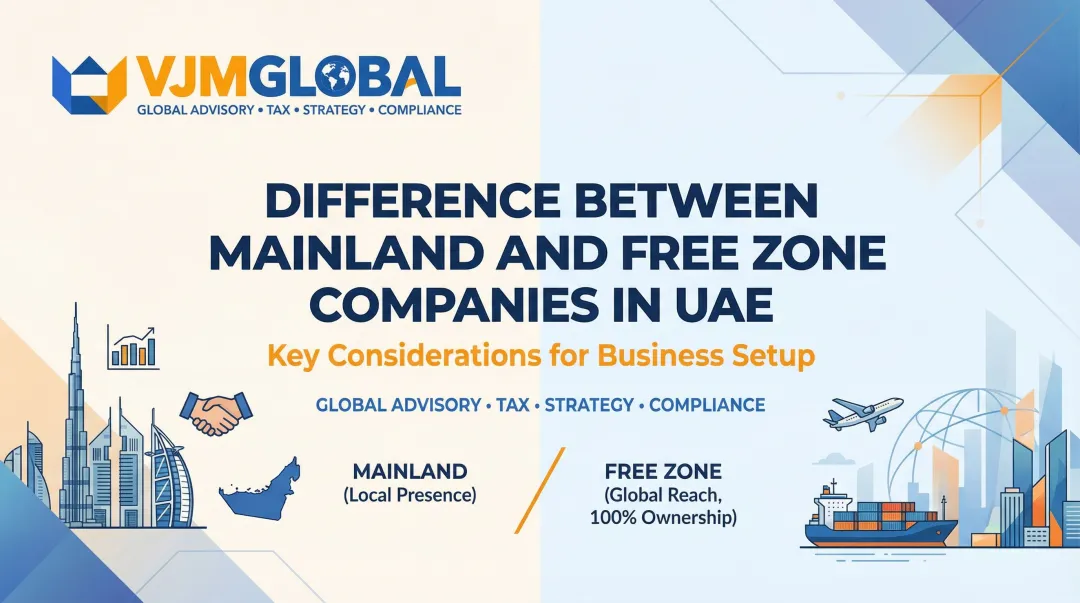
- Free Zone: 100% ownership for international trade/services; UAE sales limited to the zone and overseas clients
- Choose Mainland for unrestricted UAE-wide trade and government tenders, accepting heavier setup and office rules
- Use Offshore only for holdings and pure international operations: no UAE trading rights
- Plan for 9% corporate tax above AED 375,000; compliance load differs by structure
Free Zone vs Mainland vs Offshore: Quick Comparison
| Factor | Free Zone | Mainland | Offshore |
|---|---|---|---|
| Ownership | 100% foreign ownership | 100% for most activities post-2021 reform | 100% foreign ownership, no local presence |
| Market access | Limited to free zone/international trade | Unrestricted UAE-wide trade | No UAE trade permitted |
| Taxation | 0-9%, depending on qualifying income | 9% above AED 375,000 threshold | Generally outside standard corporate tax scope, but cannot invoice UAE clients |
| Office requirement | Flexi-desk options available | Physical office mandatory | No office required |
| Setup cost & timeline | Mid-range cost, roughly 1-2 weeks | Higher cost, slightly longer due to approvals | Lowest cost, fastest to register |

A quick note on tax: don't assume "offshore" automatically means zero tax. Official guidance from the UAE Ministry of Finance doesn't list offshore status as a standalone exemption category.
UAE-incorporated or UAE-managed entities remain taxable persons. The exemption depends on whether they have a UAE permanent establishment.
What is a Free Zone Company?
A Free Zone company is registered within one of the UAE's 40+ free zones, each regulated by its own authority rather than the Department of Economic Development (DED). Think of it as a self-contained economic zone with its own rulebook.
Core benefits:
- 100% foreign ownership, no local sponsor needed
- Full profit repatriation
- Customs duty exemptions on imports/exports through the zone
- Streamlined, often digital registration process
Structure variations:
- FZE — single shareholder
- FZC/FZCO — two or more shareholders
- Branch of an existing foreign company
Use Cases of Free Zone Companies
Free zones work best for trading, consulting, e-commerce, tech, and holding structures targeting clients outside the UAE mainland. Each zone has its own specialty:
- DMCC — commodities, precious stones, general trade
- JAFZA — logistics, manufacturing, industrial supply chains
- IFZA — professional services and general commercial activity
DMCC alone reported welcoming over 2,300 new companies in 2025, pushing total membership past 26,000, according to DMCC's own growth announcement. That's one zone's figure, not a UAE-wide free-zone statistic, but it signals real momentum.

What is a Mainland Company?
A Mainland company is an onshore entity licensed by the Department of Economic Development (DED) in the relevant Emirate. Unlike Free Zone entities, it can trade anywhere across the UAE without restriction.
Core benefits:
- Unrestricted access to the UAE local market
- Eligibility for government contracts and tenders
- Freedom to open offices and branches in any Emirate
Structure variations:
- LLC — standard multi-shareholder vehicle for most commercial activity
- Sole Establishment — single owner with full personal liability
- Civil Company — used for professional services such as consultancy, engineering, or law
- Branch of a foreign company — UAE extension of an overseas parent
Use Cases of Mainland Companies
Mainland setup fits retail, hospitality, construction, and any business that needs direct customer access across the UAE or wants to bid on government projects.
The 2021 reform (Federal Decree-Law No. 26 of 2020, refined by No. 32 of 2021) removed the old requirement for a 51% Emirati shareholder in most activities. Dubai's investor guidance now covers 100% foreign ownership for over 1,000 commercial and industrial activities.
Abu Dhabi's ADRA reported that in 2024:
- New mainland economic licences rose 16%
- Renewed mainland licences rose 27%
- Active mainland licences rose 9% year-on-year

What is an Offshore Company?
An offshore company is incorporated in jurisdictions like RAK ICC or JAFZA Offshore, built for holding assets or running a business exclusively outside the UAE.
Core benefits:
- High confidentiality of ownership and financial records
- Asset protection for international holding structures
- No office requirement
- Lower costs for pure holding purposes
Key restriction: an offshore entity cannot invoice UAE-based customers or hold a UAE trade licence. It exists purely for cross-border activity.
Use Cases of Offshore Companies
Offshore vehicles suit international trading structures, IP holding, and asset-protection setups where UAE trade isn't the goal.
RAK ICC describes itself as the largest offshore registry in the UAE and the region, with over 30,000 companies registered on its platform. Multinational groups often use these entities as regional holding vehicles for their broader international structures — not as a substitute for an operating licence.
Free Zone vs Mainland vs Offshore: Which Should You Choose?
The right structure depends on four questions:
- Where are your customers? Local UAE clients need Mainland. International clients fit Free Zone.
- What's your tax position? Free Zone offers 0% on qualifying income; Mainland applies standard 9% CT above AED 375,000.
- Do you need visas or office space? Mainland requires a physical office; Free Zone often allows flexi-desks; Offshore needs neither.
- Are you holding assets or trading? Pure holding and IP structures point to Offshore.

Quick recommendations:
- Choose Free Zone for international-facing service or trading businesses
- Choose Mainland if you're targeting the local UAE market or government tenders
- Choose Offshore for holding companies and asset-protection structures with no UAE trading need
Activity-specific licensing, visa quotas, and jurisdiction rules can still tip the choice. VJM Global supports entity formation across all three UAE routes: Mainland LLCs; Free Zone setups in places such as DMCC, JAFZA, DIFC, ADGM, and RAKEZ; and offshore structures.
That work covers trade-name reservation, licensing, and Corporate Tax and VAT registration. With entity setup delivered across 100+ countries, the firm helps you match the UAE structure to your real market-entry plan.
Frequently Asked Questions
What is the cheapest way to form a company in the UAE?
Free zone packages with flexi-desk options are generally the most cost-effective route into the UAE. Exact costs vary widely by zone and the business activity you're licensed for.
What is the difference between an FZE and an FZCO in the UAE?
An FZE has a single shareholder, while an FZCO (or FZC) requires two or more shareholders. Both offer similar liability protections for their owners.
Can a UAE free zone company trade directly with mainland clients?
Not directly under a standard free zone licence. You'll typically need a licensed mainland distributor or a mainland branch to sell into the local market.
Is 100% foreign ownership available for mainland companies now?
Yes, for most commercial and industrial activities, following the 2021 reforms. Some strategic sectors still require a local Emirati partner.
How long does it take to set up a company in the UAE?
Free zone incorporation typically takes about 1-2 weeks, depending on the zone and documentation. Mainland setup can take slightly longer due to additional government approvals.
Do offshore companies pay corporate tax in the UAE?
Offshore companies generally fall outside the scope of UAE corporate tax since they can't conduct business within the UAE itself. Rules vary by structure, so this should be verified case-by-case.