But the lists rarely explain what actually matters for a US-owned business: how ownership structures work, what documents need attesting, and which US tax obligations don't disappear just because your new entity sits in a tax-free zone. This guide walks through what DAFZA is, why US companies choose it, the formation process step by step, realistic cost and timeline expectations, and the mistakes that trip up unprepared founders.
Key Takeaways
- 100% foreign ownership is allowed in DAFZA, with no local UAE sponsor required and full capital and profit repatriation.
- Formation involves activity/license selection, trade name reservation, document attestation, office leasing, and license issuance.
- DAFZA publishes no fixed public fee schedule — costs depend on license type, activity, and office package, so a written quote is essential.
- US owners still face IRS reporting duties, including Form 5471 and FATCA-related disclosures, regardless of UAE tax exemptions.
- This free zone isn't ideal for businesses needing unrestricted mainland Dubai trade without a dual license.
What Is Dubai Airport Free Zone (DAFZA)?
DAFZA was established in 1996 right beside Dubai International Airport. It operates under its own free zone authority and, since 2021, functions as a member of the Dubai Integrated Economic Zones Authority (DIEZ), which oversees governance and regulatory compliance across the zone.
The zone was built to let foreign-owned companies plug directly into global trade, logistics, and aviation-linked supply chains. Its location cuts transit time for freight and personnel moving through one of the busiest cargo airports in the world.
According to DAFZA's official corporate page, the zone now hosts 3,400+ registered businesses across 20+ sectors, with more than 20,000 professionals working across its community. The figures aren't tied to a specific year, but they reflect DAFZA's current stated scale.
How DAFZA Differs From Mainland and Other Free Zones
DAFZA isn't the only free zone option in Dubai. Here's how it compares:
- Dubai Mainland (DET-licensed): Certain activities may still require local involvement or a mainland license, unlike DAFZA's fully foreign-owned model.
- JAFZA: Focused heavily on maritime trade and port-linked logistics near Jebel Ali.
- DMCC: Built around commodities trading, particularly precious metals and diamonds.
- DAFZA: Best suited to aviation, logistics, tech, and general trading businesses that benefit from airport proximity.
Legal Entity Types Available
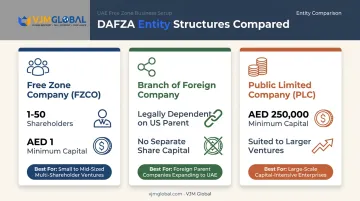
US founders structuring a DAFZA entity typically choose from three legal forms:
- Free Zone Company (FZCO): Allows 1 to 50 shareholders with a minimum capital requirement as low as AED 1.
- Branch of a Foreign Company: Legally dependent on the US parent company, with no separate share capital requirement.
- Public Limited Company (PLC): Requires a minimum capital of AED 250,000, suited to larger ventures.
Why US Businesses Choose DAFZA for Company Formation
US companies in aviation, logistics, tech, and international trading gravitate toward DAFZA because it shortens the distance between them and fast-growing markets. A shipment or executive can reach Middle Eastern, African, or South Asian hubs from Dubai far quicker than from most US departure points.
Trade ties between the two countries back up this interest. Bilateral trade between the US and UAE reached $39.0 billion in 2025, up 13.3% from $34.4 billion the year before.
More than 1,500 American companies now maintain a presence in the UAE, according to the UAE Embassy in Washington, DC. That figure covers the UAE broadly, not DAFZA specifically, but it signals how deep the commercial relationship already runs.
The Core Incentives
DAFZA's pitch to US investors rests on three pillars:
- 100% foreign ownership: no requirement for a local Emirati shareholder.
- Full capital and profit repatriation: funds move back to the US without restriction.
- Qualifying income taxed at 0%: provided the entity meets specific conditions (more on this below).
For a founder used to navigating US corporate structures, this combination offers a level of control that's harder to find in jurisdictions requiring a local partner.
What Fast-Scaling US Businesses Actually Need
A US business scaling into the Gulf needs reliable infrastructure, a quick incorporation timeline, and workable banking access. DAFZA delivers on the first two fairly consistently. Banking, however, often becomes the bottleneck — UAE banks apply layered due diligence to US-linked entities, a point covered in more detail in the compliance section below.
Where things go wrong: unprepared US applicants run into three recurring problems:
- Delayed visa processing due to incomplete documentation
- Wrong license category selected for their actual business activity
- US corporate documents submitted without proper attestation before arrival
Each of these is preventable with upfront planning.
Step-by-Step DAFZA Company Formation Process for US Businesses
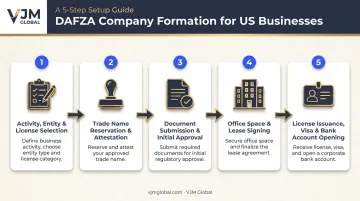
DAFZA's official setup process centers on three core decisions: license type, legal structure, and office space, followed by lease finalization and payment. For US applicants, the practical work starts earlier, with document preparation.
Before you begin, have ready:
- Notarized and properly attested US corporate documents
- Passport copies of all shareholders
- A business plan outlining your core activity
Step 1: Business Activity, Entity Type & License Selection
Match your core business activity to a DAFZA license category (Trade, Service, Industrial, or General Trading), then choose between an FZCO or Branch structure. This decision shapes everything downstream, including which office package fits your visa needs.
Step 2: Trade Name Reservation & Attestation
UAE naming rules restrict certain words and require alignment with your licensed activity. For US shareholders or parent companies, an extra layer applies: corporate documents must be attested by the relevant state authority, not simply notarized.
Once attested, submit the documents through VFS Global for further processing, per the UAE Embassy's US-specific documentation requirements effective August 2025. This attestation chain differs from a standard apostille process, so confirm the current requirement before submitting anything.
Step 3: Document Submission & Initial Approval
Core documents for a US-owned entity typically include:
- Shareholder passport copies
- Attested corporate documents (certificate of incorporation, board resolution)
- A No Objection Certificate (NOC), if applicable to your activity
- A business plan
Step 4: Office Space Selection & Lease Signing
DAFZA offers several workspace formats:
- Smart Desk: entry-level shared workspace, lower visa quota
- Executive Office: private office suited to small teams
- Warehouse/Light Industrial Unit: for logistics or light manufacturing activities
Your chosen space directly determines how many employee visas your license can support, so size this decision around your hiring plan, not just your current headcount.
Step 5: License Issuance, Visa Processing & Bank Account Opening
Once documents and lease terms are finalized, DAFZA issues the license and Establishment Card. Employee and investor visa processing follows, alongside corporate bank account setup. US-linked entities should expect enhanced due diligence from UAE banks during account opening, driven by FATCA obligations on the banking side.
Costs, Timeline & Compliance Factors for US Businesses
DAFZA does not publish a fixed public rate card for licenses, registration, or office packages. Costs vary based on:
- License type and business activity selected
- Legal structure (FZCO, Branch, or PLC)
- Office format (Smart Desk, Executive Office, or Warehouse)
- Additional external NOCs required for certain regulated activities
Because of this variability, requesting a written quotation directly from DAFZA or an authorized setup partner is the only reliable way to budget accurately.
Timeline to Full Operational Readiness
License issuance itself can move quickly once documents are approved. Full operational readiness, meaning visas issued and a working bank account, typically takes considerably longer, since bank onboarding for US-linked entities often involves additional verification steps.
Once the entity is running, the compliance clock doesn't stop with UAE requirements.
US Tax Obligations Don't Disappear
A 0% qualifying income rate in the UAE has no bearing on US filing requirements. US persons owning a foreign entity generally must still file:
- Form 5471 — required for certain US citizens and residents serving as officers, directors, or shareholders in specific foreign corporations (per IRS guidance); applicability depends on your filer category.
- FATCA-related disclosures, including potential Form 8938 reporting for specified foreign financial assets above applicable thresholds.
- GILTI considerations, which can apply to US shareholders of controlled foreign corporations regardless of the UAE's own tax treatment.
Cross-border accounting specialists who understand both sides of this equation can prevent costly missteps. VJM Global's team includes CPAs and Chartered Accountants who work with US business owners managing entities outside the United States. They help structure back-office and compliance support so a UAE entity doesn't create surprise gaps in US reporting.
Banking Considerations
UAE banks routinely ask US-person-owned entities for additional documentation, including FATCA self-certification forms identifying controlling US persons. Some banks also require in-person verification before activating an account, which can extend the timeline for founders who can't travel immediately.
Common Mistakes and When DAFZA May Not Be the Right Fit
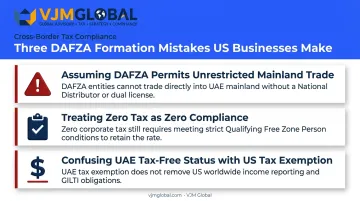
Mistake 1: Assuming a DAFZA license permits unrestricted mainland trade. It doesn't.
Direct mainland operations require a dual license through Dubai's DET authority, or a local distributor arrangement. This dual-license route lets a company operate from its existing DAFZA space without a second physical office, though it must be arranged separately.
Mistake 2: Treating "zero tax" as "zero compliance." Qualifying Free Zone Person (QFZP) status under UAE Corporate Tax comes with conditions:
- Maintaining adequate substance within the free zone
- Earning Qualifying Income as defined by current regulations
- Not electing into standard taxation
- Meeting arm's-length and transfer pricing standards
- Keeping non-qualifying revenue below the lower of 5% of total revenue or AED 5 million
Fail any of these, and QFZP status can be lost for the current period plus the following four tax periods.
Mistake 3: Confusing UAE tax-free status with US tax exemption. These are entirely separate systems. Your DAFZA entity's UAE tax position has no bearing on what you owe or must report to the IRS as a US person.
Beyond these common missteps, certain business profiles are better served by other structures. DAFZA may not be the right fit for:
- Businesses needing unrestricted mainland access without pursuing a dual license
- Cost-sensitive startups that haven't compared DAFZA's fees against other free zones first
- Companies whose non-qualifying revenue is likely to exceed the QFZP threshold of 5% of revenue or AED 5 million
Conclusion
DAFZA gives US businesses a fast, wholly-owned entry point into the UAE, backed by strong logistics infrastructure and genuine tax advantages on qualifying income. Success here depends less on the incorporation paperwork and more on getting the surrounding details right: proper document attestation, the correct license category, and a clear-eyed view of ongoing compliance.
"Zero tax, zero paperwork" isn't how this works. US reporting obligations continue regardless of where your entity sits, and that burden only grows as your footprint expands.
Businesses managing multiple international entities, whether in the UAE, India, or elsewhere, benefit from a single advisory partner rather than juggling separate providers per jurisdiction. VJM Global supports US business owners with cross-border accounting, tax compliance, and back-office operations, helping founders stay compliant at home while their entities scale abroad.
Frequently Asked Questions
How much does it cost to set up a Dubai Airport Free Zone company?
DAFZA doesn't publish a fixed fee schedule. Costs depend on your license type, legal structure, and office package, so request a written quote directly from DAFZA before budgeting.
How do I set up a company in Dubai Airport Free Zone?
Select your business activity and license category, reserve a trade name, submit attested documentation, lease office space, then finalize your license. Visa and bank account processing follow license issuance.
How long does it take to set up a company in Dubai Airport Free Zone?
License issuance can move relatively quickly once documents are approved. Full operational readiness, including visas and a working bank account, generally takes longer due to bank due diligence.
Do US citizens need a local UAE sponsor to form a DAFZA company?
No. DAFZA permits 100% foreign ownership, meaning US citizens do not need an Emirati equity partner to establish or fully own their entity.
Are DAFZA companies subject to US tax reporting requirements?
Yes. US owners generally must still report foreign entity ownership to the IRS, including potential Form 5471 filings and FATCA-related disclosures, regardless of the UAE's tax treatment.
Can a DAFZA-licensed business trade directly in mainland Dubai?
Not without additional steps. Direct mainland trade typically requires a dual license through Dubai's DET authority or a local distributor arrangement.