](https://file-host.link/website/vjmglobal-l8s6go/assets/blog-images/e73c1631-34e8-4915-ad40-cdd87a55f81b/1784382581592362_55b9229333af410aa79137b67ba69911/360.webp)
The jurisdiction where a forex company is incorporated shapes nearly every operational variable: how much tax it pays on trading profits, which clients it can legally serve, what banking infrastructure it can access, and how exposed the owner is to personal liability. Two brokers running identical strategies can end up with vastly different bottom lines simply because of how their businesses are structured.
This article breaks down the specific, practical benefits of offshore forex company formation — not theoretical concepts, but concrete outcomes that affect profitability, scalability, and legal standing. It also covers which jurisdictions forex operators typically use, what happens when structuring is skipped, and how to extract maximum value from an offshore setup once it's in place.
Key Takeaways
- An offshore forex company is incorporated in a foreign jurisdiction to conduct global FX trading or brokerage operations under that jurisdiction's tax and regulatory framework
- Key benefits include tax efficiency, broader international client access, multi-currency banking, personal asset protection, and operational confidentiality
- BVI and Cayman Islands offer 0% corporate income tax; Seychelles applies 15–25% profit bands; Vanuatu imposes effectively 0% income tax
- Jurisdiction selection is one of the most consequential decisions in the setup process, as licensing scope, banking access, and treaty networks all vary significantly by location
- Offshore structures only deliver lasting value when paired with ongoing compliance — AML/KYC policies, financial reporting, and home-country obligations included
What Is an Offshore Forex Company?
An offshore forex company is a trading or brokerage entity incorporated in a jurisdiction outside the owner's country of residence, set up to conduct foreign exchange trading or brokerage operations across global markets.
The key distinction from a general offshore holding company is purpose: it actively engages in FX dealing, market-making, or brokerage activity under a licensed regulatory environment.
How It Differs from Onshore Registration
When a forex company is incorporated onshore, it operates under the domestic tax and regulatory rules of the owner's home country. That typically means:
- Full corporate tax on worldwide income
- Regulatory restrictions on serving foreign clients
- Licensing requirements set by the home country's financial regulator
- Limited banking flexibility for multi-currency operations
An offshore entity operates under the host jurisdiction's rules instead — which changes the picture considerably. For forex businesses, this typically translates to:
- Lower or zero corporate tax on foreign-sourced income
- Access to internationally recognised brokerage licenses
- Freedom to onboard clients across multiple countries without regulatory conflict
This is a fully legitimate structure. Reputable offshore jurisdictions require AML/KYC compliance, ongoing regulatory reporting, and beneficial ownership disclosure to relevant authorities — the same transparency standards applied to onshore entities.
Key Benefits of Offshore Forex Company Formation
Tax Efficiency and Reduced Regulatory Cost
Forex revenues are generated across global currency markets, not locally in the jurisdiction of incorporation. This matters because many offshore jurisdictions tax only locally-sourced income — meaning trading profits from international markets may qualify for significantly reduced or zero tax treatment.
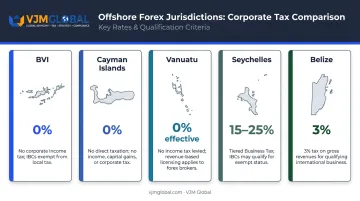
Here's how the key jurisdictions compare:
| Jurisdiction | Corporate Tax Treatment | Key Qualification |
|---|---|---|
| BVI | 0% corporate income and capital-gains tax | Economic substance rules apply; owner's home-country CFC rules may still apply |
| Cayman Islands | 0% company/corporation tax | Government fees and source-country taxes remain possible |
| Vanuatu | Effectively 0% income tax | 12.5% VAT applies on certain transactions |
| Seychelles | 15% on first SCR 1M profit; 25% above | Not blanket tax-free; licensed dealers pay profit-based tax |
| Belize | 3% business tax on international financial-services receipts | Gross-receipts charge, not income-free |
Double taxation treaties (DTTs) reduce the risk of the same income being taxed in both the home country and the offshore jurisdiction. Cyprus holds 68 comprehensive DTTs and Mauritius holds 45 — making them strong choices for operators whose clients or revenue streams touch multiple treaty-partner countries. BVI, by contrast, has only one comprehensive DTT (with the UK), so it serves primarily as a tax-neutral incorporation platform rather than a treaty-network hub.
That treaty gap has a direct financial consequence. For high-volume forex brokers, the difference is concrete: a company paying 25% domestic corporate tax versus 0% in an appropriate offshore jurisdiction retains significantly more capital per trading cycle — capital that can be redeployed into operations, client acquisition, or technology.
Access to Global Forex Markets and International Client Base
Serving clients across borders is the core commercial logic of offshore forex formation. Onshore entities are typically restricted to their domestic market; an offshore forex company incorporated in a recognised financial jurisdiction can legally onboard clients from multiple countries, expanding the addressable market from one country to potentially dozens.
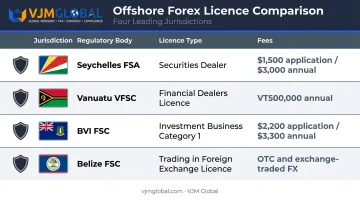
International brokerage licenses available to offshore entities include:
- Seychelles FSA — Securities Dealer licence (e.g., SD018 held by Raw Trading Ltd/IC Markets), with a $1,500 application fee and $3,000 annual fee
- Vanuatu VFSC — Financial Dealers Licence, directly named for forex/derivatives activity; annual fee of VT500,000 following 2024 amendments
- BVI FSC — Investment Business licence (Category 1), with application fees from $2,200 and annual fees of $3,300
- Belize FSC — Trading in Foreign Exchange Licence, expressly permitting OTC and exchange-traded FX
The retail forex market continues growing. Finance Magnates reported that active FX/CFD accounts exceeded 5 million in 2024, up nearly 30% from two years earlier. That growth spans multiple regions simultaneously, making international client access a direct revenue lever rather than a regulatory convenience.
One important caveat: an offshore license does not automatically authorise soliciting clients in every country. The rules of each target client's home country still apply. In 2026, the CFTC ordered foreign firms Netrios LP Ltd and Red Acre Ltd to pay a combined $2.5 million for illegal off-exchange transactions with US customers — despite being incorporated offshore. Offshore formation and a valid license must be paired with proper client-country compliance.
Flexible Multi-Currency Banking and Segregated Accounts
Forex is, by definition, a multi-currency business. Offshore banking partners typically offer corporate accounts that hold, receive, and transact in multiple currencies simultaneously — eliminating conversion friction that erodes margins on every cross-currency transaction.
IOSCO's framework for client asset protection recommends:
- Client-by-client asset records
- Clear separation between client funds and the firm's proprietary assets
- Daily calculation of entitlements and obligations
- Regular reconciliation against third-party records
Offshore structures make proper fund segregation more operationally straightforward, mirroring institutional standards and reducing both financial and legal risk.
Key metrics this benefit improves:
- Currency conversion costs (eliminating unnecessary FX spreads on operating transactions)
- Transaction processing speed across time zones
- Client fund security and audit trail clarity
- Risk management clarity between operating capital and client deposits
This is particularly critical for brokerages managing client funds across Asia, Europe, and the Americas simultaneously.
Asset Protection and Limited Liability
Offshore incorporation creates legal separation between the owner's personal assets and the company's liabilities. If the forex business faces claims, trading losses, or regulatory disputes, personal wealth in the owner's home country is shielded by the corporate veil.
Some offshore jurisdictions go further than standard limited liability protection:
- Nevis LLC: Under the 2020 revised ordinance, a charging order is the exclusive creditor remedy — it is non-renewable, expires after three years, and foreign judgments against a membership interest are not directly recognised or enforced
- Cayman Islands: Foreign judgments generally require a fresh common-law enforcement action; the judgment must be final, conclusive, and for a definite money sum — creating procedural hurdles even for legitimate creditors
The FCA reported 37 Final Notices and over £186 million in fines in 2024/25 across the financial sector. Forex operators face inherent counterparty risk, market volatility, and regulatory exposure. For operators at any scale, separating personal and business assets is one of the few risk controls that costs nothing extra to establish at incorporation.
Enhanced Privacy and Confidentiality
Many offshore jurisdictions do not require public disclosure of shareholder or director identities. Practical privacy mechanisms include:
- Nominee directors — a registered agent-level director stands in public records instead of the beneficial owner
- Private registers — shareholder and beneficial owner data is held at the registered agent, not in a public registry
- Non-disclosure rules — formal legal restrictions on sharing ownership information without authority request
Offshore privacy means controlled confidentiality, not anonymity. BVI, Seychelles, Cayman, and Nevis all require beneficial ownership information to be filed with or maintained for competent authorities. In BVI, legitimate-interest access to beneficial ownership data became available from April 1, 2026. Cayman's 2024 regulations permit access by applicants investigating or preventing specified financial crimes.
For high-net-worth individuals, proprietary trading firms, and operators managing significant capital in competitive markets, this controlled confidentiality still offers meaningful protection against commercial exposure.
Top Jurisdictions for Offshore Forex Company Formation
The right jurisdiction depends on the actual instrument being traded, target client geography, banking partners needed, treaty requirements, and the owner's tax residence. No single jurisdiction is optimal for every operator.
| Jurisdiction | Corporate Tax | Regulatory Body | Key Forex Advantage |
|---|---|---|---|
| BVI | 0% income & capital gains | BVI FSC — Investment Business | Strong legal infrastructure; tax neutrality; one DTT (UK) |
| Seychelles | 15–25% profit bands | FSA Seychelles — Securities Dealer | Active offshore dealer regime; established licensing framework |
| Cayman Islands | 0% company tax | CIMA — Securities Investment Business | IOSCO-aligned framework; CI$100,000 base capital for broker-dealers |
| Vanuatu | Effectively 0% income tax | VFSC — Financial Dealers Licence | Directly named FX/derivatives licence; accessible entry point |
| Belize | 3% business tax | Belize FSC — Trading in Foreign Exchange | Expressly forex-labelled licence; OTC and exchange activity permitted |
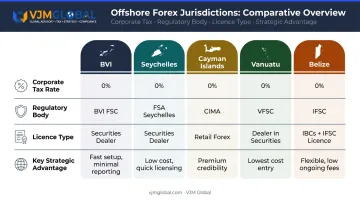
Across these options, the cheapest jurisdiction is rarely the most strategically sound. Several factors beyond cost regularly justify higher-cost choices:
- Banking access — correspondent relationships vary significantly by jurisdiction
- Client onboarding — some regions face friction opening accounts with lesser-known regulators
- Institutional recognition — larger counterparties and prime brokers apply their own jurisdiction filters
Seychelles and Vanuatu offer accessible entry points for early-stage operators. BVI and Cayman carry more institutional credibility, though they require careful licensing analysis to confirm the actual forex activity falls within the authorized scope.
What Happens When Forex Companies Skip Offshore Structuring
Operating a forex company through a high-tax onshore structure carries compounding costs:
- Tax drag: UK corporation tax sits at 25% for profits above £250,000; the US federal rate is 21% before state taxes; Germany's combined burden averages around 30%. Applied to forex trading profits sourced internationally, these rates represent a direct and preventable drag on earnings
- Client access restrictions: Domestic financial services regulations typically limit client onboarding to local residents, capping growth at the home market
- Banking limitations: Onshore corporate accounts rarely support the multi-currency functionality forex operations require without costly conversion
- Personal liability exposure: Without proper corporate separation, individual traders transitioning to brokerage operations carry personal risk for business disputes and regulatory actions
- Confidence gap: Institutional and professional clients often assess counterparty credibility partly through the sophistication of the operator's legal and regulatory structure
The scale problem compounds over time. Forex businesses that don't optimize their structure early tend to face restructuring costs later — re-licensing, banking migration, client agreement amendments, and tax remediation. Fixing a poorly structured business at scale costs far more — in time, money, and operational disruption — than getting the structure right from the start.
How to Get the Most Value from Your Offshore Forex Company
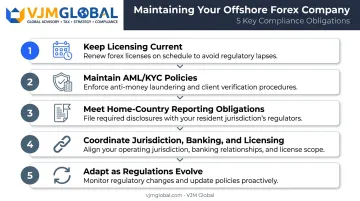
Offshore formation is a starting point, not a destination. The structure delivers ongoing value only when it is properly maintained:
- Keep licensing current — Annual fees, prudential filings, and regulatory reporting must be completed on schedule. Lapsed licences create immediate legal exposure
- Maintain AML/KYC policies — Most offshore forex jurisdictions require up-to-date anti-money laundering procedures and know-your-customer protocols as a condition of the licence
- Meet home-country reporting obligations — CFC rules, FBAR equivalents, FEMA compliance for Indian residents, and FATCA obligations for US persons don't disappear because the company is offshore. These must be actively managed
- Coordinate jurisdiction, banking, and licensing simultaneously — Delays in any one element can stall the entire operation. Treat these as a single coordinated process, not sequential steps
- Adapt as regulations evolve — Beneficial ownership disclosure requirements have expanded across BVI, Seychelles, Cayman, and Nevis in recent years. Structures that were compliant three years ago may require updating
Working with advisors who understand both the offshore jurisdiction's rules and the owner's home-country obligations is essential. For Indian residents and NRIs managing offshore forex entities, this means simultaneous fluency in FEMA, DTAA, and the regulatory framework of the chosen offshore jurisdiction.
VJM Global has supported this combination for 30+ years, with specific capabilities in FEMA advisory, international tax planning, and cross-border business setup for clients with India-connected capital flows.
Conclusion
Offshore forex company formation works because its advantages compound. Tax efficiency, global market access, multi-currency banking, asset protection, and operational privacy reinforce each other — reducing costs while expanding what a forex business can realistically do.
None of those benefits materialise automatically. The structure must be properly set up, maintained, and adapted as international regulations evolve. Beneficial ownership regimes are expanding. Licensing requirements are tightening. Market-access rules — as the $2.5 million CFTC enforcement action demonstrated — apply regardless of where a company is incorporated.
Regulatory scrutiny is only increasing. Getting the structure right early — jurisdiction selection, licensing, and banking — avoids costly enforcement exposure and operational disruption later. Businesses that establish compliant offshore structures from the outset trade more and restructure less.
Frequently Asked Questions
What are the benefits of having an offshore company?
Offshore companies offer tax efficiency on foreign-sourced income, personal asset protection through corporate separation, operational confidentiality, access to international markets, and more flexible banking arrangements. For forex brokerages, this combination directly reduces operating costs while broadening the client base they can legally serve.
Which jurisdiction is best for an offshore forex company?
There is no single best jurisdiction — the right choice depends on target client geography, regulatory reputation needed, banking access, and budget. BVI and Cayman Islands suit operators prioritising tax neutrality and legal infrastructure; Seychelles and Vanuatu offer more accessible licensing frameworks; Belize provides the most directly forex-labelled authorisation.
Is offshore forex company formation legal?
Yes, when done correctly. Offshore incorporation is legal provided it complies with the host jurisdiction's requirements and the owner's home-country reporting obligations. The critical distinction is between legal tax optimisation and illegal tax evasion — offshore structures must be disclosed and reported as required by the owner's residence country.
What licenses are typically required for an offshore forex company?
Requirements vary by jurisdiction, but most recognised offshore forex hubs require a forex or securities dealer licence, AML/KYC policies, and a registered office address. Licensing bodies include the FSA (Seychelles), VFSC (Vanuatu), BVI FSC, CIMA (Cayman Islands), and the FSC (Belize).
Can an offshore forex company open a multi-currency bank account?
Yes. Offshore forex companies typically access banking partners that offer multi-currency corporate accounts, allowing the business to hold and transact in multiple currencies without conversion friction.
What is the difference between onshore and offshore forex company registration?
Onshore registration subjects the company to domestic tax rates and regulatory requirements of the owner's home country, including restrictions on serving foreign clients. Offshore registration operates under the host jurisdiction's framework — typically offering lower tax on foreign-sourced income, broader client access, and more flexible licensing options.