
But here's where many UK companies stumble: they treat city selection as an afterthought. They pick Mumbai because it sounds like a financial capital, or Bengaluru because someone mentioned tech. The result is higher costs, slower setup, and compliance friction that could have been avoided entirely.
The right Indian city depends on your sector, your talent requirements, your supply chain, and which state-level incentives you're eligible for. This article breaks down the five best Indian cities for UK business registration — and gives you a practical framework for choosing the right one before you incorporate.
Key Takeaways
- India's IMF-forecast 6.5% real GDP growth for 2026 makes it one of the most compelling expansion markets available to UK businesses right now
- City selection directly affects talent access, operating costs, state incentives, and regulatory ease
- 100% FDI under the automatic route is permitted in most sectors — no local equity partner required
- The India-UK DTAA reduces double taxation on dividends, interest, and royalties for Indian subsidiaries and UK parents
- VJM Global has guided 250+ UK businesses through Indian market entry, from city selection to full operational compliance
Why UK Businesses Are Expanding to India Right Now
The numbers frame the opportunity clearly. UK FDI stock in India reached £19.1 billion at end-2024, up £1.7 billion from the previous year, and bilateral goods-and-services trade hit £47.9 billion in the same period. The IMF forecasts India's real GDP growth at 6.5% for 2026 — the fastest among major economies.
Three structural factors make this especially favourable for UK businesses:
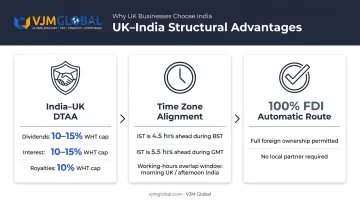
- India-UK DTAA: The 1993 Double Taxation Avoidance Agreement (updated by the 2020 OECD Multilateral Instrument) caps withholding tax on dividends at 10–15%, interest at 10–15%, and royalties at 10% — so income between an Indian subsidiary and a UK parent isn't taxed twice
- Time zone alignment: India sits 4.5 hours ahead during BST (5.5 hours during GMT), creating a workable overlap window for back-office and shared services teams
- 100% FDI automatic route: UK businesses can own their Indian entity outright in most sectors — no local partner required, no equity dilution
What the macro picture doesn't answer is where in India to register — and that's the decision with the most practical consequences for day-to-day operations, talent access, and tax efficiency.
Best Cities in India for UK Businesses to Register
The five cities below were selected based on:
- Talent availability and English-language capability
- FDI activity and state government policy for foreign investors
- Sector-specific infrastructure
- Alignment with sectors where UK businesses are most active
Bengaluru
Bengaluru is India's technology capital, and it's the first city most UK tech businesses should evaluate. Karnataka's GCC Policy 2024 reports 875+ GCC units, representing more than 30% of India's total Global Capability Centres and 35% of GCC employment nationwide.
The UK connection here is concrete. NatWest opened a Bengaluru hub in 2025 with capacity for 6,000 colleagues. Arm identifies Bengaluru as its third-largest global office and a core product-development hub. Startup India's rankings have consistently placed Karnataka among the country's top-performing states.
For UK businesses, the draw is a deep English-speaking technical talent pool, a mature VC ecosystem, and strong on-the-ground precedent from UK firms already operating locally.
| Category | Details |
|---|---|
| Best For | Tech startups, SaaS, GCC setup, IT services, R&D centres |
| Key Industries | Information technology, fintech, biotech, e-commerce, aerospace |
| UK Business Fit | UK fintech companies, digital agencies, software development arms, GCC buildouts |
Mumbai
Mumbai is India's financial capital — home to the Bombay Stock Exchange (at Dalal Street since its founding) and the Reserve Bank of India (which moved its Central Office permanently to Mumbai in 1937). For UK financial services businesses, it is the natural entry point.
Maharashtra received 39% of India's total FDI equity inflow in FY2024-25 — the largest share of any state. Jawaharlal Nehru Port handled 8.17 million TEUs in FY2025-26, making it the natural gateway for UK businesses with goods-based operations. Barclays and HSBC both maintain India head offices in Mumbai.
| Category | Details |
|---|---|
| Best For | Financial services, trading, FMCG, capital markets, luxury retail |
| Key Industries | Banking, capital markets, logistics, entertainment, manufacturing |
| UK Business Fit | UK banks, insurance firms, wealth managers, trading companies, consumer goods brands |

Delhi NCR (Gurugram / Noida)
Delhi NCR functions as India's corporate and government-facing hub. Gurugram houses major multinational offices across sectors, while Noida has grown into a significant IT/ITeS and back-office cluster. The British High Commission is in New Delhi, alongside the largest concentration of UK trade and diplomatic offices in India — a practical advantage for UK businesses that need regulatory engagement or government liaison.
VJM Global is headquartered in Noida (Sector 142, GMIT Park) and maintains a registered office in South Delhi. This dual presence within the NCR corridor supports the full range of regulatory interactions — from RoC filings to FEMA advisory — that UK businesses require during and after incorporation.
| Category | Details |
|---|---|
| Best For | Corporate headquarters, BPO, outsourcing, government liaison, professional services |
| Key Industries | IT/ITeS, real estate, retail, education, healthcare, consulting |
| UK Business Fit | UK consulting firms, back-office operations, compliance-heavy businesses, professional services |
Hyderabad
Hyderabad offers two distinct advantages that few Indian cities can match simultaneously: a world-class life sciences cluster and meaningfully lower operating costs than Bengaluru or Mumbai.
Genome Valley hosts 200+ biotechnology and pharmaceutical companies from 18 countries, including vaccine manufacturers with global supply chains. In April 2026, AstraZeneca India signed an MoU with the Telangana government for AI-enabled lung cancer screening; GSK licensed a Shigella vaccine candidate to Genome Valley-headquartered Bharat Biotech in June 2025. The UK pharma sector's ties to Hyderabad are active and deepening.
The TS-iPASS single-window clearance system processes approvals in 1–30 days depending on clearance type. On costs, KPMG's 2024 talent feasibility study ranks Hyderabad third-lowest among major Indian cities for commercial leasing costs — compared to sixth for Bengaluru and seventh (highest) for Mumbai.
| Category | Details |
|---|---|
| Best For | Pharma, life sciences, IT services, biotech, shared services |
| Key Industries | Pharmaceuticals, information technology, FMCG, aerospace, logistics |
| UK Business Fit | UK pharma and biotech companies, NHS-linked healthcare tech, life sciences R&D operations |
Chennai
Chennai is south India's industrial engine, with particular strength in automotive, electronics, and heavy engineering. Tamil Nadu contributed 7% of India's FDI equity inflow in FY2024-25, and a 2025 Tamil Nadu State Planning Commission report identifies 350+ tier-one automotive suppliers within 50 km of Chennai, with the state accounting for 45% of Indian automobile exports.
Chennai Port handled 1.8 million TEUs in FY2024-25, up 14.4% year on year, with direct sea freight routes linking to UK ports. UK engineering firms Renishaw opened a Chennai technology centre in 2024, and Spirax Sarco operates a manufacturing, technology, and training facility in the city.
| Category | Details |
|---|---|
| Best For | Manufacturing, automotive, electronics assembly, export-oriented businesses |
| Key Industries | Automotive, electronics, IT, textiles, healthcare devices |
| UK Business Fit | UK automotive suppliers, engineering firms, contract manufacturers, export-oriented production units |
How to Choose the Right Indian City for Your UK Business
The most common mistake UK businesses make is selecting a city based on brand recognition rather than sector logic. Choosing Mumbai because it's well-known, when your operation is pharmaceutical R&D, adds cost and reduces access to the talent and infrastructure you actually need.
Decision Framework by Sector
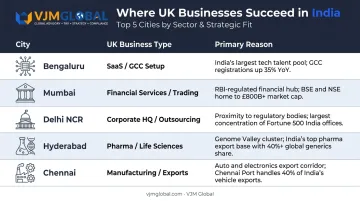
| UK Business Type | Recommended City | Primary Reason |
|---|---|---|
| Tech, SaaS, GCC buildout | Bengaluru | 875+ GCCs; deepest technical talent pool |
| Financial services, trading | Mumbai | BSE/RBI base; 39% of India's FDI inflow |
| Corporate HQ, outsourcing, government liaison | Delhi NCR | British High Commission; central regulatory access |
| Pharma, biotech, life sciences | Hyderabad | Genome Valley; TS-iPASS; lower costs |
| Manufacturing, automotive, exports | Chennai | 350+ tier-one suppliers; 1.8M TEU port |
What Else to Factor In
State-level incentives vary significantly across Karnataka, Maharashtra, Telangana, Tamil Nadu, and Uttar Pradesh. Tax holidays, land allocation, power subsidies, and single-window clearances are not uniform — and once you incorporate in a state, incentive eligibility is locked in.
This analysis must happen before registration, not after. VJM Global's pre-incorporation advisory covers incentive identification across federal, state, and local levels as a standard part of the process.
Time zone alignment also matters operationally. UK businesses running back-office or shared services operations benefit from the IST overlap: Delhi NCR and Hyderabad-based teams can hand off work that UK offices receive at the start of their business day during BST. During GMT (winter months), the overlap narrows to 5.5 hours, so plan your shift structure around that window accordingly.
What UK Businesses Need to Know Before Registering in India
Entity Structure Options
Three main entry structures exist for UK businesses:
- Wholly Owned Subsidiary (Private Limited Company): The most common route. Offers limited liability, 100% foreign ownership, local fundraising ability, and full credibility with Indian clients and regulators
- Liaison Office: For market exploration without generating local revenue. No Indian taxation, but commercial activity is prohibited. Requires RBI approval and a minimum net worth of USD 50,000
- Branch Office: Allows active operations and local revenue, but carries unlimited liability — the parent company's assets can be exposed. Minimum net worth required: USD 100,000
Under India's Consolidated FDI Policy, 100% FDI under the automatic route is permitted in most sectors relevant to UK businesses. Exceptions include defence (up to 74% automatic), news and current affairs broadcasting (49% via government route), and private banking (up to 49% automatic). These sectors require government approval before investment.
Key Compliance Requirements After Registration
Once incorporated, UK businesses face a set of mandatory ongoing obligations:
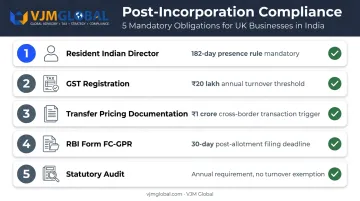
- Resident Indian director: At least one director must have spent 182 days in India during the preceding financial year (Companies Act 2013, Section 149(3)) — this must be arranged before filing. VJM Global provides nominee director services as part of its pre-incorporation advisory
- GST registration: Mandatory above ₹20 lakh annual turnover, or immediately for specified categories under CGST Act Section 24
- Transfer Pricing documentation: A Local File covering intercompany transactions must be maintained. Full Rule 10D(1) documentation applies where aggregate international transactions exceed ₹1 crore
- RBI Form FC-GPR: Must be filed within 30 days of share issuance to a non-resident investor
- Statutory audit: Audited financial statements are required annually (Companies Act 2013, Sections 139 and 143)
The India-UK DTAA in Practice
The 1993 UK-India Double Taxation Avoidance Convention (updated by the 2020 MLI-synthesised text) caps withholding tax rates at source in India:
- Dividends: 10% generally, 15% for qualifying immovable-property investment vehicles
- Interest: 15% generally, 10% for bank-to-bank payments
- Royalties and fees for technical services: 10%
In practice, a UK parent receiving dividends, intercompany interest, or royalties from its Indian subsidiary pays withholding tax at treaty rates — not India's standard domestic rates.
That difference matters: the UK parent can then claim a tax credit at home, avoiding double taxation on the same income stream.
Conclusion
India offers a genuine near-term expansion opportunity for UK businesses — but city selection is a strategic decision with long-term consequences. The right location depends on your sector:
- Bengaluru — tech companies and Global Capability Centres
- Mumbai — financial services and trade operations
- Delhi NCR — headquarters and outsourcing hubs
- Hyderabad — pharma and life sciences
- Chennai — manufacturing and export-oriented businesses
State-level incentive mapping, FDI route confirmation, and compliance planning need to happen before incorporation. Getting these decisions right at the start reduces cost, time, and legal exposure.
VJM Global's chartered accountants and business setup specialists have guided 250+ UK businesses through Indian market entry, covering:
- City selection and entity registration
- GST compliance and statutory audit
- Transfer Pricing documentation and FEMA advisory
Contact VJM Global at [email protected] or +91 9891576441 to start your India expansion.
Frequently Asked Questions
Where should I register my business in India?
The right registration location depends on your sector and operational model. The Ministry of Corporate Affairs handles incorporation nationally through the SPICe+ portal, but your chosen state determines GST jurisdiction, applicable labour laws, and eligibility for state-level incentives — which is why location analysis should happen before you file, not after.
Which city is best for business in India?
There's no single answer. Bengaluru leads for tech and GCCs, Mumbai for financial services and trade, Delhi NCR for corporate operations and government liaison, Hyderabad for pharma and IT, and Chennai for manufacturing and export-oriented businesses. The right city is the one that matches your sector and supply chain.
Can a UK company own 100% of an Indian subsidiary?
Yes — 100% FDI under the automatic route is permitted in most sectors, meaning no local equity partner is required. A small number of sectors (defence, certain media, and some financial services) have FDI caps and require government approval before investment proceeds.
What is the most common business structure for UK companies registering in India?
A Private Limited Company (Wholly Owned Subsidiary) is the standard choice. It offers limited liability, full foreign ownership, the ability to raise local funding, and strong credibility with Indian clients, banks, and regulators. Liaison Offices suit exploratory phases; Branch Offices work for operational presence without a separate legal entity.
Do UK businesses need a local director to register a company in India?
Yes. Indian company law requires at least one director who has spent 182 days in India during the preceding financial year — a residency test, not a citizenship requirement. This must be satisfied before filing. VJM Global provides nominee director services to fulfil this requirement.
How long does it take for a UK company to register a business in India?
Full setup — including GST registration, bank account opening, and compliance appointments — generally runs 4–8 weeks. Timelines vary based on document readiness and regulatory processing queues.