
Introduction
India ranks among the most compelling expansion markets for Singapore entrepreneurs in 2026. With a shared economic timezone (just 2.5 hours apart), strong bilateral trade facilitated by the Comprehensive Economic Cooperation Agreement (CECA), and access to a 1.4 billion-person consumer market, India offers genuine near-term growth opportunities for ASEAN-based businesses.
Singapore is currently India's #1 source of foreign direct investment for seven consecutive years, contributing $17.6 billion in the first nine months of FY26 alone. This established corridor makes market entry smoother for Singapore companies than many other foreign investors.
That advantage only goes so far, though — city selection still matters. Your choice of location directly shapes talent availability, regulatory ease, sector-specific infrastructure, and operational costs. This guide breaks down the top five Indian cities for Singapore entrepreneurs and how to match your business model to the right one.
Key Takeaways
- India's GDP grew 6.5% in 2024, making it one of the fastest-growing major economies globally
- Singapore contributed $17.6 billion in FDI to India in Apr–Dec FY26, accounting for 19% of total Indian FDI
- Best city depends on your sector: Bengaluru for tech/GCCs, Mumbai for finance and trade, Delhi NCR for corporate headquarters, Hyderabad for pharma/IT, Chennai for manufacturing
- The India-Singapore CECA simplifies investment flows, services trade, and professional mobility for Singaporean businesses
- State incentives, FDI routes, and compliance requirements vary by city — plan your location and legal structure together from the start
Why Singapore Entrepreneurs Are Choosing India Right Now
India's economic fundamentals present a strong rationale for Singapore-based expansion. The country's GDP reached $3.91 trillion in 2024, with the World Bank projecting growth at 6.6% through FY27. India's IT-BPM industry alone reached $315 billion as of FY26, reflecting deep digital adoption and a growing middle class with increasing purchasing power.
The Singapore-India Bilateral Advantage
The Comprehensive Economic Cooperation Agreement (CECA) between Singapore and India, in force since 2005, provides tangible advantages for Singapore entrepreneurs. Key provisions include:
- Eliminated or reduced more than 5,000 tariffs on goods trade
- Investment protection through national treatment and investor-state dispute settlement
- Temporary entry rights for professionals across 127 specific occupations
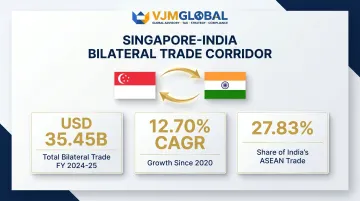
Total bilateral trade reached USD 35.45 billion in FY 2024-25, growing at a CAGR of 12.70% since 2020. Singapore accounted for 27.83% of India's overall ASEAN trade in 2024-25 — figures that reflect how central this corridor has become for both economies.
The Operational Advantage: Timezone and Connectivity
India Standard Time sits just 2.5 hours behind Singapore Standard Time. For businesses managing cross-border teams, client calls, or real-time collaboration, that overlap makes India one of the most operationally convenient markets available — coordinating with Mumbai or Bengaluru is straightforwardly simpler than syncing with London or New York.
Best Cities in India to Start a Business for Singapore Entrepreneurs
City selection in India directly shapes talent access, regulatory environment, sector infrastructure, and long-term scalability. The five cities below were evaluated on business-friendliness, FDI activity, infrastructure quality, sector strength, and relevance to Singapore business profiles.
Bengaluru
Bengaluru (Bangalore) is India's undisputed technology capital. It houses the highest density of IT firms, funded startups, and Global Capability Centres (GCCs) in the country, making it the natural first choice for Singapore tech companies, SaaS businesses, and venture-backed founders.
GCC and startup activity:
- Bengaluru accounts for 36% of all India GCC activity with 880+ GCC units and 660,000+ professionals, according to Zinnov's 2026 GCC Location Report
- The city contributed $130 billion in services exports in FY 2024-25, representing more than one-third of India's total $358 billion services exports
- Home to a mature startup ecosystem with active VC networks — Karnataka recorded six $100M+ funding rounds in 2024
- Strong English-speaking talent pool with deep technical expertise
- Multiple Singapore-headquartered tech companies already operate from Bengaluru, creating an established support ecosystem
Karnataka earned a "Best Performer" ranking in India's state ranking for startup support, reinforcing its regulatory friendliness for foreign-invested businesses.
| Category | Details |
|---|---|
| Best For | Tech startups, SaaS, GCC setup, IT services, R&D centres |
| Key Industries | Information technology, fintech, biotech, aerospace, e-commerce |
| Singapore Connection | Several Singapore-listed companies run India tech operations from Bengaluru; strong GCC activity from ASEAN MNCs |

Mumbai
Mumbai is India's financial capital — home to the Bombay Stock Exchange (Asia's oldest), the Reserve Bank of India, major banking institutions, and headquarters of India's largest conglomerates. This makes it the primary gateway for Singapore entrepreneurs in finance, trading, media, and consumer goods.
Capital markets and trade infrastructure:
- Unmatched access to capital markets and institutional investors for businesses requiring funding or listing in India
- Maharashtra receives 31.35% of all Singapore FDI into India (Oct 2019 - Dec 2024), making it the #1 destination state for Singapore investment
- Jawaharlal Nehru Port (JNPT), near Mumbai, ranks #1 in India and 23rd globally in container port performance, handling more than half of India's container cargo
- Singapore's PSA International operates a deep-water terminal at JNPT, creating direct logistics connectivity
- Cosmopolitan business culture experienced with foreign investors — DBS Bank Singapore operates in India as a wholly owned subsidiary from Mumbai
For goods-based businesses or those with significant import/export requirements, no other Indian city matches Mumbai's port and logistics depth.
| Category | Details |
|---|---|
| Best For | Fintech, financial services, trading, FMCG, media, luxury retail |
| Key Industries | Banking, capital markets, entertainment, manufacturing, logistics |
| Singapore Connection | Strong financial services corridor; Singapore banks and wealth management firms operate through Mumbai branches |
Delhi NCR (Gurugram / Noida)
Delhi NCR — encompassing Gurugram, Noida, and New Delhi — is India's most strategically central city cluster. It houses the highest concentration of multinational corporate offices, government-facing businesses, and e-commerce/logistics operations.
Corporate presence and government access:
- Gurugram hosts more than 250 Fortune 500 companies and serves as South Asian headquarters for Google, IBM, and Microsoft
- Noida (where VJM Global is headquartered) is a growing hub for IT/ITeS, back-office operations, and outsourcing, with major players like Adobe, TCS, and HCL
- Delhi NCR holds 14% of India's GCC activity with 270,000+ professionals
- Largest concentration of Singapore diplomatic and trade offices in India — the High Commission of Singapore is located in New Delhi, and Delhi received 13.64% of Singapore FDI (Oct 2019 - Dec 2024)
- Proximity to central government institutions makes it ideal for businesses requiring regulatory liaison or policy engagement
The region also offers the largest consumer market catchment outside Mumbai, which supports pan-India distribution strategies.
| Category | Details |
|---|---|
| Best For | Corporate headquarters, government liaison, e-commerce, BPO, outsourcing |
| Key Industries | IT/ITeS, retail, real estate, education, healthcare, manufacturing |
| Singapore Connection | Largest concentration of Singapore trade offices, embassies, and bilateral business chambers in India |
Hyderabad
Hyderabad has emerged as one of India's most business-friendly cities for foreign investors, supported by proactive state government policies under Telangana's industrial development framework. The city hosts a globally competitive pharmaceutical and life sciences cluster alongside a rapidly growing IT corridor (HITEC City).
Cost advantage and investor facilitation:
- Genome Valley, Hyderabad's pharma hub, spans over 2,000 acres, houses 200+ companies from 18+ countries, and contributes nearly one-third of global vaccine production
- Lower real estate and talent costs than Bengaluru or Mumbai while matching infrastructure quality — office rents in HITEC City are approximately ₹75-105/sq ft/month vs. Bengaluru's ₹100-140/sq ft or Mumbai's ₹300-550/sq ft
- TS-iPASS single-window clearance system provides a legally backed "Right to Industrial Clearance," reducing bureaucratic delays for foreign investors unfamiliar with India's multi-agency processes
- Hyderabad holds 21% of India's GCC activity with 235,000+ professionals, ranking #2 nationally after Bengaluru
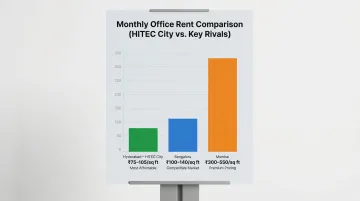
This combination of cost efficiency and structured investor support makes Hyderabad a strong first entry point for Singapore companies new to the Indian market.
| Category | Details |
|---|---|
| Best For | Pharma, life sciences, IT services, biotech, shared services |
| Key Industries | Pharmaceuticals, information technology, FMCG, aerospace, logistics |
| Singapore Connection | Hyderabad hosts multiple Singapore-linked pharmaceutical and biotech collaborations; strong in generic drug exports to ASEAN |
Chennai
Chennai is India's industrial and manufacturing powerhouse for the south, particularly strong in automotive, electronics, and heavy engineering. This makes it the top choice for Singapore companies in supply chain, contract manufacturing, or export-oriented production.
Port access and bilateral manufacturing ties:
- Chennai Port achieved record container throughput of 1.83 million TEUs in FY 2025-26, with direct shipping routes to Singapore — making it the most port-connected city for goods-based businesses
- Tamil Nadu ranks #1 for FDI in the automobile sector, accounting for 18.21% of the state's total FDI (USD 2.52 billion from Oct 2019 - Dec 2024)
- Singapore is the #1 FDI source into Tamil Nadu at 18.36% (USD 2.54 billion), demonstrating established bilateral manufacturing partnerships
- Tamil Nadu has one of India's most skilled blue-collar and engineering workforces, supported by strong ITI (Industrial Training Institute) and polytechnic networks
- Chennai holds 10% of India's GCC activity with 210,000+ professionals, increasingly focused on engineering R&D
The state government actively facilitates bilateral collaboration — Tamil Nadu recently held a Singapore Investment Roundtable to strengthen commercial ties.
| Category | Details |
|---|---|
| Best For | Manufacturing, automotive, electronics assembly, export-oriented businesses |
| Key Industries | Automotive, electronics, IT, textiles, healthcare devices |
| Singapore Connection | Direct sea freight routes to Singapore; Tamil Nadu has bilateral manufacturing agreements and is a preferred destination for ASEAN-origin FDI in production |
How to Choose the Right Indian City for Your Business Type
The most common mistake Singapore entrepreneurs make is choosing a city based on familiarity or brand recognition rather than sector fit, talent availability, or supply chain logic. This leads to higher operational costs, longer time-to-market, and unnecessary friction.
Use this decision framework:
- Tech/IP-driven businesses → Bengaluru (mature ecosystem, deep talent) or Hyderabad (cost advantage, policy support)
- Capital and trade-heavy businesses → Mumbai (financial infrastructure, port access)
- Government-interface or pan-India distribution → Delhi NCR (proximity to institutions, central location)
- Manufacturing and exports → Chennai or Pune (logistics, skilled labour, production ecosystem)
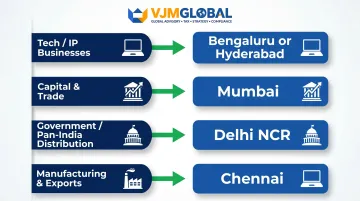
The framework above covers sector fit, but your customer and partner locations matter just as much. If your primary Indian clients are pharmaceutical companies, Hyderabad makes more sense than Delhi NCR. If you're serving automotive OEMs, Chennai's cluster advantage is significant.
One point Singapore businesses frequently miss: state-level incentive schemes should be reviewed during feasibility, not after incorporation. Tax holidays, land allocation, power subsidies, and single-window clearance portals vary significantly across states — and once you've registered in a given state, you've already locked in your eligibility. VJM Global's market entry assessments map available incentives by state so you factor them into the decision before it's made.
Key Steps for Singapore Entrepreneurs to Register a Business in India
Singapore entrepreneurs can enter India primarily as a Wholly Owned Subsidiary (Private Limited Company) or through a Liaison/Branch Office, depending on whether they intend to generate revenue in India. Most Singapore businesses choose the WOS route for full operational control.
FDI Equity Caps and Automatic Route Eligibility
Under India's Consolidated FDI Policy, 100% FDI under the automatic route is permitted in most sectors relevant to Singapore businesses, including:
- IT/Software, SaaS, and technology services
- Manufacturing (all types)
- Telecom services
- E-commerce (marketplace model)
- Pharmaceuticals (greenfield — 100%; brownfield up to 74% automatic)
- Renewable energy, hospitality, and industrial parks
Singapore companies generally qualify under the automatic route without additional government approvals (unlike entities from land-border countries subject to Press Note 3/2020 restrictions).
The Incorporation Process
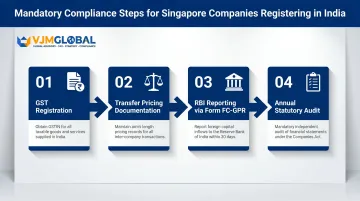
While company registration itself can be completed digitally through the MCA (Ministry of Corporate Affairs) portal, ongoing compliance requires local expertise:
- GST registration: mandatory from day one for non-resident taxable persons
- Transfer pricing documentation: required when international transactions exceed ₹1 crore (~SGD 160,000)
- RBI reporting (Form FC-GPR): filed upon share issuance to foreign investors
- Annual statutory audits: mandatory for all Private Limited Companies in India
Resident Director Requirement
India's company law mandates at least one resident Indian director on the board of a Private Limited Company — defined as someone who stayed in India for at least 182 days in the previous calendar year. This must be planned before incorporation.
Working with a firm like VJM Global — which specialises in helping foreign companies establish and operate in India — reduces setup timelines and lowers the risk of compliance gaps. The firm covers entity registration, compliance mapping, and post-incorporation operations across all five cities in this guide.
Conclusion
India offers a concrete, near-term business opportunity for Singapore entrepreneurs — but city selection is a strategic decision that should be made based on sector fit, operational model, and compliance readiness, not just city brand recognition.
Each city offers distinct advantages that align with specific business models:
- Bengaluru — Technology companies and Global Capability Centers (GCCs)
- Mumbai — Finance, trade, and financial services operations
- Delhi NCR — Corporate headquarters and government-facing businesses
- Hyderabad — Pharma and cost-conscious IT operations
- Chennai — Manufacturing and export-driven businesses
Ready to take the next step?
Singapore entrepreneurs looking to enter India should start with a structured market entry assessment: city selection, entity type, FDI route, and compliance mapping.
VJM Global's chartered accountants and business setup specialists have guided international companies through every stage of India market entry, from registration to full-scale operations, with on-the-ground presence across Bengaluru, Mumbai, Delhi NCR, Hyderabad, and Chennai.
Contact VJM Global at [email protected] or +91 98915 76441 to discuss your India expansion strategy.
Frequently Asked Questions
Which city is the best place to start a business in India?
There is no single "best" city — the right choice depends on your industry and business model. Bengaluru leads for tech and SaaS, Mumbai for finance and trading, Delhi NCR for corporate headquarters or government-facing businesses, while Hyderabad and Chennai offer strong options for pharma/IT and manufacturing respectively.
Which state is best to register a business in India?
Company incorporation is handled at the national level through the Ministry of Corporate Affairs, not by individual states. That said, state selection affects GST registration, labour compliance, and access to industrial incentives — Maharashtra, Karnataka, Telangana, and Tamil Nadu are consistently top performers for foreign entrants.
Which is the most profitable business to start in India?
Profitability depends on execution and market fit, but IT/SaaS services, fintech, healthcare tech, and manufacturing for export rank among the highest-margin sectors for foreign-invested businesses in India — especially those capitalising on India's cost-to-talent advantage.
What types of businesses in India have the highest success rates?
Businesses that establish genuine product-market fit in India, build a local leadership team, and prioritise regulatory compliance from day one tend to outperform. B2B technology services, outsourcing, and sector-specific manufacturing have shown the strongest track records for foreign entrants.
Do Singapore companies need a local partner to do business in India?
Most sectors allow 100% FDI under the automatic route, meaning no mandatory local partner is required. However, you will need at least one resident Indian director (required by law for a Private Limited Company) and a local compliance advisor to meet regulatory obligations from the outset.