Introduction
American founders have been eyeing Dubai and Abu Dhabi with new interest since 2021, when reforms allowed 100% foreign ownership of mainland companies for the first time. Pair that with a dirham pegged to the dollar since 1997, and the UAE looks like one of the easiest overseas markets a US entrepreneur can enter.
Most guides on "UAE business ideas" stop there. They rarely mention that US citizens face a heavier compliance load than European or Asian expats in the Emirates. Worldwide income taxation, FATCA reporting, and no US-UAE tax treaty put an American founder's UAE company under a second layer of rules. Most local advisors never mention it.
This article covers the UAE sectors where US expertise, capital, or brand recognition create a real edge, the US tax exposure tied to each, and the setup sequence to get a license and bank account running.
TL;DR
- US founders get 100% foreign ownership, 0% personal income tax, and a dollar-pegged dirham in the UAE
- Highest-potential openings: e-commerce, fintech, consulting, AI/tech, import-export, and real estate platforms
- US worldwide tax, FATCA/FBAR, and CFC rules (GILTI/Subpart F) still apply when you operate from the UAE
- Lock free zone vs. mainland licensing, visas, and corporate banking before revenue starts
Why the UAE Is a Strategic Market for US Entrepreneurs
The US and UAE already do serious business together. Bilateral trade in goods and services hit $47.9 billion in 2024, up 10.4% from the year before, according to the US Trade Representative's office. That scale reflects a market that's been steadily lowering the barriers for foreign founders.
Ownership rules changed in 2021. Federal Decree-Law No. 32 rewrote the UAE Commercial Companies Law, removing the requirement for a majority Emirati shareholder on mainland companies in most sectors. A US entrepreneur can now hold 100% of a mainland LLC without a local partner, something that simply wasn't possible before.
The dirham removes currency guesswork. The UAE Central Bank pegs the AED at 3.6725 to the US dollar. For a founder invoicing US clients or repatriating profits home, that peg means no currency hedging and pricing that translates cleanly between markets.
Tax rates favor the founder. The UAE:
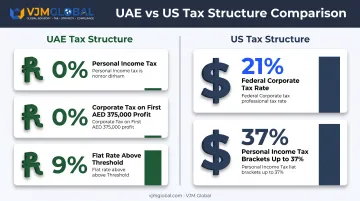
- Charges 0% personal income tax on salaries and dividends
- Applies 0% corporate tax on the first AED 375,000 in annual profit
- Taxes profit above that threshold at a flat 9%
Compare that to the 21% US federal corporate rate, and the UAE's structure leaves more room to reinvest early profit before tax bites.
The UAE also works as a regional base. Dubai and Abu Dhabi put major markets across the Middle East, Africa, and South Asia (MEASA) within a few hours' flight. A company licensed in a UAE free zone can service clients across that region without separate entities everywhere, which is a different pitch than treating the UAE as a standalone market.
None of this erases US tax obligations, which we'll get to shortly. But as a launch pad, few markets combine ownership freedom, currency stability, and regional reach quite the way the UAE currently does.
Top Business Ideas for US Entrepreneurs to Start in the UAE
This list prioritizes sectors where an American founder's existing supply chains, regulatory experience, or brand recognition create a genuine edge over local competitors.
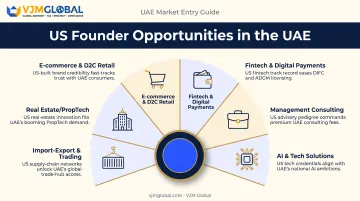
E-commerce & Cross-Border D2C Retail
US direct-to-consumer brands can license through Dubai CommerCity or a similar e-commerce free zone and start selling across the GCC without opening a physical storefront. The setup is built for exactly this model: a trade license, a fulfillment partner, and a UAE bank account.
This suits US founders because the hard part, building a product line and a brand US consumers already trust, is already done. The GCC's smartphone penetration rate is among the highest in the world, so an established Amazon or Shopify brand can often port its playbook with minor localization.
| Category | Details |
|---|---|
| License Type | E-commerce license via a free zone authority |
| Typical Setup Cost | From around AED 6,000 for a basic package |
| US-Specific Consideration | Cross-border payment processing and US-to-UAE dropshipping/inventory logistics need separate setup |
Fintech & Digital Payments
Digital wallets, buy-now-pay-later platforms, and payment gateways regulated through DIFC or ADGM are among the fastest-growing license categories in the UAE. DIFC projects the local fintech market will grow from $3.16 billion in 2024 to $5.71 billion by 2029.
US founders often have an edge here: experience navigating SEC or state-level money transmitter rules translates well into DIFC and ADGM's sandbox frameworks.
| Category | Details |
|---|---|
| License Type | DIFC (DFSA) or ADGM (FSRA) regulated financial license |
| Typical Setup Cost | Regulator application and annual fees typically AED 18,000–92,000 by activity, before incorporation and staffing |
| US-Specific Consideration | Serving US clients remotely may still trigger SEC or FinCEN registration requirements at home |
Management & Professional Consulting
UAE SMEs consistently look for outside expertise in finance, HR, marketing, and growth strategy, areas where a US consulting background carries real weight. A professional license lets a founder set up with minimal overhead: no inventory, no large office, often just a laptop and a client list.
This model suits founders monetizing relationships they already have rather than building a client base from zero.
| Category | Details |
|---|---|
| License Type | Professional license (free zone or mainland) |
| Typical Setup Cost | Roughly AED 7,000 to AED 27,000 depending on activity count and included visas |
| US-Specific Consideration | The IRS still treats this as self-employment income on your US return, even though the UAE levies no personal tax on it |
AI, Software & Tech Solutions
The UAE adopted its National AI Strategy 2031 in 2019, aiming to build an integrated AI system across government and commercial sectors. That top-down commitment has created steady demand for software and AI vendors willing to build locally.
US founders bring two things that matter: access to Silicon Valley-trained technical talent, and early credibility in a market actively subsidizing AI adoption.
| Category | Details |
|---|---|
| License Type | Commercial or free zone tech license |
| Typical Setup Cost | Roughly AED 7,000 to AED 27,000 depending on package and visa allocation |
| US-Specific Consideration | Serving both US and UAE clients means managing IP protection and data residency rules in both jurisdictions |
Import-Export & Trading
Jebel Ali Free Zone has built its reputation around exactly this model: a hub where a US manufacturer of food products, machinery, or specialty goods can warehouse inventory and distribute across the GCC, Africa, and South Asia from one location.
The advantage for US founders isn't just logistics. An existing US supplier relationship and a "Made in USA" label still function as a trust signal for regional buyers evaluating unfamiliar vendors.
| Category | Details |
|---|---|
| License Type | Commercial trading license |
| Typical Setup Cost | JAFZA licenses start from around AED 5,000, scaling with the number of activities |
| US-Specific Consideration | US Export Administration Regulations (EAR) and OFAC sanctions screening apply alongside UAE customs registration |
Real Estate Investment & PropTech Platforms
Dubai's property market isn't slowing down. The Dubai Land Department recorded 226,000 real estate transactions worth AED 761 billion in 2024, and demand for fractional ownership and property management platforms is rising alongside it.
US founders familiar with REIT structures or fractional real estate platforms back home will recognize the model quickly, since Dubai's market is maturing in a direction that mirrors what's already standard in the US.
| Category | Details |
|---|---|
| License Type | RERA-registered brokerage or commercial license |
| Typical Setup Cost | Around AED 10,000 annually for RERA licensing, plus an AED 20 knowledge fee; final costs vary by structure |
| US-Specific Consideration | Foreign real estate holdings may trigger Form 8938 or FBAR reporting once threshold values are crossed |
Key US Tax & Compliance Considerations Before You Start
Every business idea above still runs through the same filter: US tax law doesn't care where your company is incorporated.
Worldwide Income Still Applies
US citizens and green card holders are taxed on worldwide income regardless of where a company operates or how many zero-tax UAE structures sit between the founder and the profit. The UAE won't ask for a personal tax return. The IRS will.
FATCA, FBAR, and Form 8938
The UAE and US operate under a Model 1 FATCA agreement, so UAE banks report US-linked accounts directly to US authorities. On top of that, US owners typically face:
- FBAR (FinCEN 114): Required once combined foreign account balances exceed $10,000 at any point in the year
- Form 8938: Required when specified foreign assets exceed thresholds from $50,000 to $600,000, depending on filing status and US residency
Missing either isn't a minor paperwork slip. Penalties escalate quickly and compound if left unaddressed for multiple years.
CFC Rules: GILTI and Subpart F
A UAE company majority-owned by a US person generally qualifies as a Controlled Foreign Corporation. That triggers Subpart F and GILTI inclusion rules. A share of the UAE company's income gets taxed on the founder's US return in the year it's earned, not when it's distributed. The UAE's 0% personal tax rate doesn't change that calculation.
No Treaty Means No Treaty Relief
There is no comprehensive income tax treaty between the US and UAE. Founders in, say, the UK or Germany can lean on treaty provisions to avoid double taxation. US founders in the UAE generally rely on the Foreign Tax Credit under IRC Sections 901/904 instead. That credit has its own limitations tied to foreign-source income ratios.
Why This Needs Specialist Support
Running compliant books in one country is manageable. Coordinating UAE Corporate Tax and VAT alongside GILTI, Subpart F, FBAR, and Form 8938 is where most founders get stuck without help.
VJM Global's cross-border team pairs US CPAs with UAE-focused compliance staff to manage that dual-filing complexity, rather than treating each jurisdiction as a separate engagement.
How to Set Up Your Business in the UAE as a US Entrepreneur
Free Zone or Mainland?
The first decision shapes everything else:
- Free zone: 100% foreign ownership guaranteed, faster setup, but limited direct access to the mainland market without a distributor
- Mainland: Full access to the UAE market and government contracts, now also open to 100% foreign ownership in most sectors
Founders selling only to overseas or free-zone clients often start in a free zone. Those planning to sell directly to mainland customers usually need the mainland license instead.
The Registration Sequence
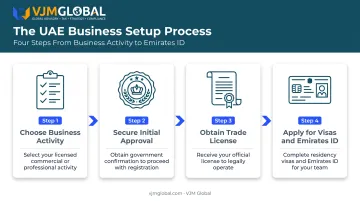
Setup follows the same order regardless of structure:
- Choose the business activity to determine which license category and authority applies
- Secure initial approval from the free zone authority or the Department of Economic Development
- Obtain the trade license once documentation and any regulatory sign-offs are complete
- Apply for visas and Emirates ID for the founder and employees, tied to the entity's approved visa quota
The Banking Step Takes Longest
Corporate bank account opening is usually the slowest part of the process for US applicants. Banks run extra FATCA-related due diligence on US-linked accounts, which means more documentation up front. Banks typically ask for:
- Detailed business plans and proof of activity
- Source-of-funds documentation
- Beneficial ownership disclosures going back further than they'd request from a non-US applicant
Preparing this paperwork before applying for the license, rather than after, shaves real time off the process. VJM Global handles UAE entity formation across mainland, free zone, and offshore structures, including trade-name reservation, licensing, and post-formation registrations that need to be in place before the banking conversation starts.
Conclusion
The UAE's ownership reforms and dollar-pegged economy have made it one of the more accessible markets for a US founder to enter. That access still comes with homework. Matching your business idea to real UAE demand matters just as much as picking the right license type.
Before committing to a jurisdiction or license, weigh the market opportunity against your US tax exposure. GILTI, FATCA, and CFC reporting don't disappear because your company sits in a 0% personal tax jurisdiction. They get filed alongside your UAE obligations, not instead of them.
If you're weighing a UAE launch and want entity formation and US-side tax filings handled together, VJM Global's cross-border team works with founders on that combination.
Frequently Asked Questions
What businesses can I start in Dubai with 50,000 AED?
At this budget, e-commerce, consulting, digital marketing, and small trading licenses are realistic options. AED 50,000 typically covers the license fee, one visa, and basic registration, though office space or extra visas can push it higher.
How can US businesses start a business in the UAE to earn a steady monthly income?
Choose recurring-revenue models—consulting retainers, e-commerce subscriptions, or service contracts—for the steadiest cash flow. A valid license and a working corporate bank account are required before you can collect consistent payouts.
What are the most profitable businesses to start in the UAE?
Fintech, real estate brokerage, and specialized consulting tend to carry the highest margins, though profitability still depends heavily on execution and how quickly you clear compliance and banking setup.
Do US citizens have to pay US tax on income earned through a UAE business?
Yes. Worldwide income taxation applies regardless of the UAE's 0% personal tax rate, and FBAR, FATCA, and CFC reporting obligations typically apply once ownership and account thresholds are met.
Can US citizens own 100% of a business in the UAE?
Yes, under free zone rules and, since 2021, under mainland reforms covering most sectors. No local Emirati sponsor is required for the large majority of business activities.
Is there a tax treaty between the US and UAE?
No comprehensive income tax treaty exists between the two countries. Double taxation is generally managed through the US Foreign Tax Credit rather than treaty-based relief.