Introduction
US-UAE bilateral trade hit $39 billion in 2025, and more than 1,500 US companies are already operating in the Emirates. For American entrepreneurs, the commercial infrastructure is there — the question is where to position within it.
What makes 2026 different is the convergence of factors: Abu Dhabi's AED 13 billion digital strategy, Dubai's record-breaking real estate market, and a May 2025 announcement of $200 billion in US-UAE commercial deals. The timing is favorable for American entrepreneurs who move deliberately.
US entrepreneurs enter with real structural advantages: English is the dominant business language, American brand credibility resonates with the UAE's affluent consumer base, and access to US capital networks sets them apart from regional competitors. What follows covers the most viable opportunities, incorporation essentials, and how to set up without costly missteps.
TL;DR
- The UAE offers 0% personal income tax, 100% foreign ownership in free zones and many mainland sectors, and 40+ free zones with sector-specific benefits
- Top sectors for US entrepreneurs include tech/AI, e-commerce, real estate consulting, financial services, and logistics
- US citizens remain taxable by the IRS on worldwide income regardless of where they live or operate — UAE tax benefits don't replace US filing requirements
- Standard free zone setup takes 3–10 business days; licensed or regulated activities require additional processing time
Why the UAE Is a Prime Market for US Entrepreneurs in 2026
The UAE's corporate tax structure, introduced in 2023, applies 0% on taxable income up to AED 375,000 and 9% on income above that threshold. Free zone companies can qualify for 0% on "Qualifying Income" as a Qualifying Free Zone Person (QFZP) — but this status requires meeting specific conditions around economic substance, audited financials, and transfer pricing compliance. That qualification isn't guaranteed by registration alone.
Beyond tax, the structural advantages are substantial:
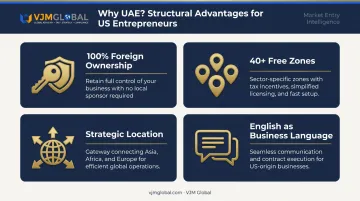
- 100% foreign ownership permitted across most mainland sectors and all free zones
- 40+ free zones offering sector-specific licenses, infrastructure, and regulatory environments
- Strategic location connecting Asia, Africa, and Europe — making the UAE a natural regional HQ for US companies targeting multiple markets
- English as the dominant language in business, law (particularly in DIFC and ADGM), and government communications
These structural advantages are backed by a strengthening bilateral relationship. A March 2025 framework committed to $1.4 trillion in UAE investment in the US over 10 years, and a bilateral AI agreement was signed alongside the May 2025 commercial deals announcement. For US entrepreneurs, this translates to government-level support for US commercial activity in the Emirates — not just favorable optics.
The business ideas below reflect where that demand, policy support, and US expertise intersect most clearly in 2026.
Best Business Ideas in the UAE for US Entrepreneurs in 2026
Technology and AI Services
The UAE's Digital Economy Strategy targets doubling the digital economy's GDP contribution from 9.7% to 19.4% within 10 years. Abu Dhabi separately committed AED 13 billion for 2025–2027 to build AI-native government infrastructure, creating direct procurement opportunities for enterprise software and AI service providers.
US tech founders and SaaS companies are well-positioned here. Free zones like Dubai Internet City and Abu Dhabi's Hub71 (operating within ADGM) offer 100% foreign ownership, full profit repatriation, and access to regional government and enterprise clients. Hub71 startups have surpassed $2.7 billion in funding, signaling strong regional investor appetite.
Why US entrepreneurs have an edge:
- Deep AI and SaaS experience that regional competitors lack
- Access to US venture capital and angel networks
- Credibility with enterprise clients who prefer proven US-origin technology stacks
E-Commerce and Cross-Border Trade
The UAE's e-commerce market is forecast to reach $17 billion in 2025, supported by 99% internet penetration across a population of affluent, mobile-first consumers. As a regional logistics hub adjacent to GCC, South Asia, and East Africa, the Emirates offers distribution reach that few markets can match.
US entrepreneurs with Amazon, Shopify, or DTC experience can establish regional operations through Dubai CommerCity, a dedicated e-commerce free zone offering specialized licenses, scalable warehousing, fulfillment centers, and last-mile services. A dual-license option allows some mainland sales without full mainland incorporation.
This is particularly compelling for US private-label brands looking to reduce dependence on US and EU markets. The UAE serves as both a sales market and a distribution base for the broader region.
Real Estate Consulting and Property Management
Dubai recorded 226,000 real estate transactions worth AED 761 billion in 2024, up 36% by volume year over year. Average residential prices rose 19.1%, with villas up 20.2% and apartments up 18.9%. Sustained high-net-worth migration is the primary driver, and that migration shows no signs of slowing.

American business models in property are underrepresented here. US real estate professionals can establish consulting, brokerage, or property management firms that bring operational sophistication the local market hasn't fully adopted. The formats with the clearest gap include:
- Franchise-style property management companies
- Tech-enabled brokerage platforms
- Short-term rental operators with yield optimization systems
Note that real estate brokerage in Dubai requires a RERA (Real Estate Regulatory Agency) license, which involves local registration requirements separate from free zone incorporation.
Financial Services and Wealth Management
Henley & Partners forecast a net inflow of 9,800 millionaires to the UAE in 2025, carrying approximately $63 billion in investable wealth. That level of HNWI concentration creates consistent demand for wealth structuring, cross-border tax advisory, financial planning, and family office services.
US financial advisors and CPAs with international expertise hold a distinctive advantage. Both DIFC (Dubai International Financial Centre) and ADGM (Abu Dhabi Global Market) operate under English common law frameworks, familiar territory for US professionals. Court proceedings are conducted in English, contracts follow common law principles, and regulatory structures align closely with standards US professionals already understand.
Operating in DIFC requires authorization from the DFSA (Dubai Financial Services Authority). ADGM requires authorization from the FSRA. Neither is a light regulatory lift, but for qualified professionals, the common law environment makes compliance more navigable than mainland alternatives.
Tourism, Hospitality, and Luxury Experiences
Dubai welcomed 19.59 million international overnight visitors in 2025 (up 5% year over year). UAE-wide tourism generated AED 257 billion in tourism revenue in 2024, with hotel revenue reaching AED 44.8 billion.
US entrepreneurs in luxury travel, experiential tourism, and hospitality concepts find a ready market here. American brand cachet — boutique hotel concepts, curated adventure experiences, premium F&B brands — commands premium pricing in a market where high-income tourists actively seek differentiated experiences. Tourism-related businesses typically operate well on the mainland, where direct consumer access is unrestricted.
Logistics, Freight, and Supply Chain Services
Jebel Ali ranked 9th globally in Lloyd's List's One Hundred Container Ports 2025, the highest-ranked port in the Arab world. The UAE logistics market is valued at $57.6 billion in 2025 and projected to grow at a 5.58% CAGR through 2034, reaching $96.3 billion.
US logistics entrepreneurs bring expertise in warehouse management systems (WMS), transportation management systems (TMS), and tech-enabled supply chain operations that remain differentiating in a UAE market still maturing on the technology side. Establishing a UAE arm of an existing US logistics operation — or launching a greenfield freight forwarding or last-mile business — can leverage the Emirates' geographic position to serve GCC, South Asian, and East African markets simultaneously.

Professional Consultancy and Business Advisory
The UAE business management consulting market is estimated at $2.9 billion in 2025, with a projected 12.2% CAGR through 2034. With thousands of foreign companies entering the UAE annually and established multinationals continuously optimizing operations, demand for market entry strategy, compliance advisory, and operational consulting is steady.
US consultants with corporate backgrounds in Big Four firms, financial services, or technology have strong positioning. Startup costs in consultancy are low — a free zone license, a registered address, and a laptop are sufficient to begin operations. The challenge is business development, not capital.
What US Entrepreneurs Must Know Before Starting a Business in the UAE
US Tax Obligations Don't Disappear
Before anything else: US citizens are taxed on worldwide income regardless of where they live or work. The UAE's zero personal income tax does not eliminate IRS obligations.
Key US compliance requirements for UAE-based entrepreneurs:
- FBAR (FinCEN Form 114): Required when aggregate foreign account balances exceed $10,000 at any point during the calendar year
- Foreign Earned Income Exclusion (FEIE): Up to $130,000 per qualifying person in tax year 2025, but only if you meet the bona fide residence or 330-day physical presence test
- Form 5471: Required for US shareholders with 10%+ ownership in a controlled foreign corporation (a UAE entity will qualify for most US entrepreneurs)
- Form 8938 (FATCA): Separate from FBAR; requires disclosure of specified foreign financial assets
Consult a cross-border tax specialist before incorporating. The structure of your UAE entity directly affects your US tax position.
Free Zone vs. Mainland: Choosing the Right Structure
| Factor | Free Zone | Mainland |
|---|---|---|
| Foreign ownership | 100% | 100% (most sectors) |
| UAE market access | Restricted (requires distributor or permit) | Unrestricted |
| Government contracts | Not eligible (exceptions apply) | Eligible |
| Setup speed | 3–10 business days (standard) | Slower; more regulatory steps |
| Tax benefits | QFZP status available | Standard 9% above AED 375K |
| Best for | Regional HQ, export-oriented, digital services | Consumer-facing, retail, B2G |
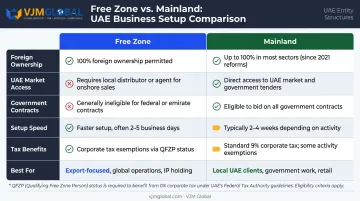
Dubai's Executive Council Resolution No. 11 of 2025 created a new pathway: eligible free zone companies can apply for a permit to conduct activities outside the zone, valid for six months at AED 5,000 (renewable). This partially bridges the gap between structures.
Banking and FATCA Scrutiny
Opening a UAE corporate bank account is often the most time-consuming step for US entrepreneurs. UAE banks conduct thorough KYC and AML checks, and US persons face additional scrutiny under FATCA.
Standard documentation requirements include:
- Valid trade license
- Constitutional documents (Memorandum and Articles of Association)
- Board resolution (where applicable)
- Valid passports and Emirates IDs for owners and signatories
- Form W-9 or equivalent US tax documentation
Some banks advertise 72-hour account opening, but US persons should expect a longer review process due to FATCA-related disclosures. Plan for this in your setup timeline.
Activity Classification Matters
The UAE requires an activity-specific trade license. Choosing a generic license category and expecting it to cover adjacent activities is a common and expensive mistake.
Before submitting any incorporation application, get this right:
- Identify your precise business activity codes upfront
- Confirm the codes cover all planned revenue streams, not just your primary service
- Budget for delays if amendments are needed post-submission — corrections cost both time and licensing fees
How to Set Up Your Business in the UAE as a US Entrepreneur
The Five Core Steps
- Define your business activity and choose jurisdiction — Free zone or mainland decision based on your target customers and revenue model
- Reserve a trade name and obtain initial approvals — Name must comply with UAE naming conventions (no offensive terms, no impersonation of government entities)
- Submit incorporation documents — Passport copy, business plan (required for some activities), lease agreement or flexi-desk arrangement
- Obtain your trade license and sector-specific approvals — Financial services require DFSA or FSRA authorization; healthcare requires DHA/MOH approval; standard business activities are simpler
- Open a corporate bank account — Allow extra time as a US person; prepare FATCA documentation in advance
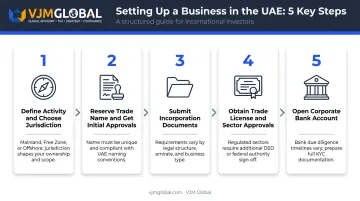
Standard free zone incorporations (DMCC, DIFC for non-financial entities) process in 3–5 working days once documentation is complete. DMCC officially estimates approximately 2–3 weeks for the overall setup process including all components. Regulated activities — financial services, healthcare, legal — typically run several months due to additional licensing requirements.
Documentation Challenges Specific to US Entrepreneurs
US entrepreneurs incorporating with a US entity as the parent company face additional requirements:
- Apostilled corporate documents from the US parent entity
- Notarized corporate records (resolutions, certificates of good standing)
- FATCA-related disclosures for banking
- Longer bank onboarding timelines (US persons face additional KYC scrutiny)
Ongoing Compliance — Start Managing It From Day One
Once incorporated, recurring obligations run on separate schedules across two jurisdictions:
- UAE corporate tax registration and annual filing
- VAT registration (if annual taxable turnover exceeds AED 375,000)
- Annual trade license renewal
- US Form 5471 for controlled foreign corporation reporting
- FBAR annually if aggregate foreign accounts exceed $10,000
- Form 8938 if specified foreign financial asset thresholds are met
Missing a single deadline can trigger IRS penalties on top of UAE fines — and the two systems rarely sync conveniently.
US entrepreneurs entering the UAE need advisors who understand both sides of the equation. VJM Global has guided 500+ American business owners through cross-border structuring, with a dedicated team of CPAs experienced in IRS compliance alongside UAE setup. Advisors who only know the UAE side can leave costly gaps in your US reporting obligations. Contact VJM Global at [email protected] to discuss your specific situation.
Conclusion
The UAE in 2026 offers a compelling environment for US entrepreneurs: favorable tax structure, strategic location, a growing high-income consumer base, government-backed industry development, and English as the functional business language. The opportunity is substantial — but the structural decisions that determine success aren't always obvious from the outside.
The decisions you make at incorporation — jurisdiction, entity structure, business activity classification — are far harder to reverse once a company is operational. The same applies to US tax planning: retrofitting a proper cross-border structure after the fact typically costs more than building it correctly from day one.
Prioritize cross-border tax planning and proper jurisdiction selection from the outset. Work with advisors who understand both sides: the UAE regulatory environment and the IRS obligations that follow US citizens everywhere. VJM Global has supported 500+ American business owners navigating exactly this intersection — cross-border structuring, US compliance, and international market entry — across 15+ industries.
Frequently Asked Questions
Which business is most profitable in the UAE?
Real estate consulting, technology/AI services, and financial services consistently rank among the highest-margin sectors. Specific profitability depends on your background, target client base, and chosen jurisdiction — financial services in DIFC commands premium fees but carries higher regulatory costs.
How much does it cost to set up a business in the UAE?
DMCC free zone packages currently range from AED 31,000 to AED 43,780 depending on inclusions, with DIFC processing applications within 3–5 working days. Costs vary significantly by free zone, activity type, office arrangement, and required approvals. Request a quote directly from your target free zone authority for an accurate figure.
Can US citizens own 100% of a business in the UAE?
Yes. 100% foreign ownership is permitted in all UAE free zones and in most mainland business activities following regulatory reforms. Most sectors no longer require an Emirati local sponsor following recent regulatory reforms.
Do US entrepreneurs still pay US taxes on income earned in the UAE?
Yes. US citizens are taxed on worldwide income by the IRS regardless of residence. The UAE's zero personal income tax does not exempt US entrepreneurs from US obligations — FBAR, FEIE, Form 5471, and Form 8938 requirements may all apply simultaneously.
What is the difference between a UAE Free Zone and Mainland company?
Free zones offer 100% ownership, faster setup, and QFZP tax benefits, but cannot trade directly with UAE customers without a licensed mainland distributor. Mainland companies allow full UAE market access and government contracts, but require more regulatory steps to establish.
How long does it take for a US entrepreneur to set up a business in the UAE?
Free zone incorporations typically complete in 3–7 business days once documents are in order, with the full process running 2–3 weeks. Mainland setups and regulated activities like financial services or healthcare can take 1–3 months, depending on the approvals required.