
Introduction
The UAE-India trade corridor isn't slowing down. Bilateral trade hit $100.06 billion in FY 2024-25, up 19.6% year on year, according to a Ministry of Commerce release on the India-UAE CEPA Joint Committee. For UAE companies riding that momentum, a branch office is often the fastest way to plant a flag in India without setting up a brand-new Indian company.
The rulebook looks straightforward on paper. In practice, UAE-based applicants hit specific snags: converting AED net worth into the RBI's USD threshold, figuring out which UAE documents actually need attestation, and navigating DTAA paperwork that generic "foreign company" guides skip entirely.
This guide walks through eligibility, the exact step-by-step process from a UAE parent's perspective, required documents, common mistakes, and how a branch stacks up against other India entry routes.
Key Takeaways
- A branch extends the UAE parent (not a separate Indian company); RBI approval via Form FNC is mandatory first
- UAE applicants need 5 years of profitability and net worth of at least USD 100,000 (~AED 367,000)
- The UAE is outside the Hague Apostille Convention, so documents need MOFA attestation and consular legalisation
- Branches may only run RBI-permitted activities (export/import, consultancy, IT); manufacturing and retail are barred
- Branches are taxed as foreign companies at up to 38.22% (35% plus surcharge and cess), above subsidiary rates
Step-by-Step Process to Set Up a Branch Office in India from the UAE
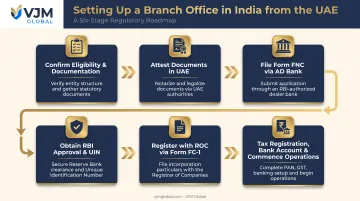
Setting up a branch involves two parallel tracks: preparing documents in the UAE and securing approvals in India. Getting the sequencing wrong is where most delays happen.
Step 1: Confirm Eligibility and Finalise the UAE Parent's Documentation
Before anything else, verify the UAE entity — mainland LLC or free zone company — actually clears the bar:
- 5 consecutive years of profitability, evidenced by audited financial statements
- Net worth of at least USD 100,000, calculated as paid-up capital plus free reserves, minus intangible assets
Once confirmed, draft a board resolution authorising the Indian branch and naming an authorised representative who will act on the company's behalf during the application process.
Step 2: Attest Documents in the UAE
Here's where many applicants get tripped up. The UAE has been a party to the Hague Apostille Convention since January 2022, so corporate documents can receive an apostille from the UAE Ministry of Foreign Affairs for use in India. Confirm the exact chain your AD bank wants before you start—some still ask for Indian Embassy attestation on top of the apostille.
- Apostille (UAE MOFA) the Certificate of Incorporation, MOA/AOA, and board resolution; add Indian Embassy attestation if your bank requires it
- If the UAE applicant doesn't meet the net worth or profitability threshold on its own, a Letter of Comfort from a qualifying parent company can close the gap
Step 3: File Form FNC Through an AD Category-I Bank
The application doesn't go straight to the RBI. It's routed through an Authorised Dealer (AD) Category-I bank in India, along with:
- A banker's report from the UAE bank confirming the applicant's standing
- KYC documentation for the authorised signatory
Most sectors fall under the automatic route and are cleared at the bank level. Sensitive sectors — defence, telecom, private security, and broadcasting — trigger an additional layer of government approval before the bank can proceed.
Step 4: Obtain RBI Approval and a Unique Identification Number
The RBI (acting through the AD bank under delegated authority) reviews the parent's financials and the proposed Indian activity before issuing approval and a Unique Identification Number.
The commonly cited "3-year validity" rule applies to Liaison Offices, not branch offices. A branch office's operating conditions are set out in its specific approval letter.
The single biggest reason applications get delayed? A mismatch between the activity proposed and what RBI actually permits for branch offices. Double-check your intended Indian activity against the approved list before filing.
Step 5: Register with the Registrar of Companies (Form FC-1)
Once RBI approval comes through, the branch must establish a physical place of business in India and file Form FC-1 with the Registrar, Central Registration Centre. The deadline is 30 days of establishing that office, not 30 days from approval—a timeline in effect since a September 2024 procedural change.
On successful registration, the branch receives its CIN (Corporate Identification Number).
Step 6: Complete Tax Registrations, Open a Bank Account, and Commence Operations
The final stretch involves:
- Applying for PAN and TAN
- Opening an INR current account with the AD bank
- Registering for GST and an Import Export Code (IEC) if the branch will trade in goods or services
Cross-border document coordination matters most at this stage. VJM Global handles the India-side work: Form FNC submission through a registered AD bank, PAN/TAN applications, GST registration, digital signature setup, and ROC registration. The team works alongside your UAE-side attestation process so paperwork keeps moving without resubmission delays.
Eligibility Criteria and Documents Required for UAE Companies
Eligibility Criteria for UAE-Incorporated Companies
The RBI's threshold applies identically whether the applicant is a UAE mainland LLC or a free zone entity. There's no separate concession or higher bar for either structure. Both need:
- 5 years of documented profitability
- Net worth of at least USD 100,000 (roughly AED 367,000), verified against the latest audited balance sheet
If a UAE subsidiary can't independently meet these numbers, the Letter of Comfort route allows a qualifying parent group to vouch for it instead.
Sector restrictions also apply. Some activities need prior government approval rather than automatic route clearance, so check your specific sector before filing.
Documents Required from the UAE Parent
The core document set includes:
- Certificate of Incorporation
- Memorandum and Articles of Association (MOA/AOA)
- Board resolution and Power of Attorney
- Audited financial statements for the preceding 5 years
- Banker's report and KYC of the authorised signatory
Two details cause the most rejections:
- Attestation errors: UAE documents need MOFA attestation rather than apostille. Applicants who assume a simplified process often submit incorrectly certified paperwork.
- Name mismatches: The branch's registered name in India must match the UAE parent's registered name exactly, with no abbreviations or variations.
Branch Office vs Other India Entry Options for UAE Companies
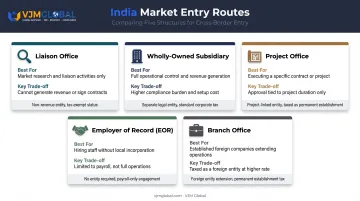
A branch office isn't automatically the right call. Three alternatives, plus a no-entity option, are worth weighing first.
| Route | Best for | Key trade-off |
|---|---|---|
| Liaison Office | Market exploration without earning revenue | Cannot generate any India income; funded entirely by parent remittances |
| Wholly-Owned Subsidiary | Long-term operations, lower tax rate, broader activities | Requires new incorporation and share capital; longer setup |
| Project Office | A specific, time-bound Indian contract | Scope locked to the project; winds up on completion |
| Employer of Record (EOR) | Testing the market by hiring a handful of people | No direct revenue generation or contracting in India |
Liaison Office
If a UAE company just wants a presence to explore the market or represent the parent without billing anyone in India, a liaison office fits better. The catch: it cannot earn a rupee of Indian income and survives purely on inward remittances.
Wholly-Owned Subsidiary (Private Limited Company)
Companies planning to stay in India for the long haul, or wanting a materially lower effective tax rate than the 35%+ branch rate, usually end up here. It requires incorporating a fresh Indian legal entity and injecting share capital, which means a longer initial timeline than a branch registration.
Project Office
For a UAE company that's won a specific contract from an Indian entity — an infrastructure project, for instance — a project office is purpose-built. It exists only for that project and automatically dissolves once the contract closes.
Employer of Record (EOR) as a No-Entity Alternative
Sometimes a company just needs to hire two or three people in India before committing to any entity at all. VJM Global's EOR service lets UAE companies do exactly that: hire Indian talent compliantly, with VJM Global as the legal employer handling contracts, payroll, statutory contributions, and offboarding—all without incorporating a branch or subsidiary first.
The trade-off is that the company still can't contract or invoice directly in its own name in India until it sets up a formal entity.
Common Mistakes and Ongoing Compliance Pitfalls
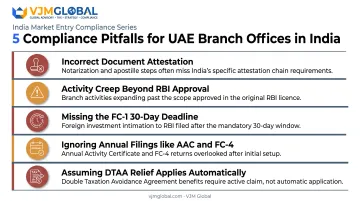
Most branch office headaches trace back to a handful of recurring errors:
- Incorrect document attestation: Submitting UAE documents without MOFA attestation or consular legalisation forces RBI to reject and return the application
- Activity creep: Operating beyond RBI-approved activities can trigger FEMA penalties or a compounding application
- Missing the FC-1 deadline: The 30-day window after establishing a physical office is strict; late filing attracts Companies Act penalties
- Ignoring annual filings: AAC to RBI, Form FC-4 to the ROC (within 60 days of year-end), and transfer pricing docs for UAE-parent deals each carry separate deadlines
- Assuming the DTAA works automatically: India-UAE relief under Article 25 needs a tax residency certificate and supporting documents; it does not apply itself
Track RBI, ROC, and tax deadlines on one compliance calendar. Treating them as separate workstreams is how most missed filings happen.
Conclusion
A branch office gives UAE companies a controlled way to operate in India without floating new equity. The parent must clear the eligibility bar, and activity must stay within RBI's approved list.
Most rejections and delays come from UAE-side documentation gaps — attestation errors, mismatched names, incomplete banker's reports — rather than the India process itself.
Working with advisors who understand both jurisdictions, such as VJM Global, cuts that risk considerably.
Frequently Asked Questions
What is a branch office of a foreign company in India?
It's a legal extension of the UAE parent company, not a separately incorporated Indian entity. It can only conduct activities that the RBI has specifically approved for branch offices.
Can a UAE free zone company open a branch office in India?
Yes. Free zone entities can apply if they meet the same 5-year profitability and USD 100,000 net worth criteria as mainland companies. There is no separate concession.
How long does it take to set up a branch office in India from the UAE?
There's no fixed RBI or ROC processing timeline. The hard deadline is filing Form FC-1 within 30 days of establishing your physical office. Document delays, especially attestation, usually stretch the overall timeline.
Do UAE companies need to apostille their documents for RBI approval?
No. The UAE hasn't joined the Hague Apostille Convention, so documents still require attestation through the UAE Ministry of Foreign Affairs and, in some cases, certification by an Indian notary or embassy.
Can profits earned by an Indian branch office be repatriated back to the UAE?
Yes, branch profits are freely remittable to the UAE once applicable Indian taxes are paid and audited financials are in order. The India-UAE DTAA helps prevent double taxation on that same income.
What is the difference between a branch office and a liaison office for a UAE company?
A branch office can generate revenue in India through RBI-permitted activities like consultancy or export/import. A liaison office cannot earn any Indian income. It is restricted to representation and communication on the parent's behalf.