Introduction
The UAE — particularly Dubai — has long attracted Indian entrepreneurs, and the numbers show why. With 4.3 million Indian nationals making up roughly 35% of the UAE's total population, Indians form the largest expat community in the country. Zero personal income tax, strategic proximity to global markets, and direct access to the UAE's domestic economy have helped make it India's seventh-largest investment partner, with cumulative FDI inflows exceeding US$ 25 billion.
The 2023 commercial law reforms changed the equation significantly. The historic requirement for 51% UAE national ownership in mainland companies has been removed for most sectors — meaning Indian entrepreneurs can now set up 100% foreign-owned Limited Liability Companies (LLCs) on the UAE mainland.
But ownership structure is only part of the picture. Indian residents must also comply with FEMA (Foreign Exchange Management Act), manage RBI reporting obligations, and structure their entities to benefit from the India-UAE Double Taxation Avoidance Agreement.
This guide explains what a UAE LLC is, how it works, and what the setup process involves. Given these cross-border compliance requirements, it also covers what Indian entrepreneurs need to know before remitting capital or establishing operations in the UAE.
Key Takeaways
- A UAE LLC is a mainland business structure allowing 2–50 shareholders, with liability capped at invested capital
- 100% foreign ownership is now permitted in most sectors following the 2021 commercial law reforms
- Setup costs range from AED 15,000–50,000 (roughly ₹3.87–12.9 lakh) depending on the emirate and business activity
- Indian entrepreneurs must follow FEMA ODI rules — this includes obtaining a UIN and filing Annual Performance Reports with the RBI
- Under the India-UAE DTAA, dividend withholding is capped at 10% — but Indian tax residents must still declare global income in India
What is an LLC in the UAE?
A UAE Limited Liability Company (LLC) is a legal business entity registered on the UAE mainland under Federal Decree Law No. 32 of 2021 on Commercial Companies. The defining characteristic: shareholders' personal liability is limited to their share of invested capital — personal assets remain protected from business debts.
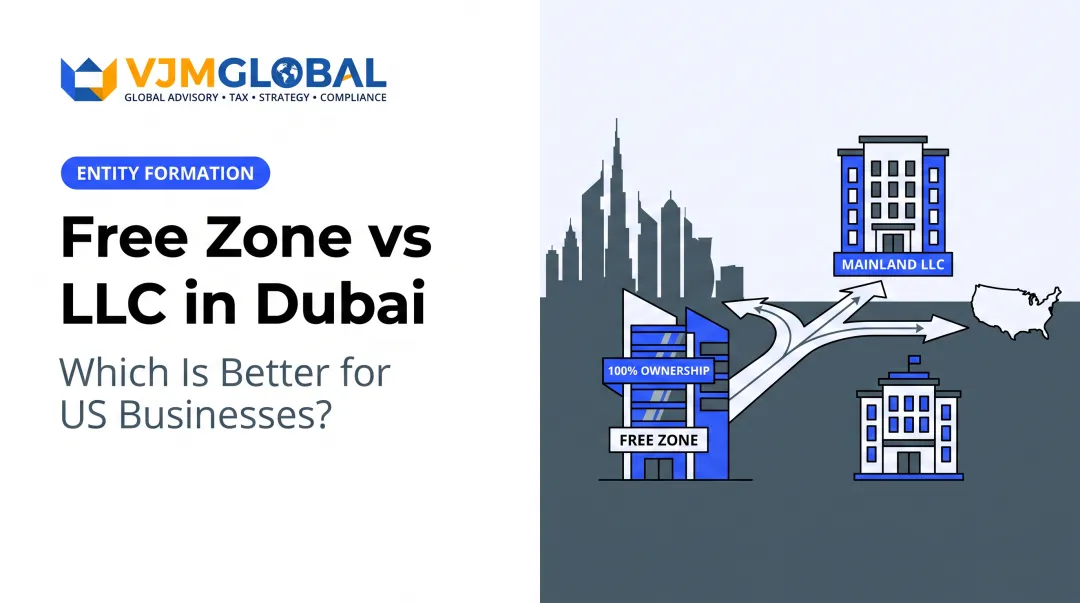
The LLC is the most common mainland structure — and the key distinction from free zone entities comes down to market access. Free zone companies operate under separate regulatory frameworks with restrictions on selling directly to UAE-resident customers. An LLC faces no such limit: it can trade directly with local customers, bid on government contracts, and run retail or service outlets without a local distributor.
Key structural features:
| Requirement | Detail |
|---|---|
| Shareholders | 2 minimum, 50 maximum (individuals or corporate entities) |
| Management | At least one appointed manager |
| Registered office | Physical address required (Dubai mandates an Ejari-registered lease) |
| Auditor | Ministry of Economy-approved auditor for annual financial statements |
| Permitted activities | Commercial, trading, industrial, and professional — subject to sector approvals |
For Indian entrepreneurs, this combination of liability protection and unrestricted mainland access is what makes the LLC the default starting point — particularly when the goal is serving the UAE's AED 5.23 trillion domestic trade market rather than re-exporting goods through a free zone.
Key Benefits of a UAE LLC for Indian Entrepreneurs
Limited Liability Protection
Shareholders are liable only up to their invested capital. If the business incurs debt or faces litigation, personal property, savings, and other assets remain shielded. For Indian entrepreneurs making cross-border investments of USD 100,000 or more, this legal firewall is crucial.
Full Mainland Market Access
Unlike free zone companies, which are restricted to trading within their designated zones or internationally, an LLC can:
- Trade directly with UAE-resident customers
- Bid on government tenders and contracts
- Operate retail outlets, restaurants, or service centers
- Engage in B2B sales without appointing a mainland distributor
The UAE's GDP stands at US$ 621.55 billion, with projected growth of 5% in 2026. The domestic market alone represents a massive opportunity, particularly in sectors like construction, professional services, retail, and technology.
Tax Efficiency Compared to India
| Tax Type | UAE (LLC) | India (Sec 115BAA) |
|---|---|---|
| Corporate tax | 9% (above AED 375,000 profit) | 25.17% effective |
| Below-threshold rate | 0% (up to AED 375,000) | N/A |
| Personal income tax | 0% | Up to 30% (slab-based) |
| Dividend withholding | 0% | 10% (above ₹5,000) |
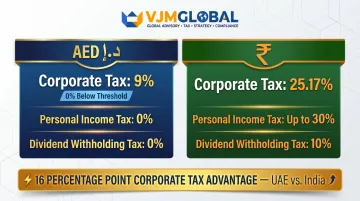
The 16-percentage-point corporate tax differential creates a significant incentive for profit retention and reinvestment. The UAE imposes no personal income tax, meaning founder salaries, dividends, and capital distributions are tax-free at the UAE level (Indian tax residency still applies — see DTAA section below).
Easier Visa Sponsorship
Mainland LLCs can sponsor employee and investor visas directly through MOHRE and GDRFA, with quotas typically based on office space (approximately 1 visa per 80–100 sq ft). Free zone companies, by contrast, are subject to quota restrictions imposed by individual free zone authorities, which can limit hiring flexibility.
For Indian entrepreneurs building local teams, this means no authority-imposed headcount caps — you hire to match growth, not to fit a quota.
Credibility and Access to Banking
UAE banks, government entities, and international partners recognize mainland LLCs as full-fledged legal entities. This makes it easier to:
- Open corporate bank accounts
- Secure trade finance and working capital lines
- Attract investors or partners
- Enter into contracts with government bodies
Together, these advantages make a UAE LLC one of the most commercially practical structures available to Indian entrepreneurs expanding into the Gulf market.
How to Set Up a UAE LLC: Step-by-Step Process
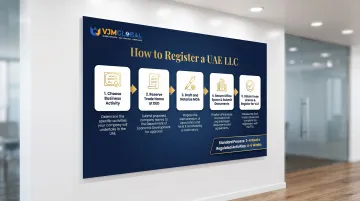
Step 1: Choose Your Business Activity and License Type
The activity you select determines your license category (commercial, industrial, or professional) and whether additional regulatory approvals are needed. Common activities pursued by Indian entrepreneurs include:
- Commercial license: Trading, import/export, retail
- Industrial license: Manufacturing, assembly, packaging
- Professional license: Consulting, IT services, marketing, accounting
Certain sectors — healthcare, education, finance, oil & gas — require pre-approvals from specialized regulators. Build this into your timeline if your activity falls under a regulated category.
Step 2: Reserve a Trade Name and Obtain Initial Approval
Submit your proposed trade name to the Department of Economic Development (DED) or equivalent emirate authority. Naming rules:
- Must end with "LLC" (or the Arabic equivalent)
- Cannot resemble existing registered entities
- Must not violate UAE moral or religious standards
- Cannot reference prohibited activities
Cost: Trade name reservation in Dubai costs AED 620 (approx. ₹16,000). Initial approval fees are AED 345 (approx. ₹8,900).
Step 3: Draft and Notarize the Memorandum of Association (MOA)
The MOA is the foundational legal document that outlines:
- Ownership structure and shareholding percentages
- Business objectives and permitted activities
- Profit/loss distribution arrangements
- Management roles and responsibilities
Three requirements apply without exception:
- Must be drafted in Arabic (an English version can accompany it, but Arabic takes legal precedence)
- Must be notarized to be legally valid
- All shareholders must sign
You'll need the MOA for bank account opening, visa applications, and regulatory filings — keep certified copies ready.
Step 4: Secure Office Space and Submit Documentation
A physical registered office is mandatory. You'll need to submit:
- Valid tenancy contract (Ejari-registered in Dubai)
- Shareholder passport copies
- No Objection Certificate (if shareholder is employed in the UAE)
- Memorandum of Association
- DED application forms
Office lease costs vary significantly by emirate:
| Emirate | Annual Lease Cost (AED) | Approx. INR Equivalent |
|---|---|---|
| Dubai (Emaar Business Park) | 600,000 – 1,090,000 | ₹15.48 – 28.12 lakh |
| Ras Al Khaimah | 6,000 – 91,000 | ₹1.55 – 23.49 lakh |
| Sharjah | Similar to RAK | Lower than Dubai |
RAK and Sharjah offer cost-effective alternatives for budget-conscious entrepreneurs.
Step 5: Obtain the Trade License and Register for VAT
Once the DED issues your commercial license, three actions follow in sequence:
- Register with the Chamber of Commerce (emirate-specific requirement)
- Open a corporate bank account — requires your trade license, MOA, and shareholder passports
- Register for VAT if expected annual turnover exceeds AED 375,000
VAT registration thresholds: voluntary below AED 187,500; mandatory above AED 375,000. Foreign businesses must register regardless of turnover.
Timeline: Standard licenses take 2–4 weeks when documents are complete. Regulated activities typically extend this to 4–6 weeks.
Cost of Setting Up a UAE LLC: What Indian Entrepreneurs Should Budget For
| Cost Component | Dubai (AED) | INR Equivalent |
|---|---|---|
| Trade name reservation | 620 | ₹0.16 lakh |
| Initial approval | 345 | ₹0.09 lakh |
| DED activity fees | 15,000 | ₹3.87 lakh |
| Commercial license (mainland) | 24,500 | ₹6.32 lakh |
| General trading license (total) | 29,685 | ₹7.66 lakh |
| Total DED license range | 15,000 – 50,000 | ₹3.87 – 12.9 lakh |
| MOA drafting & notarization | 2,000 – 5,000 | ₹0.52 – 1.29 lakh |
| Local service agent (annual)* | 5,000 – 15,000 | ₹1.29 – 3.87 lakh |
| Office lease (Dubai, annual) | 600,000+ | ₹154.8 lakh+ |
| Office lease (RAK, annual) | 6,000 – 91,000 | ₹1.55 – 23.49 lakh |
INR conversions use SBI TT rate of AED 1 = ₹25.8 (May 2026 midpoint).
Local Service Agent (If Required)
While 100% foreign ownership is now permitted for most activities, certain strategic sectors still require a UAE national partner or local service agent:
- Military or defense-related activities
- Financial services (banking, insurance)
- Telecommunications
The service agent holds no equity or profit share; their role is purely regulatory liaison. Typical annual fees: AED 5,000–15,000 (₹1.29–3.87 lakh).
Recurring Annual Costs
- Trade license renewal: AED 15,000–30,000 (varies by activity)
- Office lease: AED 6,000 (RAK) to AED 600,000+ (Dubai)
- Auditor appointment: AED 3,000–10,000 annually
- Visa fees: AED 3,000–5,000 per employee/shareholder visa
Total first-year setup cost (Dubai): AED 60,000–100,000 (₹15.48–25.8 lakh)
Total first-year setup cost (RAK/Sharjah): AED 25,000–50,000 (₹6.45–12.9 lakh)
Choosing a more affordable emirate like RAK or Sharjah can cut first-year costs by 40–50%, though Dubai's market visibility and infrastructure often justify the premium for businesses targeting high-value clients or trading partners.
UAE LLC vs. Free Zone Company: Which Should Indian Entrepreneurs Choose?
| Factor | UAE Mainland LLC | Free Zone Company |
|---|---|---|
| Foreign ownership | 100% (most sectors, post-2021 reforms) | 100% |
| UAE local market access | Unrestricted | Restricted — requires mainland distributor or branch |
| International trade | Permitted | Permitted |
| Government contracts | Can bid directly | Limited access |
| Retail operations | Permitted | Not permitted (outside free zone) |
| Typical setup cost | AED 25,000–100,000 | AED 15,000–50,000 (depending on free zone) |
| Setup timeline | 2–4 weeks | 1–2 weeks |
| Best for | Domestic market sales, retail, government B2B | Export/re-export, e-commerce, holding structures |
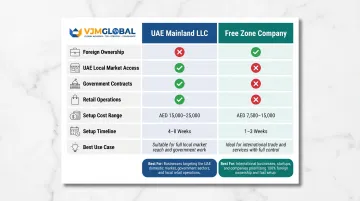
The right structure depends on where your customers are and how you plan to operate. Here's how each option lines up in practice.
When to Choose a Free Zone
Free zones such as DMCC, IFZA, RAKEZ, and Jebel Ali work well for:
- Export-focused businesses that don't need UAE mainland market access
- International consulting or SaaS businesses serving global clients
- E-commerce platforms selling outside the UAE
- Holding companies or IP licensing structures
The restriction is clear: free zone companies "must either work through a licensed mainland distributor or establish a mainland branch or company" to sell goods or services locally.
When to Choose a Mainland LLC
A mainland LLC makes more sense when your business depends on direct access to UAE customers or government work:
- Retail or hospitality businesses (restaurants, stores, salons)
- Professional services targeting UAE-resident clients (consulting, accounting, legal)
- Businesses bidding on government tenders or contracts
- Trading companies that import goods for local distribution
The deciding factor is usually straightforward: if your clients are inside the UAE, a mainland LLC removes the friction. If you're serving global markets or building a holding structure, a free zone often costs less and sets up faster.
India-Specific Considerations: FEMA, DTAA, and Cross-Border Compliance
FEMA and Overseas Direct Investment (ODI) Obligations
Indian residents investing in a UAE LLC must comply with the Foreign Exchange Management (Overseas Investment) Rules, 2022. This is not optional.
Key requirements:
- Unique Identification Number (UIN): Must be obtained before remitting funds or acquiring equity
- Investment limits:
- Individuals: USD 250,000 per financial year under the Liberalized Remittance Scheme (LRS)
- Indian entities: Up to 400% of net worth (last audited balance sheet) via ODI route
- Annual Performance Report (APR): Must be filed annually; late submission incurs penalties and blocks further investments
- Prohibited activities: Real estate, gambling, or rupee-linked financial products (without RBI approval)
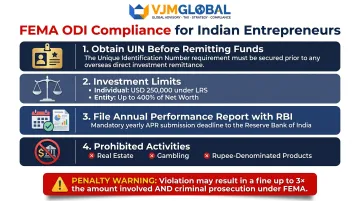
FEMA penalties for non-compliance:
- Up to 3x the sum involved for measurable violations
- Criminal prosecution for foreign assets exceeding ₹1 crore (up to 5 years imprisonment plus fine)
For Indian entrepreneurs structuring a UAE LLC, FEMA compliance is the single highest regulatory risk. Engaging a Chartered Accountant with ODI expertise is essential — errors here carry criminal liability, not just financial penalties.
India-UAE Double Taxation Avoidance Agreement (DTAA)
The India-UAE DTAA (in force since September 1993) prevents Indian entrepreneurs from being taxed twice on the same income.
Key treaty provisions:
| Income Type | Treaty Rate/Rule |
|---|---|
| Dividends | Max 10% withholding |
| Interest (bank loans) | Max 5% withholding |
| Interest (other) | Max 12.5% withholding |
| Business profits | Taxable only in home state unless PE exists |
| Capital gains (immovable property) | Taxable in state where property is located |
How it works: If you repatriate dividends from your UAE LLC to India, the UAE does not withhold tax (0% rate), but India may tax the dividend as part of your global income. You can claim a foreign tax credit under the DTAA to avoid double taxation.
Tax Residency and Global Income Reporting
Critical rule: Merely owning a UAE LLC does not make you a UAE tax resident.
Under Indian tax law, you are an Indian tax resident if you spend 182 days or more in India during a financial year (April–March). Indian tax residents must report worldwide income — including profits from a UAE LLC — in their Indian tax return.
Example scenario:
- You own 100% of a UAE LLC generating AED 1 million in profit
- UAE corporate tax: 9% (AED 90,000)
- You spend 200 days in India → You are an Indian tax resident
- You must report the remaining AED 910,000 in your Indian tax return and may owe additional tax (subject to DTAA relief)
Getting this wrong means paying tax in both jurisdictions — which is precisely what the DTAA is designed to prevent, but only if your structure is set up correctly from the start.
VJM Global: Your Partner for Cross-Border Compliance
VJM Global helps Indian entrepreneurs structure UAE LLCs in a way that holds up under both FEMA scrutiny and Indian tax law. With 30+ years of experience in tax, audit, and advisory services, our Chartered Accountants handle:
- FEMA/ODI compliance: UIN registration, Annual Performance Reports, and regulatory filings
- India-UAE DTAA structuring: Tax-efficient repatriation strategies and foreign tax credit optimization
- Cross-border tax planning: Dual-jurisdiction advisory covering both UAE Corporate Tax and Indian Income Tax Act obligations
- RBI reporting support: Assistance with LRS compliance and regulatory documentation
Our FEMA consultants review your entity structure before you remit a single rupee, catching compliance gaps that become expensive to fix later. Reach us at [email protected] or +91 98915 76441 to schedule a consultation.
Frequently Asked Questions
How much does an LLC cost in the UAE?
Total setup costs range from AED 15,000 to AED 50,000 (₹3.87–12.9 lakh), covering trade license fees, MOA drafting, office space, and registration charges. Dubai is at the higher end; RAK and Sharjah offer more affordable alternatives. Annual recurring costs — license renewal, office lease, and auditor fees — add another AED 20,000–50,000+ per year.
Can a foreigner open an LLC in Dubai?
Yes. UAE commercial law reforms in 2021 permit up to 100% foreign ownership in most business sectors. Certain strategic activities (military, financial services, telecommunications) may still require a UAE national service agent, but equity ownership can remain 100% foreign.
Can an Indian entrepreneur own 100% of a UAE LLC?
Yes. The 2021 amendments to Federal Decree Law No. 32 eliminated the mandatory 51% UAE national ownership requirement for most sectors. Indian entrepreneurs can hold 100% ownership in a mainland LLC, subject to the specific business activity. Activities on the "strategic impact list" may still have restrictions.
What taxes does an Indian-owned UAE LLC pay?
UAE LLCs pay 9% corporate tax on profits above AED 375,000 (0% below that threshold), with no personal income tax or withholding tax on dividends. Indian owners must also account for their tax residency status in India — Indian residents are required to report global income. The India-UAE DTAA provides relief from double taxation in such cases.
How long does it take to register an LLC in UAE?
The typical timeline is 2–4 weeks for standard licenses when all documentation is complete. Sector-specific regulatory approvals (healthcare, education, finance) can extend this to 4–6 weeks. Delays often occur during document notarization, attestation, or visa processing stages.