Subsidiary formation often gets treated as a paperwork checkbox. In reality, its value shows up later, in tax efficiency, faster market access, and liability protection once the business is actually running. This article looks at why a subsidiary structure benefits UAE businesses in practice, not just on paper, and walks through the setup process step by step.
Key Takeaways
- UAE parents get 100% ownership, limited liability, and full control through a separate Indian legal entity
- CEPA and the India-UAE DTAA deliver trade and tax advantages tailored to UAE-origin investors
- Incorporation often completes in a few weeks when UAE apostille and attestation are handled correctly
- Sustained ROC, FEMA, and GST compliance is what keeps those benefits intact long term
What Is a Subsidiary Company (Brief Context)
A subsidiary is an Indian-incorporated company, most commonly a Private Limited Company, where a UAE parent holds majority or 100% of the shares. Section 2(87) of the Companies Act, 2013 defines this relationship in Indian law.
This structure suits UAE trading houses, IT and services firms, and holding companies that want a direct, revenue-generating presence in India, rather than a representational one.
Unlike a liaison office, which cannot earn income, or a branch office, which is restricted to specific approved activities, a subsidiary can trade, contract, and invoice in its own name.
For UAE businesses, the subsidiary is the standard market-entry vehicle. Two ownership variants are common:
- Wholly owned subsidiary – UAE parent holds 100% of shares
- Majority-owned subsidiary – UAE parent holds more than 50%, with other shareholders holding the balance
Key Benefits of Setting Up a Subsidiary Company in India from the UAE
For a UAE parent, the value shows up in landed costs, tax on cross-border payments, control of the Indian entity, and how much risk stays on the parent balance sheet.
Preferential Market Access via the India-UAE CEPA
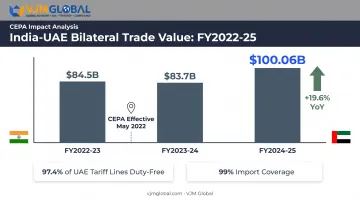
CEPA eliminates duties on 97.4% of UAE tariff lines, covering 99% of imports from India, while India has reduced or removed tariffs on more than 80% of products from the UAE side, per the PIB's CEPA anniversary release. Not every product gets zero duty immediately; some phase down over several years, so rules of origin still matter.
For an Indian subsidiary of a UAE parent, this translates into:
- Lower landed cost of goods sourced from or shipped to the UAE
- Shorter supply chain lead times on covered tariff lines
- Better margins on cross-border transactions between the two entities
Bilateral trade under the corridor moved from $84.5 billion in FY2022-23 to $83.7 billion in FY2023-24, then climbed to $100.06 billion in FY2024-25. An Indian subsidiary lets a UAE group operate as a resident counterparty on the ground—contracting, stocking, and invoicing locally—while routing covered goods under CEPA terms rather than selling in only as an offshore supplier.
Tax Efficiency Through the India-UAE DTAA
The Double Taxation Avoidance Agreement prevents the same income from being taxed in both India and the UAE. It also caps the withholding tax India can apply on payments flowing from the Indian subsidiary to the UAE parent.
Under the treaty, source-state withholding is capped at:
| Payment type | Treaty ceiling |
|---|---|
| Dividends | 10% |
| Interest (bank/financial institution loans) | 5% |
| Interest (other, including ordinary parent loans) | 12.5% |
| Royalties | 10% |
These rates, confirmed in the official treaty text on the Income Tax Department's website, directly shape how a UAE parent structures dividend repatriation and royalty or management fee arrangements. The treaty has no separate fees-for-technical-services article, so those payments must be classified carefully rather than assumed to fall under the 10% royalty rate.
Parents that repatriate profits often or license IP into India feel this quickly—a few points of withholding on recurring flows compound over a multi-year hold.
100% Foreign Ownership and Full Operational Control
Most sectors permit 100% FDI via the automatic route, meaning no prior government approval and no mandatory local partner. Manufacturing, IT/services, wholesale trading, e-commerce marketplaces, and single-brand retail all fall under this category, per the DPIIT's FDI policy.
This is a meaningful shift from older joint-venture-style entry norms, where a local partner often held decision-making leverage. Full ownership means:
- Faster time-to-market, since strategic calls don't need partner sign-off
- Complete strategic autonomy on hiring, pricing, and expansion
- Stronger protection of proprietary processes, brand, and IP
A handful of sectors, such as defence (74% automatic) and private banking (49% automatic), still cap the automatic route below 100%. For a typical trading, IT, or services subsidiary, though, full control is the default.
Limited Liability and Credibility as a Separate Legal Entity
A subsidiary's debts, contracts, and litigation exposure sit with the Indian entity, not the UAE parent's balance sheet. If a customer contract goes wrong or a vendor dispute ends up in court, the parent's assets in the UAE stay ring-fenced.
Beyond liability, a registered Indian company carries more weight than a liaison or branch office when dealing with:
- Indian banks for corporate accounts and credit lines
- Vendors extending trade credit
- Government tenders that require an Indian-registered bidder
High-volume trading, manufacturing, and other risk-heavy activity need that local contracting capacity—an unregistered presence cannot open corporate accounts or bid in its own name.
Subsidiary vs. Branch Office vs. Liaison Office: Choosing the Right Structure
UAE businesses often default to a liaison or branch office without realising how much commercial activity that choice rules out.
| Factor | Subsidiary | Branch Office | Liaison Office |
|---|---|---|---|
| Legal status | Separate Indian company | Extension of foreign parent | Extension of foreign parent |
| Commercial activity | Any lawful activity, full revenue generation | Limited to RBI-approved activities (consultancy, trading support, IT services) | Representation only, no income |
| Liability | Ring-fenced from parent | Parent remains liable | Parent remains liable |
| Taxation | Domestic company rate: 22% under Section 115BAA (plus surcharge and cess) | Foreign company rate: 35% base (plus surcharge and cess) | Generally no tax, since it can't earn income |
A subsidiary is the only one of the three that allows full commercial revenue, local contracting, and long-term scalability. Branch and liaison offices work for market research or narrow, RBI-approved functions, but they hit a ceiling fast if the goal is actual trading or service delivery in India.
How to Set Up Your Indian Subsidiary from the UAE: Step-by-Step Process
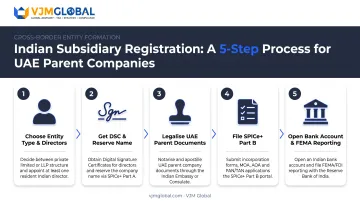
Setting up an Indian subsidiary from the UAE follows a fixed MCA and FEMA sequence. Most timeline slips come from late UAE document attestation or incomplete Indian filings, so order matters.
- Choose entity type and directors – Most UAE parents opt for a Private Limited Company. Appoint at least two directors, including one resident Indian director (182+ days in India in the financial year).
- Get Digital Signature Certificates and reserve the name – Apply for DSCs for the proposed directors, then reserve the company name through Part A of the SPICe+ form on the MCA portal.
- Legalise UAE parent documents – Attest the Certificate of Incorporation, Board Resolution, and MOA/AOA via the UAE Ministry of Foreign Affairs and the Indian Embassy or Consulate. Start early; this UAE-specific step is where timelines most often slip.
- File incorporation via SPICe+ Part B – One integrated filing covers incorporation plus PAN, TAN, GST, EPFO, and ESIC registrations.
- Open a bank account and complete FEMA reporting – Open the Indian bank account, bring in capital, and allot shares to the UAE parent within 60 days of inward remittance. File Form FC-GPR with the RBI within 30 days of allotment.
Coordinating UAE attestation with Indian ROC and FEMA filings is where VJM Global supports UAE parents—catching incomplete paperwork before it triggers rejection on either side.
Post-Incorporation Compliance and Common Pitfalls for UAE Parents
Incorporation is the easy part. The benefits above only hold up if compliance stays current afterward. Recurring obligations include:
- ROC filings – AOC-4 (financial statements) and MGT-7/7A (annual return), due within 60 days of the AGM
- GST returns – GSTR-1 and GSTR-3B on a monthly or quarterly cycle, depending on turnover
- Income tax filings and statutory audit – Annual company return and mandatory statutory audit
- FEMA reporting – FC-GPR on share allotment, and the FLA return by 15 July each year if the subsidiary carries reportable foreign liabilities
The most common mistakes UAE-origin parents make stem from treating the subsidiary as an administrative extension rather than an independent legal entity. That shows up as:
- Missing transfer pricing documentation for intercompany transactions (Local File, in particular, is mandatory for the Indian entity)
- Delaying FC-GPR filings, which attract RBI penalties—sometimes running into lakhs of rupees before reduction on appeal
- Treating intercompany invoicing casually, without arm's-length pricing support
A fixed compliance calendar, backed by accounting, tax, and FEMA advisory support, protects the tax, ownership, and liability advantages when regulators review the structure.
Frequently Asked Questions
What are the benefits of a Pvt Ltd company in India?
A Private Limited Company offers limited liability, a separate legal identity, easier access to funding, and stronger credibility with banks and vendors compared to unregistered or partnership structures.
Can a UAE company set up a 100% owned subsidiary in India?
Yes. Most sectors, including trading, IT, and manufacturing, permit 100% FDI via the automatic route. A small number of sectors, like defence and private banking, cap automatic ownership lower and need government approval beyond that.
How long does it take to register an Indian subsidiary from the UAE?
Core incorporation steps on the MCA portal typically move within days once documents are ready. UAE document attestation through MOFA and the Indian Embassy is usually the longer variable, so starting it early matters.
Is there a double taxation avoidance agreement between India and UAE?
Yes, the India-UAE DTAA has been in force since 1993 and was updated by a 2007 protocol. It caps withholding tax on dividends, interest, and royalties paid from the Indian subsidiary to the UAE parent.
What is the minimum capital required to set up an Indian subsidiary from UAE?
None. The Companies (Amendment) Act, 2015 removed the mandatory minimum paid-up capital requirement, so UAE parents can decide how much share capital to inject.
What compliance obligations does an Indian subsidiary of a UAE company have?
It must complete ROC annual filings, GST and income tax returns, and a statutory audit, plus FEMA reporting such as FC-GPR and, where applicable, the annual FLA return to the RBI.