Introduction
For most UAE companies eyeing India, a Liaison Office (LO) is the first real step through the door. It's a low-risk way to test the market before committing capital to a full entity.
The timing makes sense. India-UAE bilateral trade hit $101.25 billion in FY2025-26, with India's exports to the UAE crossing $37.35 billion. The Comprehensive Economic Partnership Agreement (CEPA) has only tightened that corridor since 2022.
RBI approval is the main hurdle. On paper it looks like a fixed checklist. In practice, outcomes hinge on your eligibility profile, document quality, and which Authorized Dealer (AD) Bank you work with.
This guide covers what an LO actually is, the exact setup steps from the UAE, eligibility and documentation, ongoing compliance, and when a different structure makes more sense.
Key Takeaways
- An LO lets a UAE company research and promote in India without invoicing or signing local contracts
- Setup runs through RBI via an AD Bank, then ROC and PAN/TAN registration, typically taking 3-6 months
- UAE applicants need 3 years of profitability and $50,000+ net worth, or a parent Letter of Comfort
- The licence runs 3 years and requires annual filings (AAC, ITR-6, FC-3/FC-4) even at zero revenue
- Businesses wanting revenue from day one should look at a Branch Office, subsidiary, or EOR instead
What is a Liaison Office in India?
A liaison office (LO) is a representative office, not a revenue-generating entity. Its sole role is to connect a UAE parent company with Indian vendors, customers, and regulators. Every rupee it spends comes from inward remittances sent by the parent, not from local earnings.
Think of it as a listening post. It gathers intelligence and builds relationships, but it never transacts business on Indian soil.
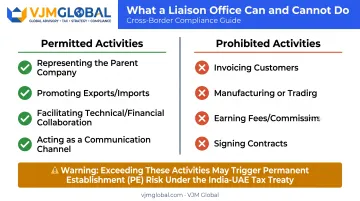
Permitted activities include:
- Representing the parent or group company in India
- Promoting exports from India or imports into India
- Facilitating technical or financial collaboration with Indian companies
- Acting purely as a communication channel
Activities that frequently trip up UAE applicants:
- Invoicing any Indian customer or vendor
- Manufacturing, trading, or reselling goods
- Earning fees, commissions, or any local income
- Signing contracts on behalf of the parent company
Cross this line, and you risk the LO being reclassified as a Permanent Establishment under the India-UAE tax treaty, exposing the parent's India-linked profits to Indian tax. A fixed place used only for preparatory or auxiliary work is excluded from PE status, but habitual contract negotiation is not.
This distinction matters more than most guides let on. An LO that quietly starts "helping close deals" for the parent has stepped outside its charter, and RBI's annual certification process is designed to catch exactly that.
Step-by-Step Process to Set Up a Liaison Office in India from the UAE
The process itself is standardized by RBI. What most guides skip is the UAE-specific document legalization layer, which can add weeks if you are not prepared for it upfront.
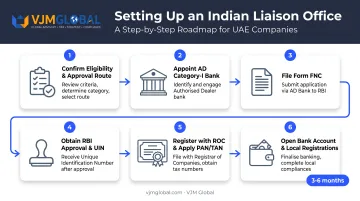
Step 1: Confirm Eligibility and Choose the Approval Route
Before filing anything, confirm two things:
- Your company has 3 consecutive years of profitability and at least $50,000 net worth (or your parent company can provide a Letter of Comfort)
- Your sector qualifies for the Automatic Route (100% FDI permitted) or needs Government Route clearance
Sector classification determines whether your AD Bank can approve directly or must route the file through RBI for consultation with the relevant ministry.
Step 2: Appoint an Authorized Dealer (AD) Category-I Bank in India
You'll need one designated AD Category-I bank to act as intermediary for all RBI submissions. This bank later hosts your LO's account and remains your point of contact for renewals and reporting.
Step 3: File Form FNC with Supporting Documents via the AD Bank
Your AD Bank submits Form FNC along with:
- Certificate of Incorporation
- MOA/AOA
- Three years of audited financial statements
- Board resolution approving the LO
- KYC documentation
UAE-issued documents don't get a free pass here. They typically require MOFA attestation and Indian Embassy/Consulate legalization before RBI or ROC will accept them (more on this below).
Step 4: Obtain RBI Approval and a Unique Identification Number (UIN)
After your AD Bank forwards the file, RBI reviews it and consults the Ministry of Finance where the sector requires it. Timelines depend on sector sensitivity and how complete your documentation is. When cleared, RBI issues a Unique Identification Number (UIN) for your LO.
Step 5: Register with the ROC and Apply for PAN/TAN
Within 30 days of establishing your place of business in India, file Form FC-1 with the Registrar of Companies. This secures your Certificate of Establishment. From there:
- Apply for PAN with the Income Tax Department
- Apply for TAN if the LO will deduct tax at source on any payments
Step 6: Open the Bank Account and Complete Local Registrations
Open your LO's bank account with the AD Bank, funded exclusively by inward remittances from the UAE parent. Depending on your activities, you may also need:
- Shops & Establishment Act registration
- Professional Tax registration
- Import Export Code, if you're bringing in samples
Coordinating AD Bank, RBI, and ROC filings in parallel—rather than one after another—is what keeps most timelines on track. Sequential filing is where projects slip by months.
A cross-border compliance partner such as VJM Global can run those workstreams together so one delayed approval does not stall the next filing.
Eligibility Criteria and Documents Required for UAE Companies
Eligibility Requirements
RBI applies two financial thresholds to every LO applicant:
- Profitability: A profit-making track record for the immediately preceding three financial years
- Net worth: At least $50,000, calculated as paid-up capital plus free reserves, minus intangible assets, per the latest audited balance sheet
If your UAE company is a subsidiary and doesn't clear these thresholds on its own, it can submit a Letter of Comfort from its parent company, provided the parent meets the criteria.
The RBI's regulatory framework confirms this substitution option explicitly. The AD Bank still reviews the full application and forwards it to RBI with its own comments.
Documents and UAE-Specific Legalization Requirements
Your core document checklist:
- Certificate of Incorporation (COI)
- Memorandum and Articles of Association (MOA/AOA)
- Audited balance sheets (3 years)
- Applicant background note (business profile and proposed LO activities)
- List of directors and shareholders
- Declaration under Section 380 of the Companies Act (foreign company compliance)
Here's where UAE applicants hit a snag that companies from other regions often don't. The UAE is not a party to the Apostille Convention. That means a simple apostille stamp won't satisfy RBI or ROC.
Instead, UAE-originated documents need:
- Notarization in the UAE
- Attestation by the UAE Ministry of Foreign Affairs
- Legalization by the Indian Embassy or Consulate
Applicants from Apostille-member countries skip step 3 entirely. For UAE companies, incomplete or out-of-sequence attestation is one of the most common causes of processing delays—plan the full legalization chain before you file.
Compliance and Reporting Obligations After Setup
Zero revenue doesn't mean zero paperwork. An LO still owes annual reports to RBI, ROC, and the Income Tax Department, and missing any of them puts your renewal at risk.
Annual filings you cannot skip:
| Filing | Purpose | Deadline |
|---|---|---|
| Annual Activity Certificate (AAC) | CA-certified confirmation that only permitted activities occurred | September 30 |
| ITR-6 | Income tax return, even at zero taxable income | October 31 |
| FC-3 | Foreign company financial statements | Within 6 months of financial year-end |
| FC-4 | Annual return to ROC | Within 60 days of financial year-end |
Your LO's 3-year licence renewal application must go through the AD Bank to RBI before expiry, and it's contingent on a clean AAC history. A single missed filing can complicate that renewal.
Common Mistakes That Put UAE-Owned LOs at Risk
- Informal invoicing or deal-closing: Treating the LO as if it can negotiate final sales terms or issue invoices "just this once" risks PE reclassification under India-UAE tax treaty scrutiny.
- Missed AAC or FC-3/FC-4 deadlines: RBI treats compliance history as a direct input into 3-year renewal approval—these are not optional formalities.
- Revenue-generating activity: Trading, fee-based consulting, or executing contracts through the LO breaches FEMA conditions and can force closure plus tax exposure.
- Bypassing AD Bank funding: Expense funding and remittances must flow through the authorized dealer bank; informal channels create FEMA breaches.
Liaison Office vs. Branch Office vs. Employer of Record: Which Fits Your UAE Business?
An LO is built for market study, not commercial operations. Once your UAE company is ready to bill Indian customers or hire local staff, you've outgrown it.
| Structure | Best for | Key requirement |
|---|---|---|
| Liaison Office | Market research, promotion, no revenue | 3 years' profit, $50,000 net worth |
| Branch Office | Invoicing, consultancy, export/import trading | 5 years' profit, $100,000 net worth |
| Wholly Owned Subsidiary | Manufacturing, sales, long-term operations | Companies Act incorporation, FDI compliance |
| Employer of Record | Hiring India-based talent, no entity | No RBI approval or incorporation needed |
Branch Office
A Branch Office suits UAE companies ready to invoice for consultancy, professional services, or export/import trading in India. It clears higher bars than an LO with a 5-year profitability track record and $100,000 minimum net worth, plus closer RBI scrutiny on permitted activities.
Wholly Owned Subsidiary
If the end goal is full manufacturing, sales, or a long-term commercial footprint, a Wholly Owned Subsidiary is the structure that supports it. It involves Companies Act incorporation, FEMA/FDI compliance, and ongoing statutory audits. That is more overhead than an LO or Branch Office, but there is no ceiling on what the entity can do commercially.
Employer of Record (EOR)
If all you need is India-based talent without RBI approval, incorporation, or annual LO compliance, an EOR route skips the entity question entirely.
VJM Global's EOR service handles this for UAE companies by acting as the legal employer:
- Drafting compliant Indian employment contracts
- Running payroll and statutory contributions
- Managing benefits, onboarding, and offboarding
Coverage spans 100+ countries and is priced per employee per month. That makes it a practical way to test India-based hiring before deciding whether a fuller entity is worth building later.

Frequently Asked Questions
How to set up a liaison office in India?
Secure RBI approval through an AD Category-I Bank by filing Form FNC, then register with the ROC and apply for PAN/TAN. See the step-by-step section above for the full sequence.
What is a liaison office in India?
It is a non-revenue representative office of a foreign parent company. It is funded only through inward remittances and limited to liaison and promotional activities.
Can a UAE company open a liaison office in India without a local partner?
Yes. An LO doesn't require an Indian partner or shareholder. You will need an AD Bank, and in some cases a locally appointed authorised representative.
How long does it take to set up a liaison office in India from the UAE?
The full process typically takes 3-6 months. RBI approval alone can take several weeks, depending on document completeness and how quickly UAE attestation steps are completed.
Can a liaison office generate revenue or sign contracts in India?
No. An LO cannot invoice, trade, or earn income in India. All operating costs must be funded through remittances from the UAE parent company.
What happens when the liaison office's 3-year approval expires?
You either renew for another 3 years through the AD Bank, subject to a satisfactory compliance history, or convert into a Branch Office or Wholly Owned Subsidiary under prevailing FDI policy.