On paper, Colombia makes this easy: 100% foreign ownership is permitted, and no local partner is required. In practice, Canadian founders often stumble on the execution — opening a bank account, securing a tax ID, and appointing a legal representative all involve more friction than the marketing brochures suggest.
This guide walks through entity options, the exact registration steps, realistic costs, visa requirements, common mistakes, and alternatives to full incorporation.
Key Takeaways
- The SAS (Simplified Stock Company) is the go-to structure for Canadian-owned companies, allowing one foreign shareholder and no minimum capital
- Registration can be done remotely from Canada via power of attorney, though most founders should budget three to four weeks door-to-door
- Corporate income tax is 35% and VAT 19%; register foreign capital to protect future profit repatriation
- CCFTA eases business travel but does not replace Colombia's visa rules for anyone running day-to-day operations
- A Colombia-based legal representative is mandatory, even though a local business partner is not
How to Set Up a Business in Colombia from Canada: Step-by-Step
Step 1: Choose Your Structure and Verify Your Company Name
Your first decision shapes everything that follows: liability exposure, governance, and how fast you can start invoicing. Most Canadian founders default to an SAS, but an Ltda., SA, or branch office might fit better depending on your growth plans (see the comparison below).
Once you've settled on a structure, search the Chamber of Commerce registry (RUES) to confirm your desired name isn't already taken. This is a quick check, but skipping it can delay your filing by days.
Step 2: Draft and Notarize Company Bylaws
Your bylaws need to cover shareholder rights, capital structure, and decision-making authority, tailored specifically for a single Canadian shareholder or parent company rather than a multi-partner setup.
If you're signing remotely via power of attorney:
- Documents must be translated into Spanish by a certified translator
- Foreign documents need an apostille (or legalization) to be valid in Colombia
- An SAS can typically use a private document rather than a full public deed, which speeds things up
Step 3: Register Your Company and Request Your NIT
Here's where the process has gotten simpler. As of June 2024, Colombia's business registration portal (VUE) eliminated the standalone Pre-RUT step. You now request your NIT (Colombia's tax ID) directly through the RUES form as part of the same mercantile registration filing at the Chamber of Commerce.
- Submit your incorporation documents, RUES forms, and beneficial-owner information to the local Chamber of Commerce
- Pay the registration tax, which runs roughly 0.7% to 1% of subscribed capital depending on the city (Bogotá sits at the lower end, per PwC's 2024 Doing Business in Colombia guide)
- Receive your RUT certificate once registration is approved
Step 4: Secure Electronic Billing Authorization from DIAN
Once your NIT is issued, you need separate authorization from DIAN, Colombia's tax and customs authority, before you can legally invoice anyone.
Colombia requires electronic invoicing for any legally obligated taxpayer. You'll register with DIAN's system and complete the electronic-invoicer habilitation process through DIAN's free software or a third-party platform. Skipping this step means you can't bill Colombian clients yet, even if your company technically exists.
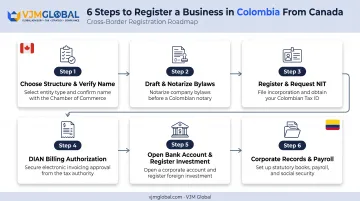
Step 5: Open a Corporate Bank Account and Register Your Foreign Investment
This is usually the slowest part of the whole process. Banks typically require:
- Certificate of existence and legal representation from the Chamber of Commerce
- The legal representative's ID
- Parent company documents (apostilled and translated)
- In-person presence at the bank in most cases
Once funds arrive, register your Canadian capital contribution. If the money moves through a foreign-exchange intermediary or compensation account, the exchange declaration itself registers the investment automatically.
If not, you'll file an International Investment Registration Declaration with Banco de la República. Either way, this step protects your right to repatriate profits later — don't skip it.
Step 6: Handle Corporate Records and Payroll Setup
Colombia eliminated Chamber registration of physical accounting books back in 2012, so you can cross that off the old checklist. Shareholder and partner registers, along with minutes books, still fall under commercial-book requirements.
If you're hiring locally, enroll in Colombia's social security and compensation fund system before your first payroll run.
Choosing the Right Business Structure for Your Colombian Entity
Your entity choice drives tax exposure, governance obligations, liability protection, and how fast you can start operating. Here's how the four main options compare:
| Structure | Shareholders | Liability | Capital Minimum | Audit Requirement |
|---|---|---|---|---|
| SAS | 1+ (Canadian non-resident allowed) | Generally limited to contributions | None fixed | Only above asset/revenue thresholds |
| Ltda. | 2–25 partners | Limited, but joint exposure for labor/tax debts | None fixed | Based on general threshold |
| SA | 5+ shareholders, formal board | Limited to contributions | Higher paid-in capital at formation | Always mandatory |
| Branch | None (parent company owns it) | Parent fully liable | Assigned by parent | Always mandatory |
Simplified Stock Company (SAS)
This is the structure most Canadian founders choose. One shareholder and one director are enough (both can be Canadian non-residents), and there's no minimum capital requirement. You still need a legal representative based in Colombia. A statutory auditor only becomes mandatory once you cross defined asset or revenue thresholds.
Limited Liability Company (Ltda.)
An Ltda. requires two or more partners, which makes it a natural fit if you're entering via a joint venture with a Colombian partner rather than going solo. The trade-off: ownership transfer is more restrictive than an SAS, which can slow down a future restructuring or exit.
Corporation (SA)
An SA demands at least five shareholders and a formal board of directors, which is overkill for most first-time market entrants but suited to larger operations or companies eyeing a future public listing. It also requires a higher percentage of paid-in capital at incorporation and mandates an external audit regardless of company size.
Branch of a Foreign Canadian Company
A branch creates no new legal entity. It operates under the same tax and regulatory obligations as a Colombian company but stays under full head-office control, with no separate subsidiary balance sheet. It's a solid fit for companies that want a visible, long-term Colombian presence without creating a separate legal entity. Know that your Canadian parent remains fully liable for the branch's Colombian debts.
Costs, Taxes and Visa Requirements for Canadian Entrepreneurs
Corporate Taxes and Foreign Investment Compliance
Budget for a 35% corporate income tax rate and 19% VAT on most goods and services (a reduced 5% rate applies to specific supplies). These are the two numbers that show up in nearly every financial model for a Colombian subsidiary.
Foreign investment registration matters more than most founders expect:
- Capital channeled through a foreign-exchange intermediary registers automatically via the exchange declaration
- Capital moved outside that channel requires a separate International Investment Registration Declaration with Banco de la República
- Controlling stakes held by a single foreign investor (commonly above 50%) must be registered in the commercial registry, typically within 30 days
Skip these filings and you risk complications when it's time to send profits home.
Visa and Entry Requirements for Canadian Business Owners
Canadians don't need a visa for short business trips. Colombia treats Canada as visa-exempt for qualifying short-stay activities up to 180 calendar days, but that exemption doesn't cover local salary or employment.
Canadian travelers also currently face an entry charge (not a visa fee) of COP 270,000, with exemptions for minors, seniors over 79, and a few other categories.
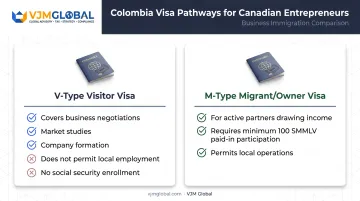
Once you move from "visiting" to "operating," the rules change:
- V-type (visitor) visa covers business negotiations, market studies, and company-formation activities—not local employment or social security enrollment
- M-type (migrant/owner) visa applies if you're an active partner or owner drawing income from the company, generally with minimum paid-in participation of 100 SMMLV (Colombia's monthly minimum wage benchmark)
The CCFTA's Chapter 12 on Temporary Entry for Business Persons streamlines entry for traders, investors, and intra-company transferees, and bars labor-certification tests for covered applicants. It does not eliminate Colombia's standard visa or admissibility procedures. It only smooths the path within them.
Common Mistakes Canadians Make When Setting Up in Colombia
Founders who've been through this once tend to point to the same handful of missteps:
- Defaulting to an SAS without comparing alternatives. It's the easiest structure, not automatically the right one: an Ltda. or branch may fit better depending on partnership plans and liability appetite.
- Underestimating banking logistics. Many banks still require the legal representative to appear in person, so founders planning a fully remote setup often get caught off guard.
- Overlooking foreign investment registration. Missing this step won't stop you from operating today, but it can block profit repatriation years down the road.
- Misjudging VAT and withholding obligations. Invoicing Colombian clients or paying local suppliers triggers withholding rules by transaction type, not a flat rate you can assume upfront.
Alternatives to Full Incorporation: Branch, Subsidiary or Employer of Record
Full incorporation isn't always the fastest or cheapest way to test the Colombian market before committing capital.
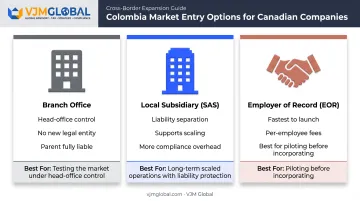
Quick comparison:
- Branch — Head-office control, no separate Colombian entity; parent stays fully liable
- Subsidiary (SAS) — Liability separation and room to hire at scale; more setup and ongoing filings
- EOR — Hire or pilot without incorporating; per-employee fees, not ideal long-term at scale
Branch Office
Best when you want centralized head-office control without creating a separate legal entity. The trade-off is real: your Canadian parent company stays fully liable for whatever debts or obligations the branch racks up in Colombia.
Local Subsidiary (SAS)
Better suited to companies planning long-term operations, local hiring at scale, and genuine liability separation from the parent. The trade-off is more setup steps and ongoing compliance: audits, corporate book maintenance, and annual filings that a branch or EOR arrangement avoids.
Employer of Record (EOR)
An EOR lets you hire Colombian talent or run limited operations without incorporating anything yet. It’s a practical way to test market demand before taking on the compliance overhead of a full entity.
The catch is ongoing per-employee service fees. EOR setups aren’t built for large-scale, long-term commercial activity, so incorporation usually makes more financial sense once you scale.
For Canadian companies weighing this decision, a firm that handles both entity formation and EOR can clarify which path fits. VJM Global delivers entity establishment and Employer of Record services across 100+ countries, and already supports Canadian companies with federal and provincial incorporation, CRA registration, and payroll compliance. That dual capability helps map the right entry path as Colombian operations grow from a pilot hire to a full subsidiary.
Frequently Asked Questions
Can a Canadian start a business in Colombia?
Yes. Colombia permits 100% foreign ownership with no local partner required, most commonly through an SAS. Foreign investment still needs to be registered with the appropriate exchange system or Banco de la República.
Does Canada have a free trade agreement with Colombia?
Yes, the CCFTA has been in force since August 2011. It includes a chapter easing temporary entry for business persons, traders, and investors, though it doesn't replace standard visa requirements.
How much do Canadians have to pay to enter Colombia?
Short-stay Canadian travelers currently face an entry charge of COP 270,000, separate from any visa fees required for longer business stays. Certain travelers, including minors and seniors, are exempt.
What is the most popular business structure for foreign-owned companies in Colombia?
The SAS, by a wide margin. Its single-shareholder flexibility, lack of minimum capital, and faster setup make it the default choice for most Canadian founders.
Do I need a local partner or resident director to own a business in Colombia?
No local partner is required for any entity type. You do need a Colombia-based legal representative, regardless of whether you set up an SAS, Ltda., SA, or branch.
How long does it take to register a company in Colombia from Canada?
The core filing steps can move in about a week once documents are complete. Realistically, plan for three to four weeks once translations, apostilles, and bank account setup are factored in. All of that can be handled remotely via power of attorney.