Indian entrepreneurs, IT firms and export-driven SMEs have historically leaned on the US, EU and Middle East for growth. Colombia offers a fourth lane, one that's less crowded and, for the right sector, genuinely underserved.
This guide walks through entity types, registration steps, compliance obligations and visa considerations for Indian founders looking at Colombia seriously.
Key Takeaways
- Foreigners can own 100% of a Colombian company with no local partner required
- The SAS structure suits most Indian-owned businesses: one shareholder, minimal capital
- Registration often takes 3-4 weeks and can start remotely via power of attorney
- Compliance runs through the Chamber of Commerce, DIAN, NIT and mandatory e-invoicing
- First-time Indian entrants usually avoid rework and multi-week stalls by using a cross-border formation partner for POA, filings and DIAN setup
Why Colombia Is Gaining Attention Among Indian Entrepreneurs
Colombia's geography does a lot of the selling itself. It's a bridge between the Pacific and Atlantic, giving Indian exporters and service providers a foothold that connects to both North and South American markets. Its free trade network, per ProColombia's 2025 Legal Guide, reaches over 60 countries and 1.5 billion consumers.
Colombia ranked 67th of 190 economies in the World Bank's Doing Business 2020 report. That data is current only to May 2019, so treat it as historical context rather than a live benchmark.
The sharper opportunity sits at the sector level:
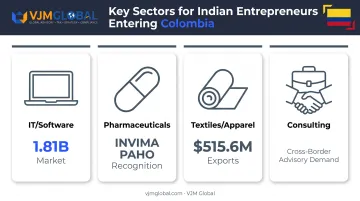
- IT/software — Colombia was Latin America's third-largest IT market in 2021, worth over $1.81 billion
- Pharmaceuticals — supported by INVIMA's PAHO level-IV recognition and existing manufacturing capacity
- Textiles/apparel — $515.6 million in apparel exports in 2024 alone
- Consulting and professional services — riding the same demand curve as IT
These are exactly the areas where Indian firms already have deep operational experience. That overlap is why Colombia keeps coming up in market-diversification conversations.
Business Structures Available to Indian Founders in Colombia
Colombian company law doesn't require a local partner. An Indian founder can hold 100% of the equity in most non-regulated sectors, subject to normal registration.
The SAS: Default Choice for Most SMEs
The Sociedad por Acciones Simplificada (SAS) is the go-to structure, and for good reason:
- Requires just one shareholder — no minimum of two or five
- Capital can start as low as $1, paid within two years
- No mandatory board of directors
- Legal representative can be a foreign national (no residency requirement stated in Colombia's corporate framework)
How It Compares to Other Structures
| Structure | Owners | Governance | Best For |
|---|---|---|---|
| SAS | 1+ | Board optional, auditor only above thresholds | Most Indian SMEs, consultancies |
| Ltda. | 2-25 | Manager(s), no mandatory board | Small closed partnerships |
| SA | 5+ (none over 95%) | Mandatory board + statutory auditor | Larger, dispersed ownership |
| Branch | N/A (parent-owned) | Colombia-licensed CPA auditor from day one | Firms wanting centralised HQ control, accepting parent liability |
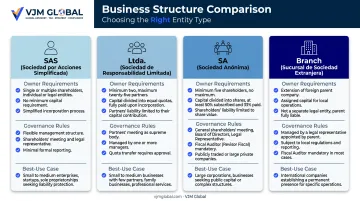
A branch avoids creating a new legal entity, which appeals to Indian companies wanting tight HQ control. The trade-off: the parent company bears full Colombian liability, and branch documents need apostille/legalisation.
Bottom line: unless there's a specific reason for a branch or SA, most Indian founders will land on an SAS. It's faster, cheaper and more flexible for a services or trading business.
Step-by-Step: How to Register a Business in Colombia from India
Incorporation can be initiated remotely from India through a power of attorney. That said, a local representative becomes essential once banking and government interactions start.
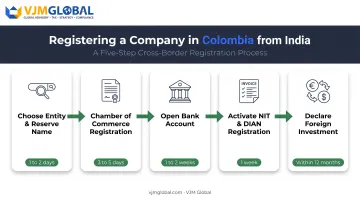
Step 1: Choose Entity Type and Reserve Company Name
Check name availability through Colombia's RUES registry (the homonimia search). Note: this check confirms availability. It doesn't reserve the name or protect a trademark. Draft your bylaws (estatutos) with a local lawyer alongside this step.
Step 2: Register with the Chamber of Commerce
Submit incorporation documents and notarized bylaws to receive your Matrícula Mercantil. Since 2024, Colombia's simplified VUE (Ventanilla Única Empresarial) process folds NIT assignment into this same registration flow, removing the old separate pre-RUT step.
Step 3: Open a Corporate Bank Account
This is where things slow down. Indian shareholders will need Colombia-specific documentation, and banks generally require in-person coordination — a trusted local representative matters here more than at any other stage.
Step 4: Activate the Permanent NIT and Register with DIAN
Complete registration with DIAN (the tax authority) and enable electronic invoicing (facturación electrónica). This involves selecting invoicing software, running test documents, and getting invoice numbers authorised.
Step 5: Declare Foreign Investment
Capital brought in from India must be registered with Banco de la República, Colombia's central bank:
- Formal exchange market: Registration happens automatically via the exchange declaration
- Non-FX contributions: File a separate electronic declaration
- Skip this step and you create compliance headaches later
Tax, Compliance and Visa Considerations for Indian Business Owners
Tax Basics
Colombia's general corporate income tax rate sits at 35%, with 19% IVA (VAT) as the standard rate. These apply regardless of where the shareholders are from. There is no special regime tied to being Indian-owned. Some activities and municipalities carry exceptions, so model your specific case before pricing anything.
Visa Options: Ownership Isn't Immigration Status
Owning a Colombian company doesn't automatically grant work rights. Relevant visa categories use thresholds in SMLMV (Colombia's legal monthly minimum wage):
- M shareholder-owner visa — requires at least 100 SMLMV in paid capital
- M investor visa (direct investment) — over 650 SMLMV
- M investor visa (real estate) — at least 350 SMLMV
Founders who want to stay in India and run the company remotely don't need any of these. It's only relevant if you plan to relocate and work on the ground.
If You're Hiring Locally
Colombian labour law adds obligations on top of salary:
- Pension: 12% employer, 4% employee
- Health: 8.5% employer, 4% employee
- Cesantías (severance fund): one month's salary per year, deposited by February 15
- Service bonus: 15 days' salary per semester
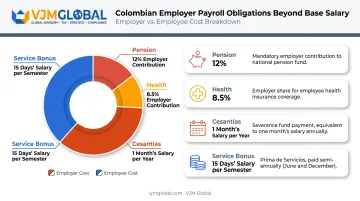
This is where many first-time founders underbudget. Payroll in Colombia is not just gross salary times headcount.
Those employment costs sit alongside tax and reporting duties that are harder to run from India. DIAN registration, e-invoicing and payroll compliance usually need local support on the ground.
VJM Global can help structure the India side of a Colombia entry, including FEMA reporting and outbound investment compliance, while you coordinate Colombian counsel for country-specific filings.
Practical tip: engage a local accountant early, before you send any capital across. E-invoicing and DIAN filings are ongoing, not one-time tasks.
Costs and Common Mistakes Indian Entrepreneurs Should Avoid
What to Budget For
Colombia's official Chamber of Commerce fees are asset-based, not a flat percentage, so treat any "0.7-1% of capital" figure you see online as a rough approximation, not a quote. Budget separately for:
- Chamber of Commerce registration fees
- Legal fees for bylaws drafting
- Accounting setup for e-invoicing
- Bank account opening costs (often underestimated in time, not just money)
- Apostille and translation of Indian corporate documents
Get itemized quotes rather than relying on affiliate-site price tables. Actual costs shift with apostilles, translations and the complexity of your bylaws.
Common Pitfalls
- Picking SA when SAS would do — adds mandatory audit and board requirements you don't need at the start
- Skipping the foreign investment declaration — creates FX compliance problems later when repatriating profits
- Underestimating the bank account timeline — weeks, not days, and it usually needs someone physically present
- Treating the one-day VUE registration claim as the whole timeline — it covers the legal entity creation step only, not banking, FX or tax setup
Does Money Go Further in Colombia?
For early-stage service businesses, yes. Lower operating costs than India's metros (or the US) stretch a smaller budget further on rent, salaries and basic overhead. That edge is strongest for lean consulting or trading setups; it will not apply evenly to every expense line.
Frequently Asked Questions
Can someone from India start a business in Colombia?
Yes. Indians can own 100% of a Colombian company, typically structured as an SAS, without a local partner. Standard registration and a foreign investment declaration still apply.
What is the 183-day rule in Colombia?
It relates to tax residency. DIAN (Colombia's tax authority) treats you as a tax resident if you spend more than 183 days in the country within any 365-day period, whether continuous or not.
What are good businesses for someone from India to start in Colombia?
IT and software consulting, import-export, textiles, pharmaceuticals, and professional services align well with Indian expertise and Colombian market demand.
Is $2,000 a lot of money in Colombia?
For many everyday costs, $2,000 covers a solid monthly budget or basic lean startup expenses, given Colombia's lower cost of living versus India's major metros.
How long does it take to register a company in Colombia from India?
Typically 3-4 weeks with complete documentation. The legal entity itself can sometimes be created in a single day through Colombia's VUE platform, but banking and tax setup add time.
Do I need to visit Colombia to set up my company?
Incorporation itself can often be done remotely via power of attorney. Opening a bank account and certain DIAN procedures usually require local presence or a trusted representative on the ground.