Singapore's tax treaty network, political stability, and English-language legal system make it one of the lowest-friction jurisdictions for a Canadian to set up shop abroad. But here's what most guides leave out: the Canada Revenue Agency doesn't stop watching just because your company is registered overseas.
Once you own a Singapore entity, CRA foreign reporting rules, including Form T1134 and Form T1135, along with Foreign Accrual Property Income (FAPI) rules, apply whether or not you ever set foot in Singapore. This article walks through both sides: the Singapore incorporation process and the Canadian compliance obligations that run alongside it.
Key Takeaways
- You can own 100% of a Singapore Pte Ltd, but need a resident director and filing agent
- Minimum paid-up capital is just S$1, with total incorporation fees around S$315
- CRA foreign reporting (T1134, T1135) and FAPI rules apply once you own a Singapore entity
- The Canada-Singapore tax treaty caps dividend withholding tax at 15%, reducing double taxation
- Incorporation takes 1-3 business days, but a working bank account can take several weeks longer
Why Canadian Entrepreneurs Are Choosing Singapore
Singapore ranked 2nd out of 70 economies in IMD's 2026 World Competitiveness Ranking, climbing one spot from the prior year. For Canadian founders comparing jurisdictions, that ranking reflects something practical: predictable regulation, efficient courts, and a government that treats foreign capital as an asset rather than a risk.
The tax structure reinforces that reputation:
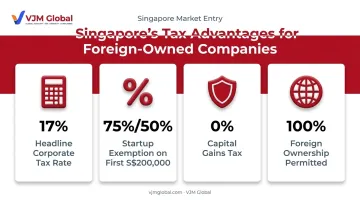
- 17% headline corporate tax rate, applied to local and foreign-owned companies alike
- 75% exemption on the first S$100,000 of chargeable income and 50% on the next S$100,000 for a qualifying company's first three years of assessment
- No capital gains tax, though the line between capital and income gains depends on the facts of each disposal
- 100% foreign ownership permitted, with no restrictions on shareholding structure or profit repatriation
An ASEAN Gateway with Real Scale
Singapore sits at the doorstep of a market of 684.1 million people across ASEAN, based on 2025 ASEANstats data. For a Canadian e-commerce or SaaS founder, that's a consumer base roughly 17 times the size of Canada itself, reachable from a single, English-speaking regional base.
The Treaty Advantage
The Canada-Singapore Income Tax Treaty caps withholding tax on cross-border dividends, interest, and royalties at 15% of the gross amount, according to the Canada-Singapore tax convention text published by the Department of Finance. That cap matters when profits eventually flow back to Canadian shareholders.
Combined with the shared common-law tradition and English-language commercial and legal system, Canadian founders face far less friction here than in most non-English jurisdictions.
What Canadian Founders Must Know Before Setting Up
Canada does not require pre-approval to send capital abroad. There's no outbound investment screening regime like some countries impose. That said, Canadian tax residents take on reporting duties the moment they hold an interest in a foreign corporation, regardless of whether money ever moves.
CRA Foreign Reporting Obligations
Two forms matter most:
Form T1135 (Foreign Income Verification Statement) applies once the total cost amount of specified foreign property exceeds CAD 100,000 at any point in the year. Shares in your Singapore Pte Ltd generally count toward that threshold. The filing deadline matches your regular tax return due date.
Form T1134 (Information Return Relating to Controlled and Not-Controlled Foreign Affiliates) must be filed by anyone who controls, or holds a qualifying interest in, a foreign affiliate. For tax years beginning after 2020, it's due within 10 months of your tax year-end.
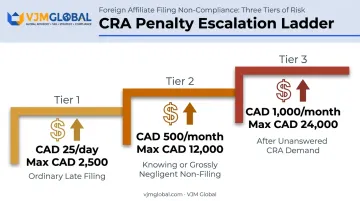
Penalties escalate quickly for missed filings:
- CAD 25/day for ordinary late filing, up to CAD 2,500
- CAD 500/month (max CAD 12,000) for knowing or grossly negligent non-filing
- CAD 1,000/month (max CAD 24,000) after a formal CRA demand goes unanswered
FAPI and Controlled Foreign Affiliate (CFC) Rules
Foreign Accrual Property Income rules exist to stop Canadians from parking passive income offshore tax-free. Under subsection 91(1) of the Income Tax Act, a Singapore company that qualifies as a controlled foreign affiliate triggers accrual taxation on its passive income. Interest, royalties, and rents get taxed to you in Canada whether or not the company ever distributes them.
Here's the distinction that actually matters for most founders: genuine active business income earned by a real operating company in Singapore is treated differently. Section 95 of the Act excludes active business income from FAPI treatment. This is exactly why substance matters, meaning actual staff, day-to-day operations, and decision-making authority based in Singapore, not just a mailbox and a nominee director.
Canada-Singapore Double Taxation Agreement
The treaty allocates taxing rights between the two countries and, as noted above, caps withholding tax on dividends repatriated from your Singapore entity back to Canadian shareholders at 15%. Without the treaty, source-country withholding could run higher, and you'd risk being taxed twice on the same income.
Physical Presence and Structuring Decisions
You don't need to relocate to own and control a Singapore company. Appoint a nominee resident director to satisfy the local-residency requirement, while shareholder rights keep you in control of every strategic decision.
If you do want to relocate, two visa routes exist:
- EntrePass – for founders of venture-backed or innovative-technology businesses who meet at least one entrepreneur, innovator, or investor criterion
- Employment Pass – requires a minimum monthly salary of S$5,600 (S$6,200 in financial services) and typically a passing score under the COMPASS points framework
Two factors decide whether a fresh Pte Ltd or a subsidiary structure fits better: whether you stay in Canada or relocate, and whether you already operate a company there. VJM Global's cross-border tax advisory team works through FAPI exposure, T1134/T1135 preparation, and treaty-efficient structuring as one connected exercise, rather than treating Singapore incorporation and Canadian reporting as separate problems.
Choosing the Right Business Structure as a Canadian National
Private Limited Company (Pte Ltd)
For nearly every foreign founder, the Pte Ltd is the default choice. Key features:
- Separate legal entity, distinct from its shareholders
- Limited liability, so shareholder exposure is generally capped at their invested amount
- Between 1 and 50 shareholders permitted
- At least one Singapore-resident director required
- Eligible for the startup tax exemption on early-year chargeable income
Singapore Subsidiary vs. Fresh Pte Ltd
If you already run a Canadian operating company, a subsidiary structure (Canadian parent owning a Singapore Pte Ltd) is often the better fit. This structure supports intra-group transactions such as licensing fees, management charges, and cost allocations, subject to transfer pricing rules requiring arm's-length pricing between related parties—documentation that firms like VJM Global prepare for clients operating in both markets.
Founders without an existing Canadian company typically default to a fresh, standalone Pte Ltd instead. It's simpler to structure, though it doesn't offer the same intra-group flexibility.
| Scenario | Best-fit structure | Key consideration |
|---|---|---|
| No existing Canadian company | Fresh Pte Ltd | Simpler ownership, no transfer pricing exposure |
| Established Canadian business expanding regionally | Singapore subsidiary | Transfer pricing documentation required for related-party dealings |
How to Set Up a Business in Singapore from Canada: Step by Step
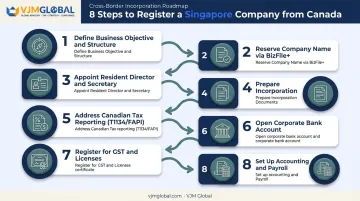
Step 1 – Define the Business Objective, Model, and Structure
Decide upfront whether the Singapore entity will function as a trading hub, a regional headquarters, or a service arm. This decision drives your SSIC code selection (Singapore's industry classification system) and determines what licenses you'll need downstream.
Step 2 – Reserve the Company Name via BizFile+
Name reservation runs through ACRA's BizFile+ portal for a S$15 fee, valid for 120 days. Foreigners cannot self-register; you must use a registered filing agent to submit on your behalf.
Step 3 – Appoint a Resident Director and Corporate Secretary
Every Singapore company needs at least one locally resident director. A nominee director arrangement satisfies this while keeping you in control through your shareholder rights. Separately, you have six months from incorporation to appoint a qualified corporate secretary.
Step 4 – Prepare and Submit Incorporation Documents
You'll need:
- Passport copies for all directors and shareholders
- Proof of residential address
- A company constitution (standard or customized)
- A registered Singapore office address
- Your chosen SSIC code
Canadian documents sometimes require notarization before Singapore authorities will accept them, so confirm this early to avoid delays.
Step 5 – Address Canadian Tax Reporting Alongside Incorporation
Flag your new foreign affiliate for T1134 reporting (Canada's foreign affiliate disclosure form) and assess FAPI exposure (Foreign Accrual Property Income) at the point of incorporation, not months later. Retroactive compliance gaps are far harder, and more expensive, to fix than getting the assessment right from day one. VJM Global can run this Canadian-side assessment in parallel with your Singapore registration so your Canadian filings stay current while the Singapore entity is being formed.
Step 6 – Open a Corporate Bank Account in Singapore
Major banks require standard KYC documentation: passports, proof of address, ACRA business profile, and constitution documents. Some banks offer remote or video-based KYC for founders who can't travel, though processing times vary bank to bank, so confirm current requirements directly with your chosen bank.
Step 7 – Register for GST and Obtain Necessary Licenses
GST registration becomes mandatory once taxable turnover exceeds S$1 million in a calendar year, or is reasonably expected to within the next 12 months. The current GST rate is 9%. Check the GoBusiness portal for industry-specific licensing requirements before you launch operations.
Step 8 – Set Up Accounting, Payroll, and Ongoing Compliance
You're required to maintain proper accounting records, file ACRA annual returns, and submit IRAS corporate tax returns from your first financial year. Most founders appoint a corporate services firm at this stage rather than trying to track two countries' filing calendars manually.
Post-Setup Obligations: Managing Compliance on Both Sides
Incorporation is the easy part. Staying compliant on both sides of the Pacific is where founders slip up.
Singapore-side recurring obligations:
- File the annual return with ACRA
- Submit the IRAS corporate tax return (Form C-S or Form C)
- Lodge GST returns quarterly, if registered
Canada-side recurring obligations:
- File the annual T1134 for controlled or non-controlled foreign affiliates
- Reassess FAPI exposure as your Singapore operations evolve
- Report T1135 alongside your personal or corporate tax return
Profit repatriation deserves its own look each year. Assess dividends flowing back to Canada against the Canada-Singapore DTA's withholding tax provisions before you distribute, not after. VJM Global supports treaty-based repatriation planning alongside dual-jurisdiction reporting, so the Singapore and Canadian filings stay aligned rather than becoming two disconnected compliance tracks.
Frequently Asked Questions
Can a Canadian start a business in Singapore?
Yes. Canadians can own 100% of a Singapore company, but you must appoint a Singapore-resident director and use a registered filing agent to complete incorporation, since foreigners cannot self-register.
Can Canadian citizens live in Singapore?
Not automatically. Incorporating a company doesn't grant residency. You'll need a separate pass, such as EntrePass or Employment Pass, to legally live and work in Singapore.
What is the easiest business to start in Singapore?
A Private Limited Company is the most straightforward and credible structure for foreign founders, regardless of industry. If you're also weighing which sector to enter, fintech, digital services, and advanced manufacturing currently receive priority support under Singapore's economic development plans.
How much does it cost to register a company in Singapore from Canada?
Government fees total roughly S$315 (S$15 name reservation plus S$300 registration). Add typical costs for a nominee director, registered office address, and corporate secretarial services on top of that.
Do I need to report my Singapore company to the CRA?
Yes, generally. Canadian tax residents owning a foreign affiliate often must file Form T1134 and may need to file Form T1135. FAPI rules can also apply to passive income earned by the affiliate.
How long does it take to register a Singapore company from Canada?
ACRA incorporation typically takes 1-3 business days once documents are ready, though complex cases can take longer. A fully operational corporate bank account usually takes several additional weeks.